Start with the exam
What you need to be able to do
Thermodynamics questions reward a consistent sign convention and careful reading of a p–V path. State that W is work done by the gas, then use ΔU = Q − W. Expansion gives positive W and compression negative W. Heat and work depend on the path between states, while internal energy depends on state. Over a complete cycle, internal energy returns to its initial value, so net heat input equals net work output. Net heat is not the same as the total positive heat absorbed.
Spend 3 minutes reading the overview and diagram, 7 minutes learning the question patterns, 5 minutes writing out the worked example, and 5 minutes on a bank question or recall check. Take longer when you need to; the full bank is here for later practice.
Recognise → set up → write
How the questions are set
Apply the first law one process at a time
Recognise it: Heat input, expansion work, an isochoric step or a multi-stage cycle is given.
- Make a table with Q, W and ΔU for each stage. Choose ΔU = Q − W consistently. Constant-volume work is zero; adiabatic heat transfer is zero.
- For an ideal gas, an isothermal process has ΔU = 0, so Q = W. A constant-pressure stage has W = pΔV, and internal-energy change follows the relevant heat-capacity or monatomic-gas model.
- Only after completing each stage should you sum a cycle. Check ΣΔU = 0. Use the question’s stated gas model instead of silently assuming every gas is monatomic.
The gas expands, so W is positive; therefore its internal-energy increase is the heat supplied minus the work done.
Adiabatic means Q = 0, not ΔU = 0.
Read path shapes and cycle area
Recognise it: Isotherms, adiabats, arrows or a shaded p–V cycle appear.
- Trace the arrows to identify expansion or compression. Work is the signed area under the path; net cycle work is the enclosed area with its orientation.
- For an ideal-gas isotherm, pV is constant. For a reversible adiabatic monatomic ideal-gas process, pV⁵ᐟ³ is constant. The adiabat is steeper than the isotherm at the same state.
- A clockwise engine cycle gives positive net work by the gas. A counterclockwise cycle requires net work input. Use graph scales in pascals and cubic metres so the area yields joules.
The clockwise enclosed p–V area equals the positive net work delivered by the gas per cycle.
Adding magnitudes of compression and expansion work does not give the net work.
Check efficiency and total entropy
Recognise it: Hot and cold reservoirs, reversible limits or multiplicity is mentioned.
- Engine efficiency is Wnet/Qhot, where Qhot is total heat absorbed from the hot reservoir, not net heat. The reversible upper bound is 1 − Tcold/Thot using kelvin.
- For a reservoir at constant temperature, ΔS = Q/T with heat sign defined for that reservoir. Sum the gas and surroundings when deciding whether a process is possible.
- A reversible complete arrangement has zero total entropy change; a real irreversible process has positive total change. If multiplicity is supplied, use S = kB ln Ω and distinguish a macrostate from the count of its microstates.
The engine’s entropy returns to its initial value each cycle, but the reservoirs together have ΔStotal ≥ 0.
A negative entropy change for one subsystem does not violate the second law if the surroundings gain more.
Write it before you reveal it
A worked exam-style example
Original teaching example, created for this lesson.
A gas absorbs 900 J of heat while expanding at constant pressure 2.0 × 10⁵ Pa from 1.0 × 10⁻³ to 3.0 × 10⁻³ m³. Find work done by the gas and its internal-energy change.
Reveal the worked solution
- Volume change is 2.0 × 10⁻³ m³, so W = pΔV = 400 J.
- Take absorbed heat as positive: Q = +900 J. Expansion gives W = +400 J.
- Apply ΔU = Q − W = 900 − 400 = +500 J.
Answer: Work by the gas 400 J; internal energy increases by 500 J.
Check: The heat input divides into 400 J transferred mechanically and 500 J retained as internal energy.
From your own collection
Apply it to past-paper questions
These questions anchor the patterns above. Attempt one without the answer, then compare your setup and conclusion with the reasoning. The linked reader contains the source answer and the question-specific syllabus review.
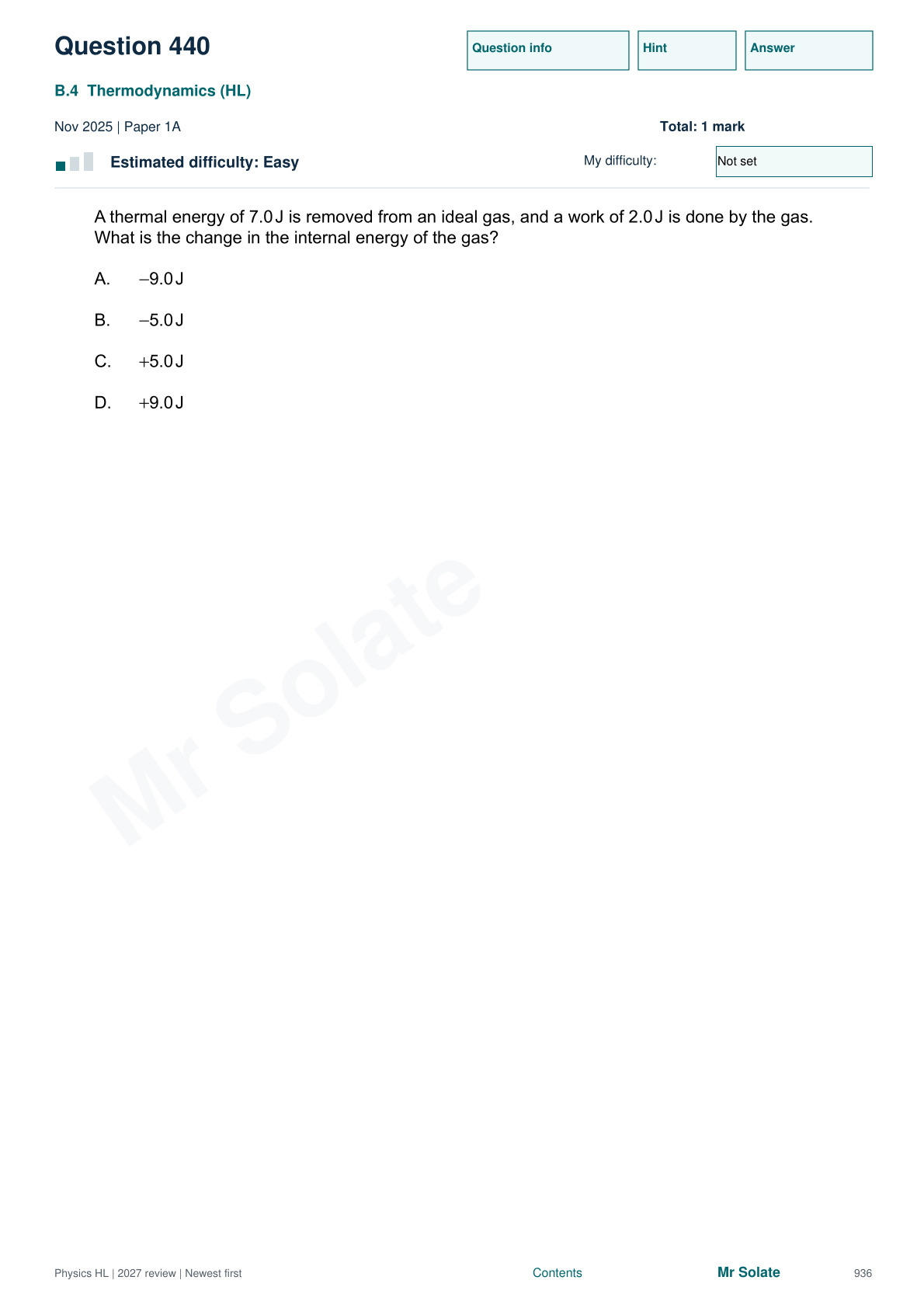
Question 440
Keeps heat and work signs consistent in the first law.
Compatibility: Current syllabus: Keeps heat and work signs consistent in the first law.
View the original question
Original page images preserve the equations and diagrams. Write your response before revealing the reasoning.
Reveal the revision reasoning
Here Q=−7 J and W=+2 J. Thus ΔU=Q−W=−9 J: both cooling and expansion work reduce internal energy.
Editorial revision reasoning. Check the original answer for its marking detail.
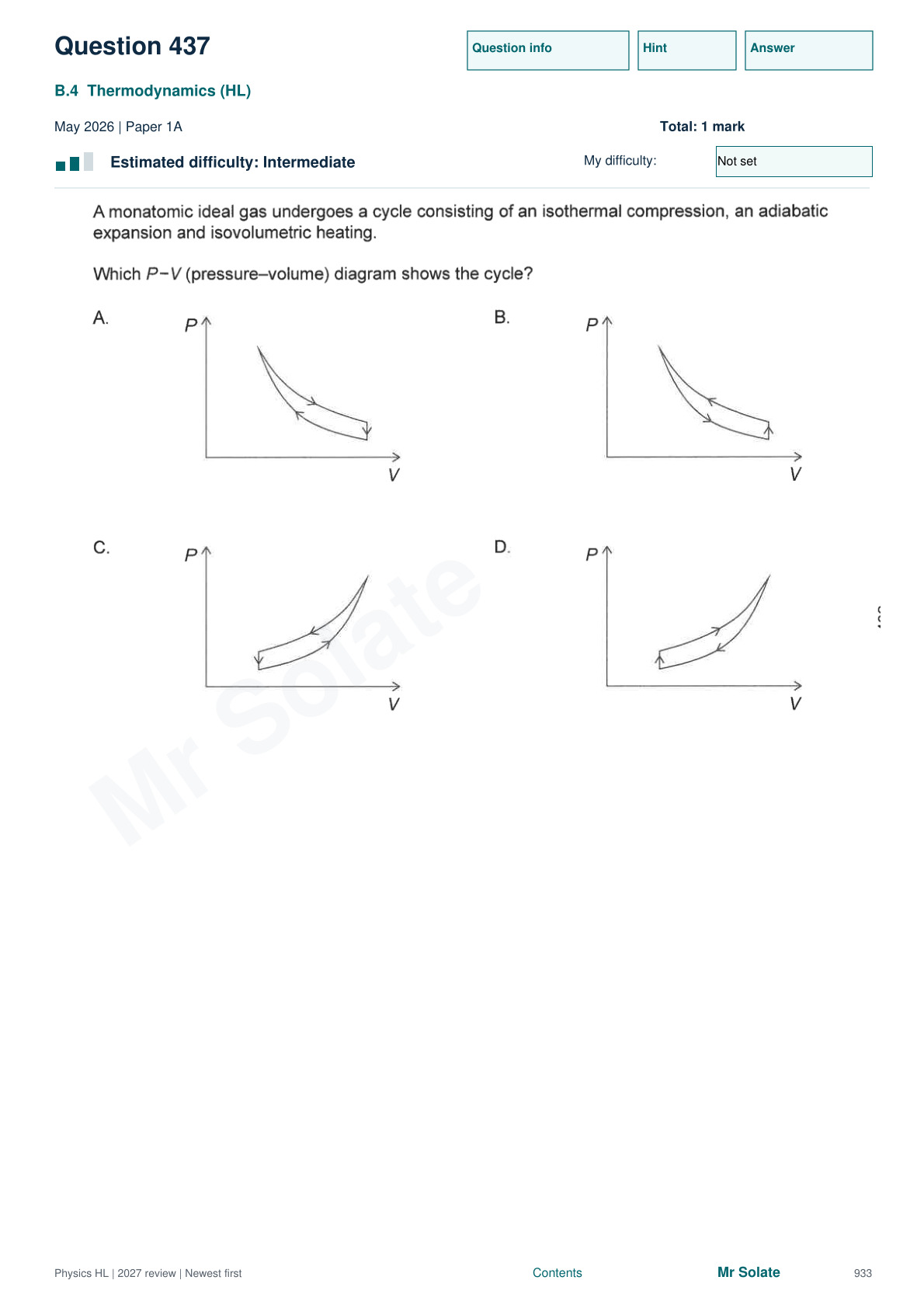
Question 437
Identifies directions and shapes of three thermodynamic processes.
Compatibility: Current syllabus: Identifies directions and shapes of three thermodynamic processes.
View the original question
Original page images preserve the equations and diagrams. Write your response before revealing the reasoning.
Reveal the revision reasoning
Compression is leftwards along the isotherm. Adiabatic expansion follows the steeper curve rightwards. Constant-volume heating is vertically upwards; all three must occur in the correct diagram.
Editorial revision reasoning. Check the original answer for its marking detail.
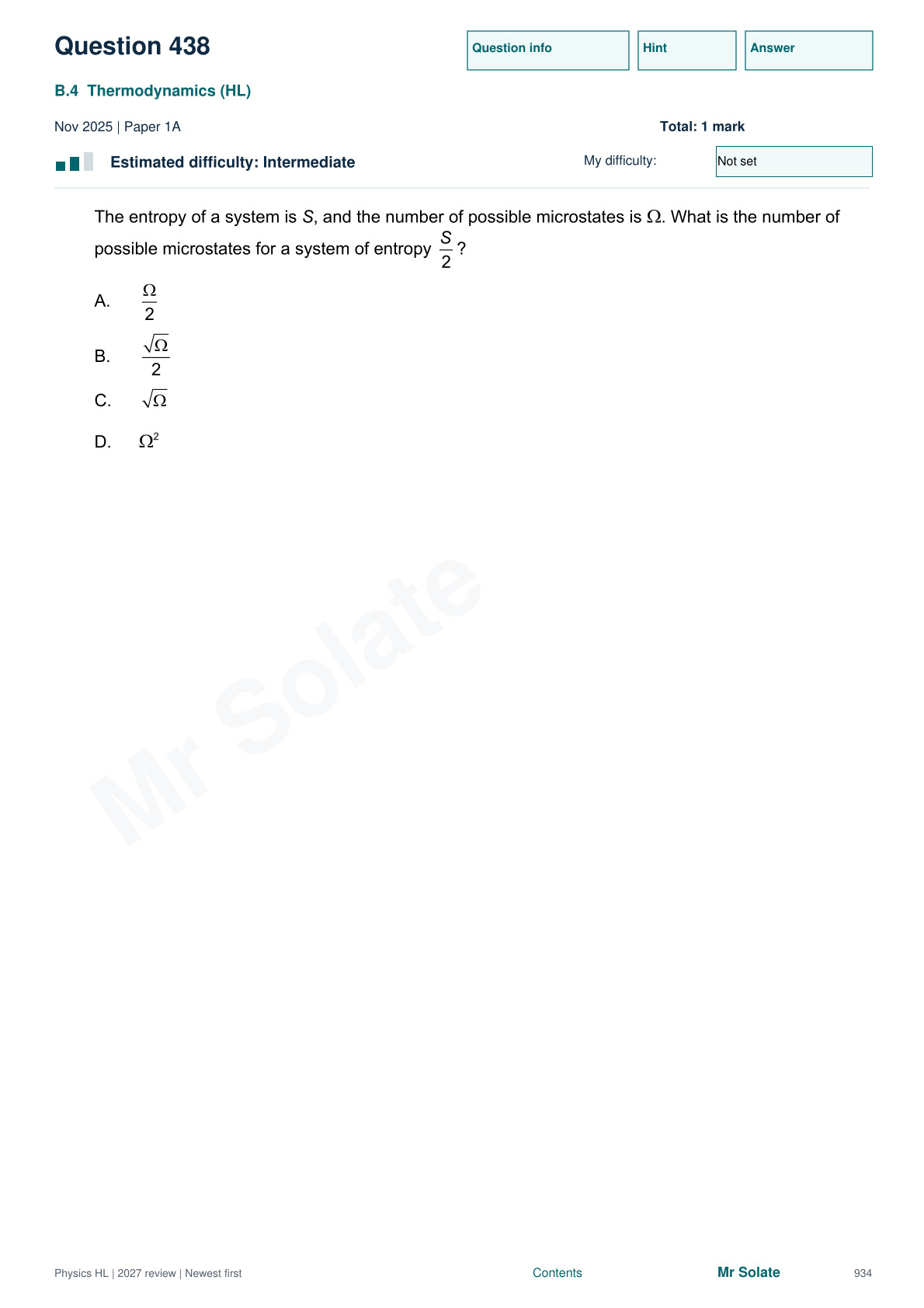
Question 438
Uses the logarithmic statistical definition of entropy.
Compatibility: Current syllabus: Uses the logarithmic statistical definition of entropy.
View the original question
Original page images preserve the equations and diagrams. Write your response before revealing the reasoning.
Reveal the revision reasoning
S=k_B ln Ω. If the new entropy is S/2, ln Ω_new=(ln Ω)/2, so Ω_new=√Ω.
Editorial revision reasoning. Check the original answer for its marking detail.
All 49 questions in this topic
Close your notes first
Can you retrieve the method?
1. What is zero in an adiabatic process?
Check answer 1
Heat transferred, Q; work and internal-energy change need not be zero.
2. What does a clockwise p–V cycle deliver?
Check answer 2
Positive net work by the gas, equal to the enclosed area.
3. Why must efficiency use Qhot rather than net heat?
Check answer 3
Efficiency compares useful work with the total energy supplied as heat.
Before you move on
- Use a signed process table before solving a complete cycle.
- Check reservoir temperatures are in kelvin before an efficiency or entropy calculation.
Your revision note
Record one missed cue, one corrected step and one question to retry. Saved only in this browser.