Start with the exam
What you need to be able to do
Rigid-body questions ask you to track both translation and rotation, or to distinguish angular momentum from rotational kinetic energy. The axis is part of the problem: the same object has different moments of inertia about different axes. Forces can cancel while their torques add, so inspect both translational and rotational equilibrium. For rolling without slipping, the contact constraint links centre speed and angular speed. If a rotating object changes its moment of inertia, angular momentum can remain constant while energy changes because work is done internally.
Spend 3 minutes reading the overview and diagram, 7 minutes learning the question patterns, 5 minutes writing out the worked example, and 5 minutes on a bank question or recall check. Take longer when you need to; the full bank is here for later practice.
Recognise → set up → write
How the questions are set
Choose the axis and use perpendicular lever arms
Recognise it: A beam, pivot, friction limit, force couple or angular acceleration appears.
- Mark the axis and state a positive rotational sense. Calculate each torque as force times perpendicular distance from the axis to the force’s line of action. A force through the axis has zero torque.
- For equilibrium, use both ΣF = 0 and Στ = 0. For rotation about a fixed axis with constant inertia, use Στ = Iα. Two opposite forces can create torques in the same sense.
- If friction limits the motion, compare the required friction with μsN after finding equilibrium. Sliding and tipping are different failure conditions and must be tested separately when both are possible.
Taking moments about the pivot eliminates the pivot reaction because its perpendicular lever arm is zero.
The distance along the beam is not the lever arm unless the force is perpendicular to the beam.
Conserve angular momentum over the correct interval
Recognise it: A spinning wheel is reversed, two rotating bodies couple, or mass moves inward.
- Identify the system and axis. If external torque is negligible over the interval, write total initial angular momentum equal to total final angular momentum. Keep signs for opposite rotation directions.
- For bodies that lock together, combine their moments of inertia about the same axis and use one final angular speed. Calculate rotational energies before and after separately to find dissipation.
- When I decreases at fixed angular momentum, ω increases and E = L²/(2I) increases. State the source of the additional energy, such as work by the person moving masses inward.
With negligible external torque, Iinitialωinitial = Ifinalωfinal; this alone does not imply constant rotational kinetic energy.
Conserving both angular momentum and energy in an inelastic rotational coupling overconstrains the problem.
Share energy between rolling and translation
Recognise it: A cylinder or wheel rolls down a slope, or a pulley accelerates a hanging load.
- For pure rolling use v = ωR with the actual rolling radius. Write kinetic energy as ½Mv² + ½Iω²; omitting either term changes the predicted speed.
- For a massive pulley, string tensions on its two sides need not be equal because a resultant torque is required. Combine the hanging mass equation with the pulley torque equation and the no-slip relation.
- Convert revolutions into radians before applying rotational kinematics. Separate an accelerating phase from a slowing phase, and use the final speed of the first as the initial speed of the second.
Mgh = ½Mv² + ½I(v/R)² for loss-free rolling from rest without slipping.
Use the shaft’s contact radius in a rolling constraint when it differs from the outer rim radius.
Write it before you reveal it
A worked exam-style example
Original teaching example, created for this lesson.
A solid cylinder rolls without slipping from rest through a vertical drop of 0.60 m. Given I = ½MR², find its centre-of-mass speed. Ignore dissipative losses.
Reveal the worked solution
- Write Mgh = ½Mv² + ½Iω² and use ω = v/R.
- Substitution gives Mgh = ½Mv² + ¼Mv² = ¾Mv².
- Thus v = √(4gh/3) = √(4 × 9.81 × 0.60/3) = 2.80 m s⁻¹.
Answer: The centre-of-mass speed is 2.8 m s⁻¹.
Check: This is below the sliding, frictionless point-particle value √(2gh) = 3.43 m s⁻¹ because some energy is rotational.
From your own collection
Apply it to past-paper questions
These questions anchor the patterns above. Attempt one without the answer, then compare your setup and conclusion with the reasoning. The linked reader contains the source answer and the question-specific syllabus review.
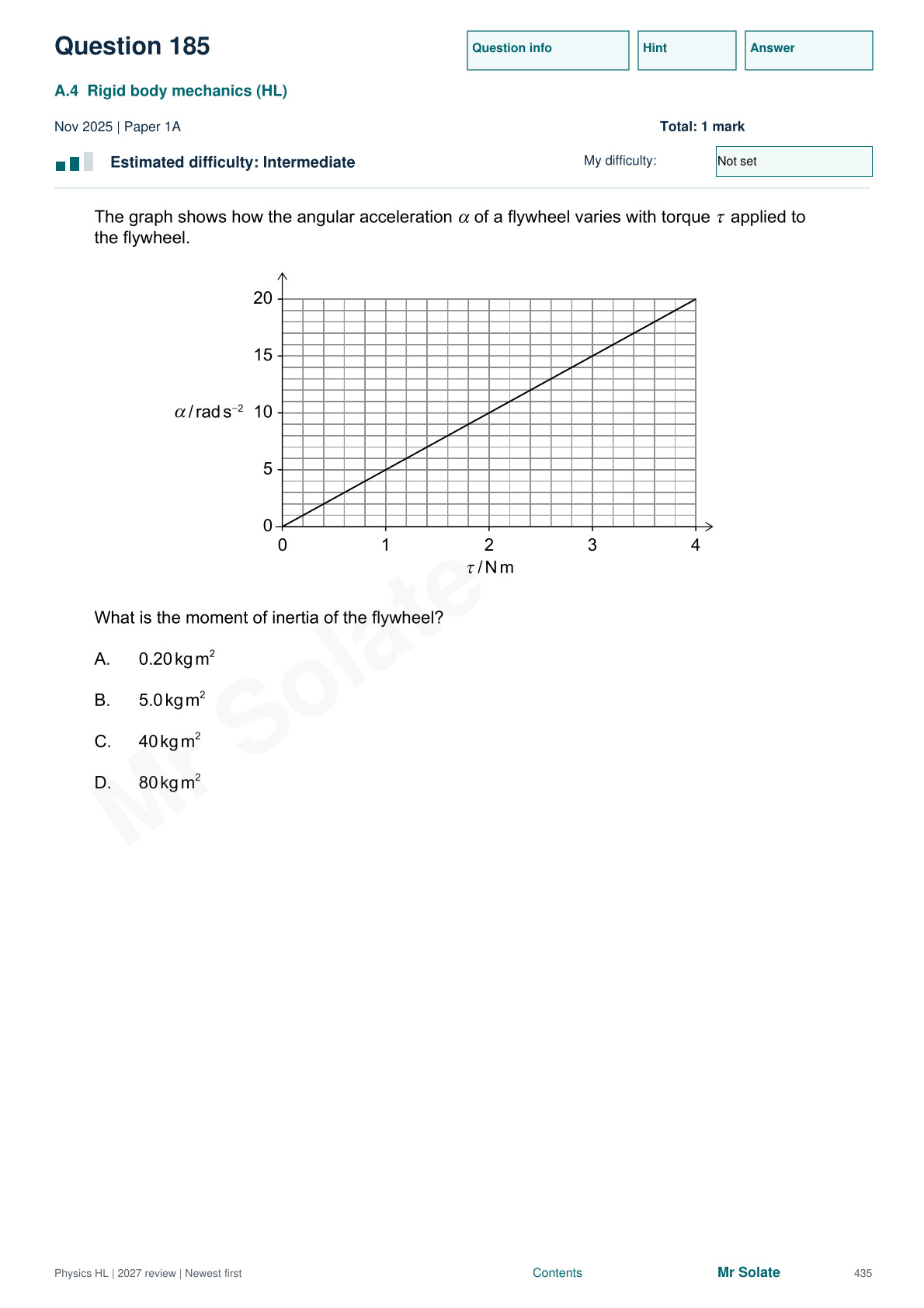
Question 185
Interprets a graph with angular acceleration on the vertical axis.
Compatibility: Current syllabus: Interprets a graph with angular acceleration on the vertical axis.
View the original question
Original page images preserve the equations and diagrams. Write your response before revealing the reasoning.
Reveal the revision reasoning
From τ=Iα, I=τ/α=4/20=0.20 kg m². Inverting the slope is essential because the axes are α against τ.
Editorial revision reasoning. Check the original answer for its marking detail.
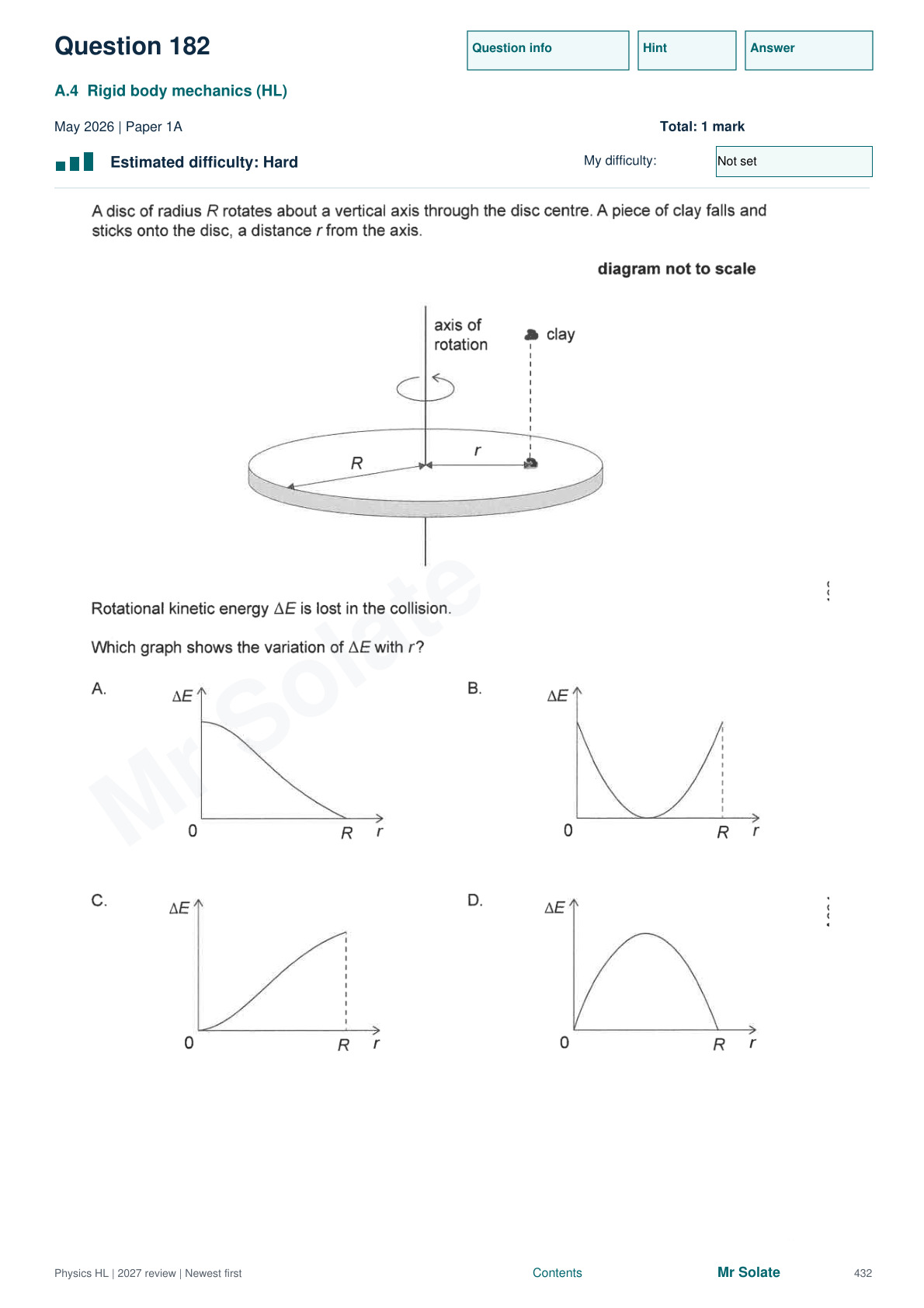
Question 182
Infers energy-loss curve from changing inertia and conserved angular momentum.
Compatibility: Current syllabus: Infers energy-loss curve from changing inertia and conserved angular momentum.
View the original question
Original page images preserve the equations and diagrams. Write your response before revealing the reasoning.
Reveal the revision reasoning
For conserved angular momentum L, final energy is L²/[2(I+mr²)]. Energy loss starts at zero and increases with r, initially quadratically. Choose the rising curve with a horizontal initial tangent.
Editorial revision reasoning. Check the original answer for its marking detail.
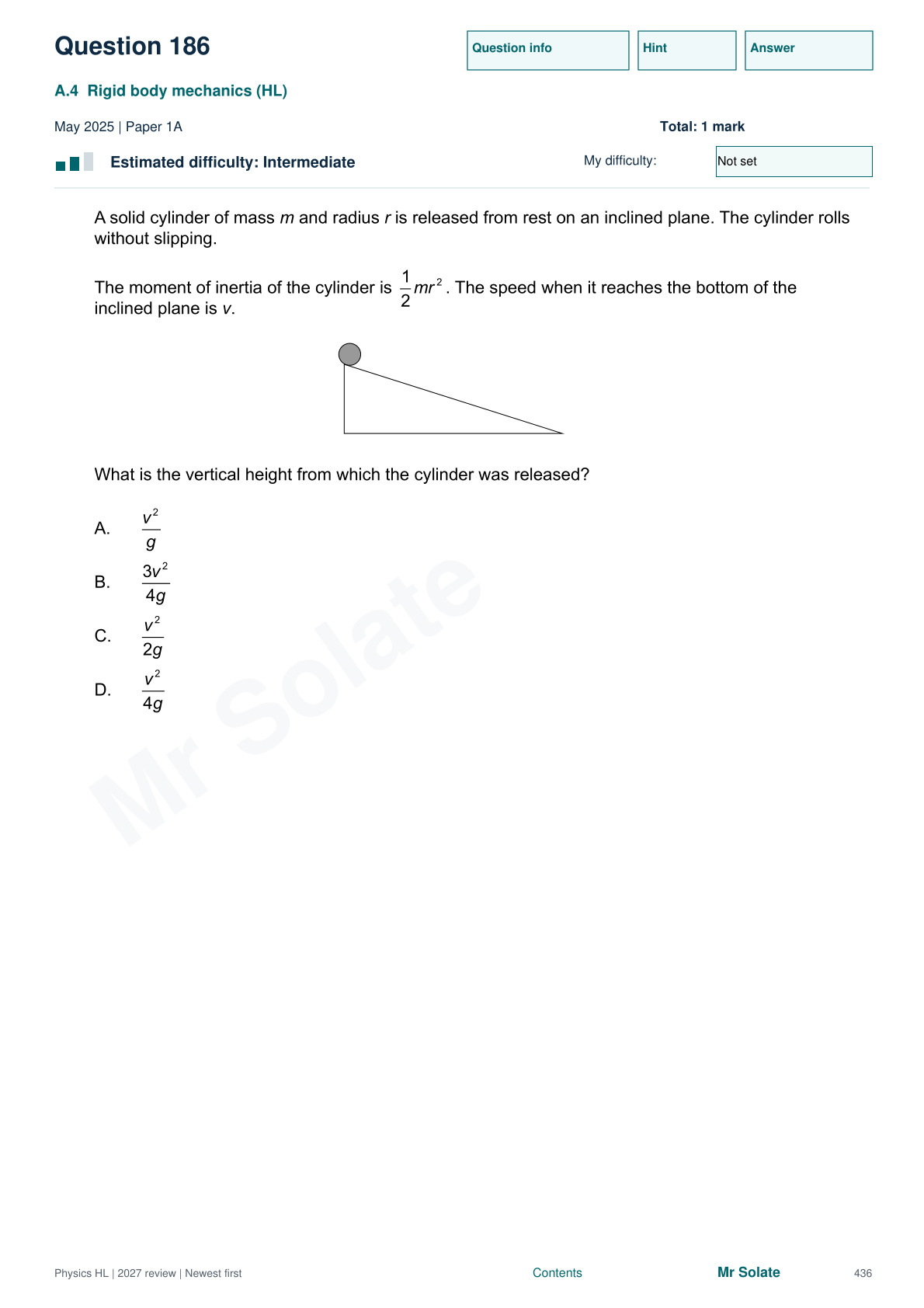
Question 186
Includes rotational as well as translational kinetic energy.
Compatibility: Current syllabus: Includes rotational as well as translational kinetic energy.
View the original question
Original page images preserve the equations and diagrams. Write your response before revealing the reasoning.
Reveal the revision reasoning
mgh=mv²/2+(mr²/2)(v²/r²)/2=3mv²/4. Hence h=3v²/(4g).
Editorial revision reasoning. Check the original answer for its marking detail.
All 43 questions in this topic
Close your notes first
Can you retrieve the method?
1. What is conserved when external torque is zero?
Check answer 1
Angular momentum about the chosen axis.
2. What makes a force’s torque zero?
Check answer 2
Its line of action passes through the axis, giving zero perpendicular lever arm.
3. Why can a massive pulley have unequal string tensions?
Check answer 3
Their difference supplies the net torque that angularly accelerates the pulley.
Before you move on
- Write the chosen axis beside every angular-momentum or torque equation.
- For rolling, check both energy terms and the no-slip constraint before calculating.
Your revision note
Record one missed cue, one corrected step and one question to retry. Saved only in this browser.