Start with the exam
What you need to be able to do
Greenhouse questions in the collection mainly test energy accounting and the distinction between incoming solar radiation, reflection and outgoing thermal radiation. A planet’s albedo is a reflected fraction; emissivity describes thermal emission relative to a black body at the same temperature. They are not interchangeable coefficients. First decide whether the model is global, local or a specified surface-and-atmosphere balance. A global factor of four comes from geometry, not a rule to insert into every radiation calculation. When comparing two explanations, look for an explicit equilibrium argument: absorbed and emitted powers balance at the final temperature. A statement that “more radiation is trapped” needs the next step explaining how outgoing emission changes as temperature rises. This makes the reasoning testable against the stated energy-flow model.
Spend 3 minutes reading the overview and diagram, 7 minutes learning the question patterns, 5 minutes writing out the worked example, and 5 minutes on a bank question or recall check. Take longer when you need to; the full bank is here for later practice.
Recognise → set up → write
How the questions are set
Write the energy balance for the stated model
Recognise it: Solar intensity, albedo, planetary temperature or an equilibrium diagram is given.
- Identify incoming power and the fraction absorbed. A sphere intercepts sunlight over πR² but radiates over 4πR² in the simple uniform-temperature model.
- For a no-atmosphere global model, write (1 − α)SπR² = εσT⁴4πR² and cancel area. For a local horizontal surface with overhead sunlight, do not divide incident intensity by four automatically.
- If the question includes atmospheric downward radiation, add that term to the surface input explicitly. Solve the given model before discussing its limitations.
For the uniform spherical model, (1 − α)S/4 = εσT⁴.
The intercepted disk and the radiating sphere have different areas.
Explain infrared absorption as a causal chain
Recognise it: Explain the greenhouse effect, identify a greenhouse gas, or compare atmosphere models.
- State that the warmed surface emits mainly infrared radiation. Greenhouse gases absorb infrared at relevant wavelengths through molecular energy changes.
- The atmosphere emits infrared in different directions, including downward. This increases energy arriving at the surface relative to a model without that downward transfer.
- At the old surface temperature, incoming and outgoing rates are no longer balanced. The surface warms until a new balance is reached. Name the actual absorption and emission processes rather than calling the atmosphere a mirror.
Greenhouse gases absorb terrestrial infrared and emit infrared toward the surface; the resulting extra input requires a higher surface temperature for equilibrium.
“The atmosphere reflects all heat back” does not describe the radiative process accurately.
Track a change in albedo or emissivity
Recognise it: Two surfaces or planets have equal temperature, or one model parameter changes.
- Keep incident, reflected and absorbed intensities separate: reflected = αI and absorbed = (1 − α)I. If reflected intensity is given, recover incident intensity before finding absorption.
- At fixed temperature and area, emitted power is proportional to emissivity. At radiative equilibrium, changing emissivity can change temperature, so specify what is held constant.
- Compare temperatures through fourth roots. A fractional change in absorbed power gives a smaller fractional temperature change; explain the direction before calculating so a reversed ratio is easier to detect.
If all other model parameters are fixed, T₂/T₁ = [(1 − α₂)/(1 − α₁)]¼.
A high albedo means strong reflection of incoming radiation, not automatically strong emission of thermal infrared.
Write it before you reveal it
A worked exam-style example
Original teaching example, created for this lesson.
In a simple airless-planet model, solar intensity is 1200 W m⁻², albedo is 0.25 and emissivity is 1. Find the uniform equilibrium temperature using σ = 5.67 × 10⁻⁸ W m⁻² K⁻⁴.
Reveal the worked solution
- Absorbed solar power per unit total surface area is (1 − 0.25) × 1200/4 = 225 W m⁻².
- Equate this to σT⁴: T⁴ = 225/(5.67 × 10⁻⁸).
- Take the fourth root to obtain approximately 251 K. This is the result of the stated airless, uniform-temperature model.
Answer: T ≈ 251 K.
Check: Substituting 251 K into σT⁴ gives approximately 225 W m⁻²; the planet’s radius cancels.
From your own collection
Apply it to past-paper questions
These questions anchor the patterns above. Attempt one without the answer, then compare your setup and conclusion with the reasoning. The linked reader contains the source answer and the question-specific syllabus review.
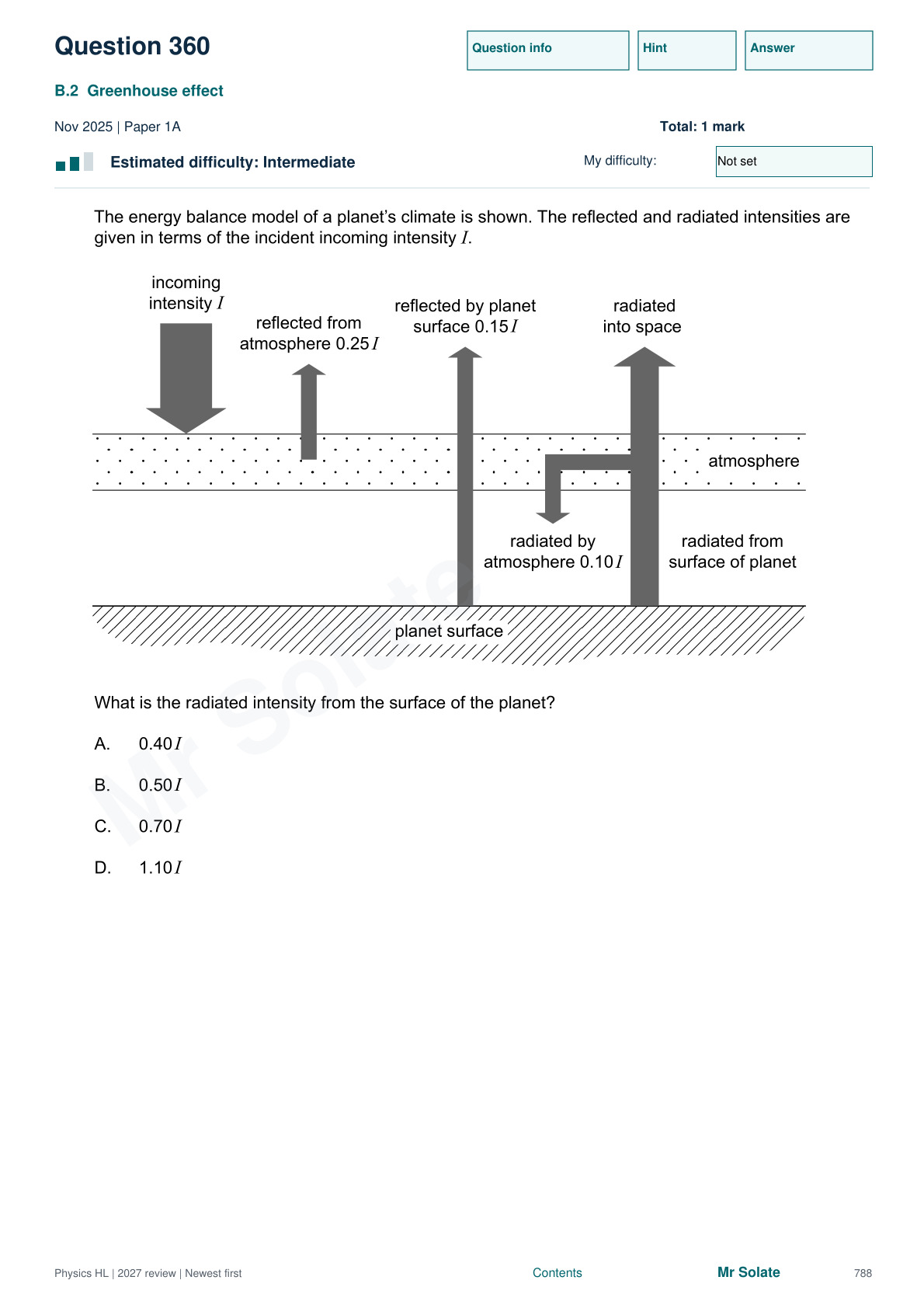
Question 360
Balances surface absorption and atmospheric back radiation.
Compatibility: Current syllabus: Balances surface absorption and atmospheric back radiation.
View the original question
Original page images preserve the equations and diagrams. Write your response before revealing the reasoning.
Reveal the revision reasoning
Of incoming I, 0.25I and 0.15I are reflected. The surface absorbs 0.60I plus atmospheric radiation 0.10I. Equilibrium therefore requires surface emission 0.70I.
Editorial revision reasoning. Check the original answer for its marking detail.
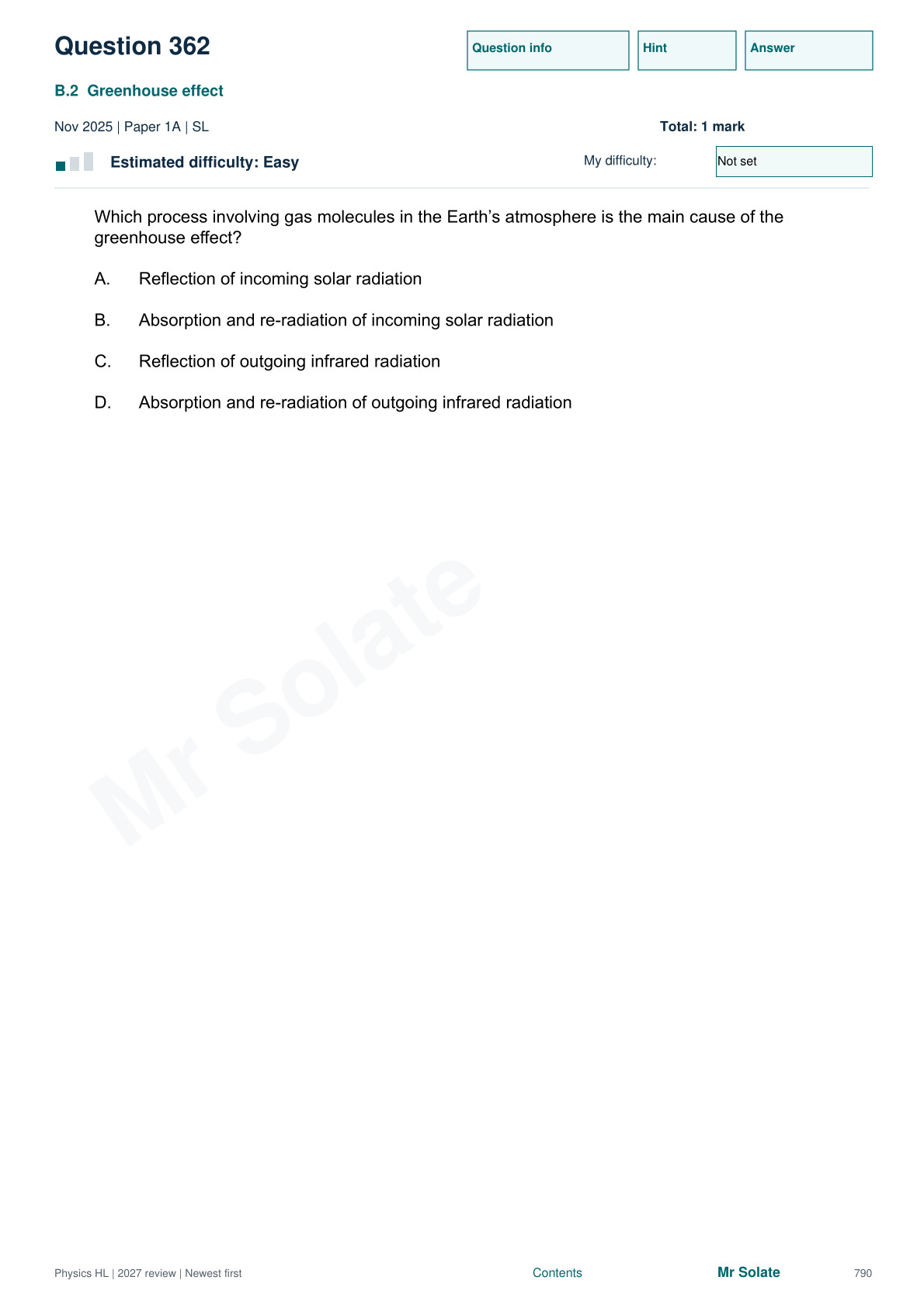
Question 362
Recognizes absorption and re-emission rather than reflection.
Compatibility: This is an SL source question testing concepts shared with the current Physics HL syllabus. Recognizes absorption and re-emission rather than reflection.
View the original question
Original page images preserve the equations and diagrams. Write your response before revealing the reasoning.
Reveal the revision reasoning
Greenhouse gases absorb outgoing terrestrial infrared and emit infrared in all directions, including back toward the surface. This reduces net radiative energy loss at a given surface temperature.
Editorial revision reasoning. Check the original answer for its marking detail.
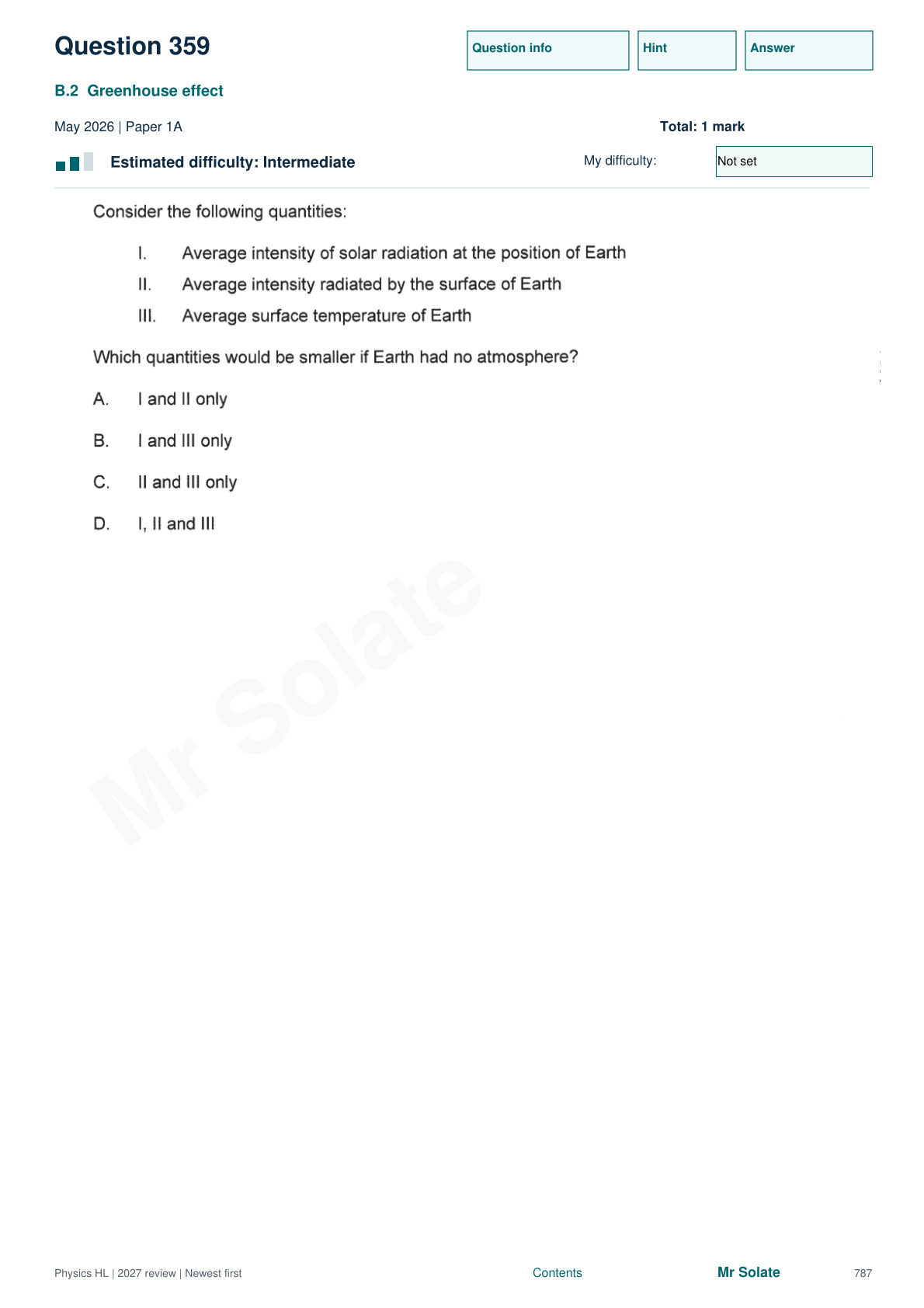
Question 359
Separates solar intensity from atmosphere-dependent surface properties.
Compatibility: Current syllabus: Separates solar intensity from atmosphere-dependent surface properties.
View the original question
Original page images preserve the equations and diagrams. Write your response before revealing the reasoning.
Reveal the revision reasoning
Incoming solar intensity at Earth's position stays unchanged. Without atmospheric warming, surface temperature and emitted intensity both decrease: II and III.
Editorial revision reasoning. Check the original answer for its marking detail.
All 34 questions in this topic
Close your notes first
Can you retrieve the method?
1. Where does the global factor 1/4 come from?
Check answer 1
Intercepted area πR² divided by radiating area 4πR².
2. What is albedo?
Check answer 2
The fraction of incident radiation that is reflected.
3. Why can downward infrared warm a surface?
Check answer 3
It adds to surface energy input, requiring greater outgoing emission at a higher equilibrium temperature.
Before you move on
- Sketch arrows for each energy transfer before manipulating the balance.
- State whether your answer refers to a local surface or a whole-planet average.
Your revision note
Record one missed cue, one corrected step and one question to retry. Saved only in this browser.