Start with the exam
What you need to be able to do
Simple harmonic motion questions ask you to connect a graph, an equation and a physical restoring mechanism. The defining feature is acceleration proportional to displacement from equilibrium and opposite in direction: a = −ω²x. The equilibrium position may already include a spring’s static extension, so x is not automatically the extension from natural length. The bank repeatedly tests phase, energy fractions and reading period or amplitude correctly. Identify those quantities before using an oscillator formula.
Spend 3 minutes reading the overview and diagram, 7 minutes learning the question patterns, 5 minutes writing out the worked example, and 5 minutes on a bank question or recall check. Take longer when you need to; the full bank is here for later practice.
Recognise → set up → write
How the questions are set
Read the oscillator from its graph or equation
Recognise it: An x–t, a–x or energy graph, or a sinusoidal equation, is supplied.
- Read amplitude as maximum displacement from equilibrium, not peak-to-peak range. Read period between successive equivalent states, such as two positive maxima.
- Use ω = 2π/T. In a = −ω²x, the gradient is −ω², so take the square root of its magnitude to obtain angular frequency. Include the axis scale factors before doing so.
- Choose sine or cosine to match the initial displacement and motion. At a positive extreme, velocity is zero and acceleration is maximally negative; at equilibrium, speed is maximum and acceleration is zero.
The acceleration–displacement graph is a straight line through the origin with negative gradient, demonstrating a = −ω²x.
An energy–time graph can repeat every half oscillation period because energy depends on squared displacement or speed.
Use energy fractions without losing the reference point
Recognise it: Speed at a position, amplitude change, damping or spring energy is requested.
- For an ideal oscillator, E = ½mω²A² and U = ½mω²x² relative to equilibrium in the oscillator model. Therefore K/E = 1 − x²/A².
- Use v = ω√(A² − x²) for speed, selecting a velocity sign separately if required. At x = A/2, potential energy is one quarter of total, not one half.
- If damping changes amplitude from A₁ to A₂ while the effective stiffness stays unchanged, E₂/E₁ = (A₂/A₁)². Explain lost oscillator energy as transfer to surroundings.
At half amplitude, U/E = (x/A)² = 1/4, so kinetic energy is 3/4 of the total.
For a vertical spring, natural-length extension and displacement from the loaded equilibrium are different quantities.
Establish the restoring law before using the period
Recognise it: Springs in combination, buoyancy oscillations or a pendulum experiment appears.
- Displace the object slightly from equilibrium and calculate the change in resultant force. Identify F = −keffective x rather than guessing the period from the visual shape.
- For a spring oscillator, T = 2π√(m/keffective). Parallel springs add their stiffnesses. For a small-angle pendulum, T = 2π√(L/g), independent of bob mass in the model.
- To test a pendulum model, time several oscillations, divide by the count and plot T² against L. The gradient gives 4π²/g, and an offset may reveal a length-reference error.
A small displacement produces a restoring resultant proportional to −x, so the motion is SHM with ω² = keffective/m.
The small-angle pendulum relation is an approximation; large amplitudes can change the measured period.
Write it before you reveal it
A worked exam-style example
Original teaching example, created for this lesson.
A 0.50 kg mass on a 32 N m⁻¹ spring oscillates with amplitude 0.10 m. Find angular frequency, total energy and speed at x = 0.060 m.
Reveal the worked solution
- ω = √(k/m) = √(32/0.50) = 8.0 rad s⁻¹.
- Total energy is ½kA² = ½ × 32 × 0.10² = 0.160 J.
- Speed is ω√(A² − x²) = 8.0√(0.0100 − 0.0036) = 0.64 m s⁻¹.
Answer: ω = 8.0 rad s⁻¹; E = 0.160 J; speed = 0.64 m s⁻¹.
Check: At this position, U = 0.0576 J and K = ½ × 0.50 × 0.64² = 0.1024 J; their sum is 0.160 J.
From your own collection
Apply it to past-paper questions
These questions anchor the patterns above. Attempt one without the answer, then compare your setup and conclusion with the reasoning. The linked reader contains the source answer and the question-specific syllabus review.
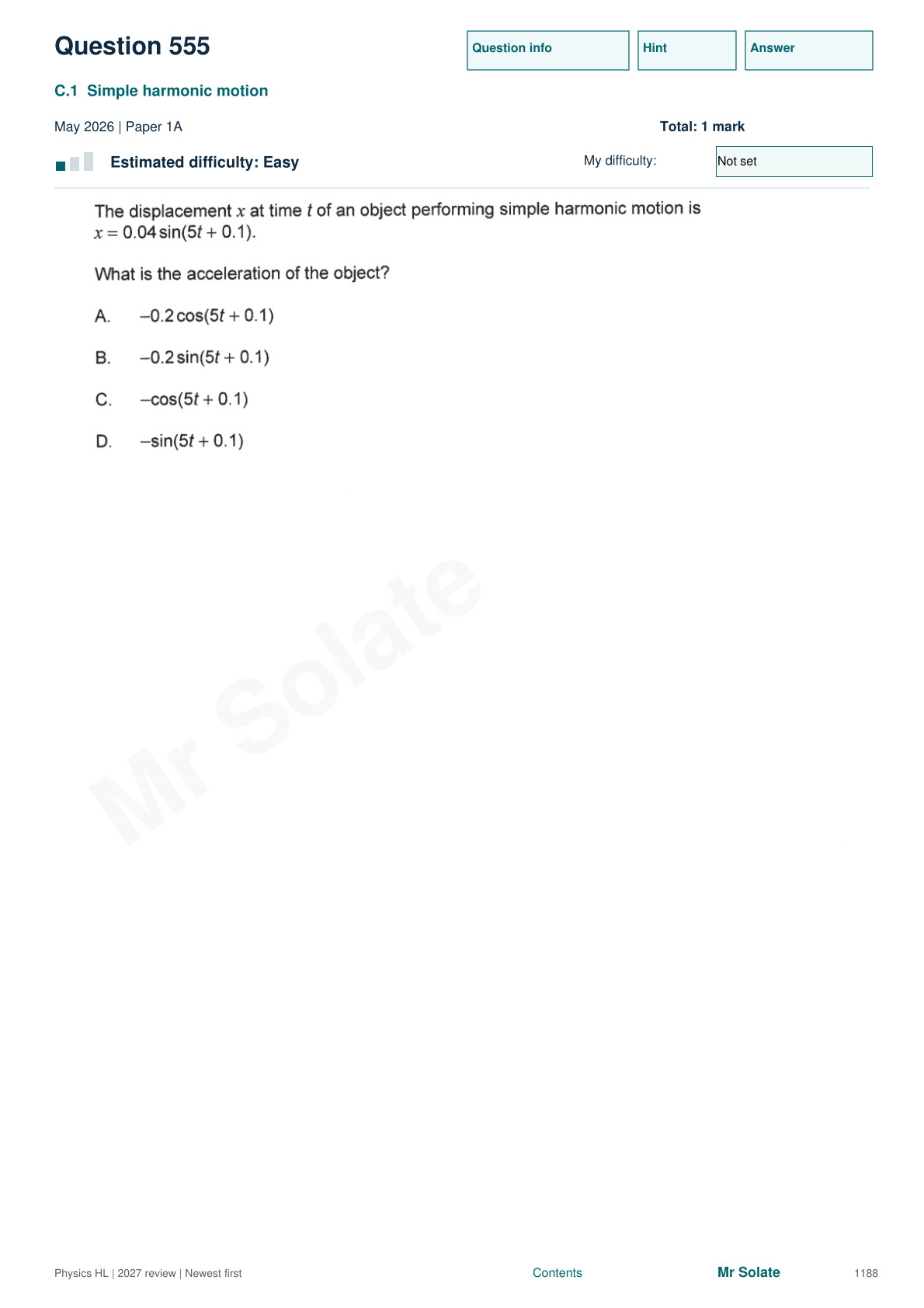
Question 555
Extracts angular frequency from an SHM equation.
Compatibility: Current syllabus: Extracts angular frequency from an SHM equation.
View the original question
Original page images preserve the equations and diagrams. Write your response before revealing the reasoning.
Reveal the revision reasoning
Here ω=5. Therefore acceleration is −25×0.04 sin(5t+0.1)=−sin(5t+0.1) m s−2.
Editorial revision reasoning. Check the original answer for its marking detail.
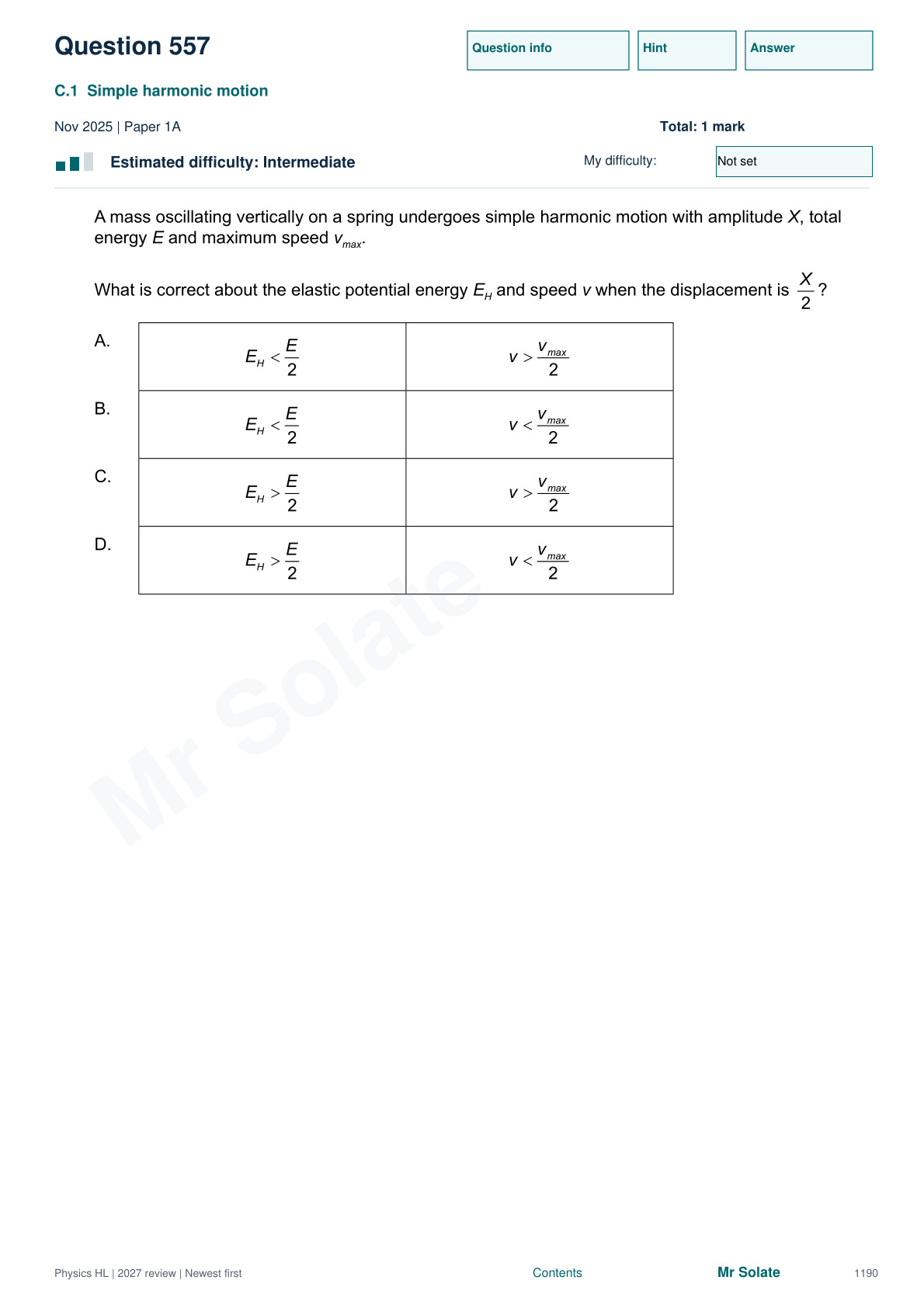
Question 557
Partitions SHM energy at half amplitude.
Compatibility: Current syllabus: Partitions SHM energy at half amplitude.
View the original question
Original page images preserve the equations and diagrams. Write your response before revealing the reasoning.
Reveal the revision reasoning
For the oscillation, U/E=x²/X²=1/4 and v/v_max=√(1−1/4)=√3/2. Thus oscillation potential energy is below E/2 and speed exceeds v_max/2. The wording elastic potential energy is imprecise for a vertical spring: raw spring energy includes its static extension; the usual intended convention is oscillation energy relative to equilibrium.
Editorial revision reasoning. Check the original answer for its marking detail.
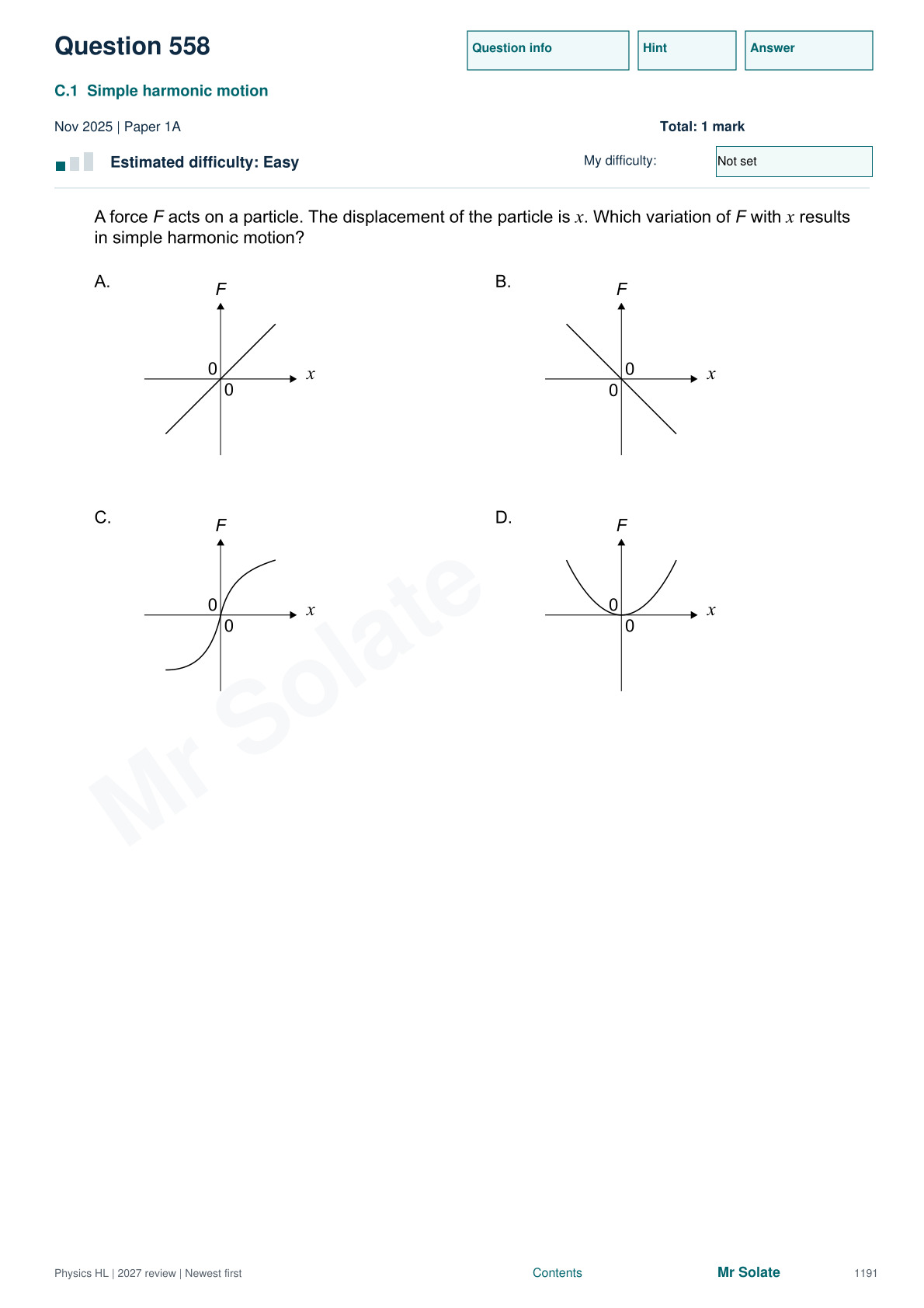
Question 558
Recognizes a linear restoring force.
Compatibility: Current syllabus: Recognizes a linear restoring force.
View the original question
Original page images preserve the equations and diagrams. Write your response before revealing the reasoning.
Reveal the revision reasoning
SHM requires F=−kx. Choose the straight line through the origin with negative gradient, not a positive-gradient or curved relation.
Editorial revision reasoning. Check the original answer for its marking detail.
All 57 questions in this topic
Close your notes first
Can you retrieve the method?
1. What is acceleration at equilibrium?
Check answer 1
Zero for ideal SHM, even though speed is maximum.
2. If amplitude halves, what happens to energy?
Check answer 2
It falls to one quarter for unchanged oscillator parameters.
3. What gives ω² on an a–x graph?
Check answer 3
The magnitude of its negative gradient.
Before you move on
- Mark the equilibrium reference and distinguish amplitude from total excursion.
- Check a proposed phase against both initial position and initial direction of motion.
Your revision note
Record one missed cue, one corrected step and one question to retry. Saved only in this browser.