Start with the exam
What you need to be able to do
Radioactive-decay questions combine nuclear bookkeeping, exponential change and energy accounting. The probability of decay per unit time is constant for each undecayed nucleus in the simple model, but the number of nuclei remaining decreases, so activity decreases. Measured count rate includes background and may differ from total source activity because only a fraction of emissions is detected. Subtract background before applying a decay law, then restore it if the question asks for a detector reading.
Spend 3 minutes reading the overview and diagram, 7 minutes learning the question patterns, 5 minutes writing out the worked example, and 5 minutes on a bank question or recall check. Take longer when you need to; the full bank is here for later practice.
Recognise → set up → write
How the questions are set
Balance a nuclear decay equation
Recognise it: Alpha, beta-minus, beta-plus or a chain of decays is supplied.
- Conserve nucleon number and electric charge across the equation. Alpha emission reduces A by 4 and Z by 2; beta-minus leaves A unchanged and increases nuclear Z by 1; beta-plus decreases Z by 1.
- Include the correct accompanying neutrino: beta-minus emits an electron antineutrino, while beta-plus emits an electron neutrino. Gamma emission changes nuclear energy state without changing A or Z.
- For a chain, update A and Z at each step. Explain continuous beta energies through energy sharing among the emitted particles and recoil, rather than claiming nuclear energy levels are continuous.
In beta-minus decay, the daughter has unchanged nucleon number and proton number larger by one, with an electron and electron antineutrino emitted.
The emitted beta particle’s charge is not the change in daughter proton number with the same sign.
Use exponential decay after correcting the measurement
Recognise it: Count rates, half-life, activity, dating or a graph with background is given.
- Subtract constant background from every measured rate before taking ratios or finding half-life. For a fixed detector geometry and efficiency, corrected count rate is proportional to activity.
- Use N = N₀e⁻λt or A = A₀e⁻λt and λ = ln2/T½. Count complete half-lives when convenient; use logarithms for other intervals.
- For absolute activity, A = λN. Obtain N from mass, molar mass and Avogadro’s constant, including isotope abundance if only part of the sample is radioactive.
After subtracting background, the source count rate halves in each half-life; background itself does not halve.
Applying the half-life law directly to total measured count rate gives the wrong decay constant.
Calculate nuclear energy with consistent masses
Recognise it: Binding energy per nucleon, mass defect, decay energy or recoil appears.
- Convert binding energy per nucleon into total binding energy before comparing nuclei. Reaction energy is the increase in total binding energy, or the loss in total rest mass times c².
- Use a consistent set of atomic or nuclear masses. Electron masses may cancel in some equations but not automatically in beta-plus calculations; follow the stated mass convention.
- When a nucleus emits an alpha particle from rest, the alpha and daughter have equal and opposite momenta. Their kinetic energies are inversely related to their masses in the nonrelativistic limit.
The released energy equals the decrease in total rest energy, with all reactant and product masses counted consistently.
Comparing binding energy per nucleon without multiplying by each nucleon count can give the wrong reaction energy.
Write it before you reveal it
A worked exam-style example
Original teaching example, created for this lesson.
A detector reads 820 counts per minute initially and 220 counts per minute after 12 minutes. Background is 20 counts per minute. Find the half-life and predict the measured rate after another 6 minutes.
Reveal the worked solution
- Corrected rates are 800 and 200 counts per minute, a decrease by a factor of four.
- That is two half-lives in 12 minutes, so T½ = 6 minutes.
- After another half-life the source rate becomes 100 counts per minute. Restore background to obtain 120 counts per minute.
Answer: Half-life 6 minutes; later measured rate 120 counts per minute.
Check: The long-time measured reading tends to 20, not zero, because background remains.
From your own collection
Apply it to past-paper questions
These questions anchor the patterns above. Attempt one without the answer, then compare your setup and conclusion with the reasoning. The linked reader contains the source answer and the question-specific syllabus review.
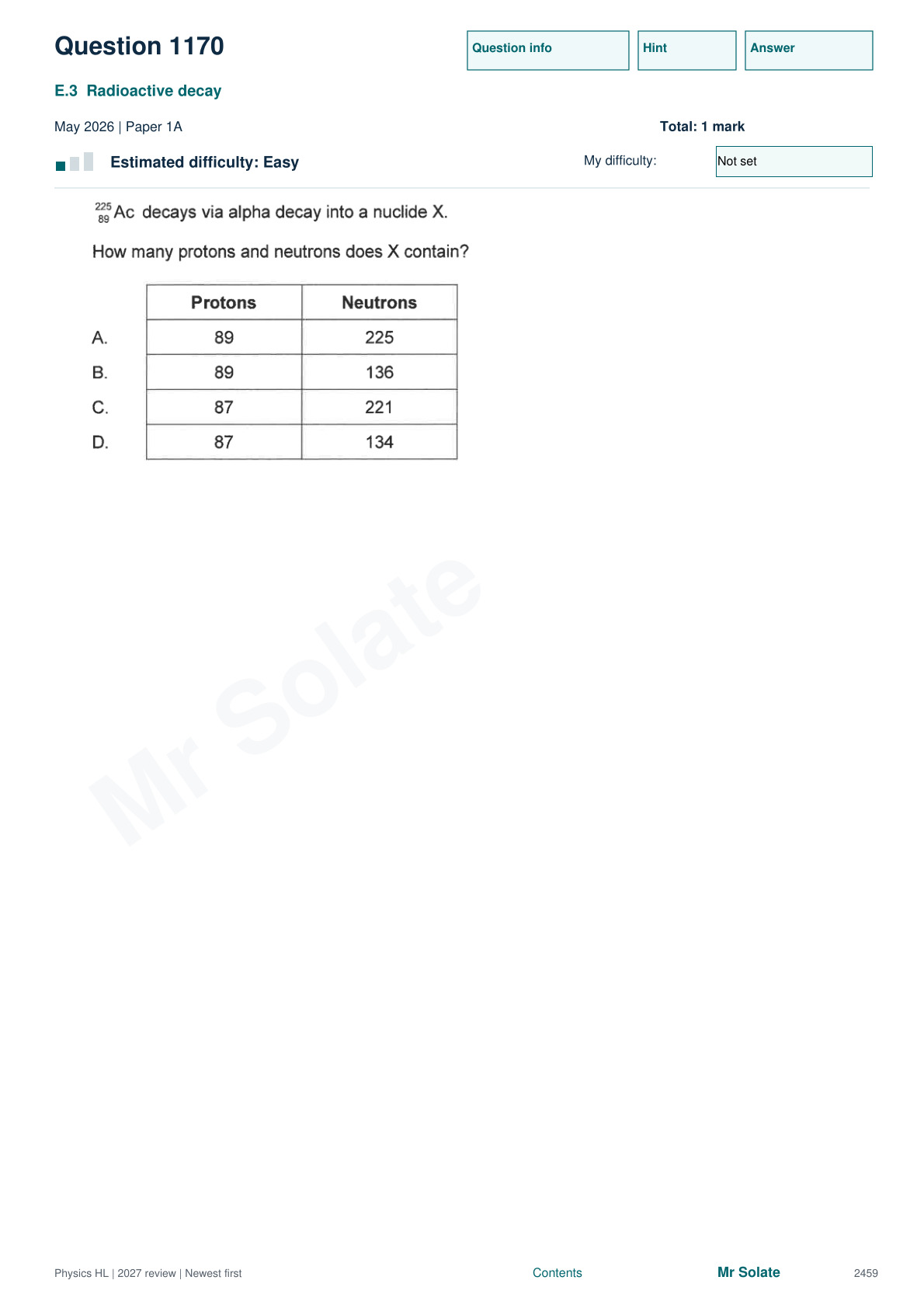
Question 1170
Tracks nucleon and proton numbers through alpha decay.
Compatibility: Current syllabus: Tracks nucleon and proton numbers through alpha decay.
View the original question
Original page images preserve the equations and diagrams. Write your response before revealing the reasoning.
Reveal the revision reasoning
A falls from 225 to 221; Z falls from 89 to 87. The daughter has 221−87=134 neutrons.
Editorial revision reasoning. Check the original answer for its marking detail.
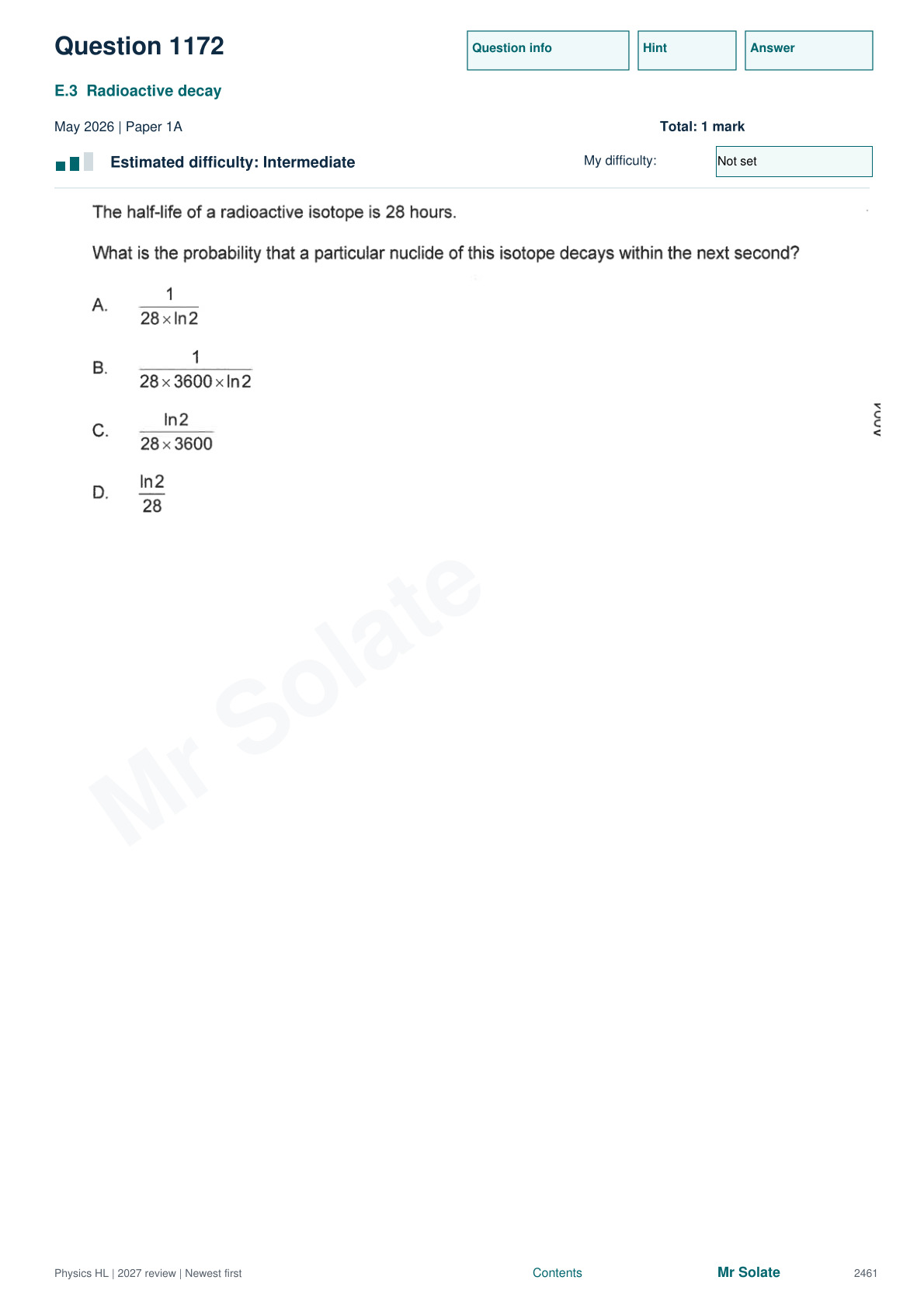
Question 1172
Converts half-life to a one-second decay probability.
Compatibility: Current syllabus: Converts half-life to a one-second decay probability.
View the original question
Original page images preserve the equations and diagrams. Write your response before revealing the reasoning.
Reveal the revision reasoning
λ=ln2/(28×3600). The one-second probability 1−e^(−λ) is approximately λ because the value is very small.
Editorial revision reasoning. Check the original answer for its marking detail.
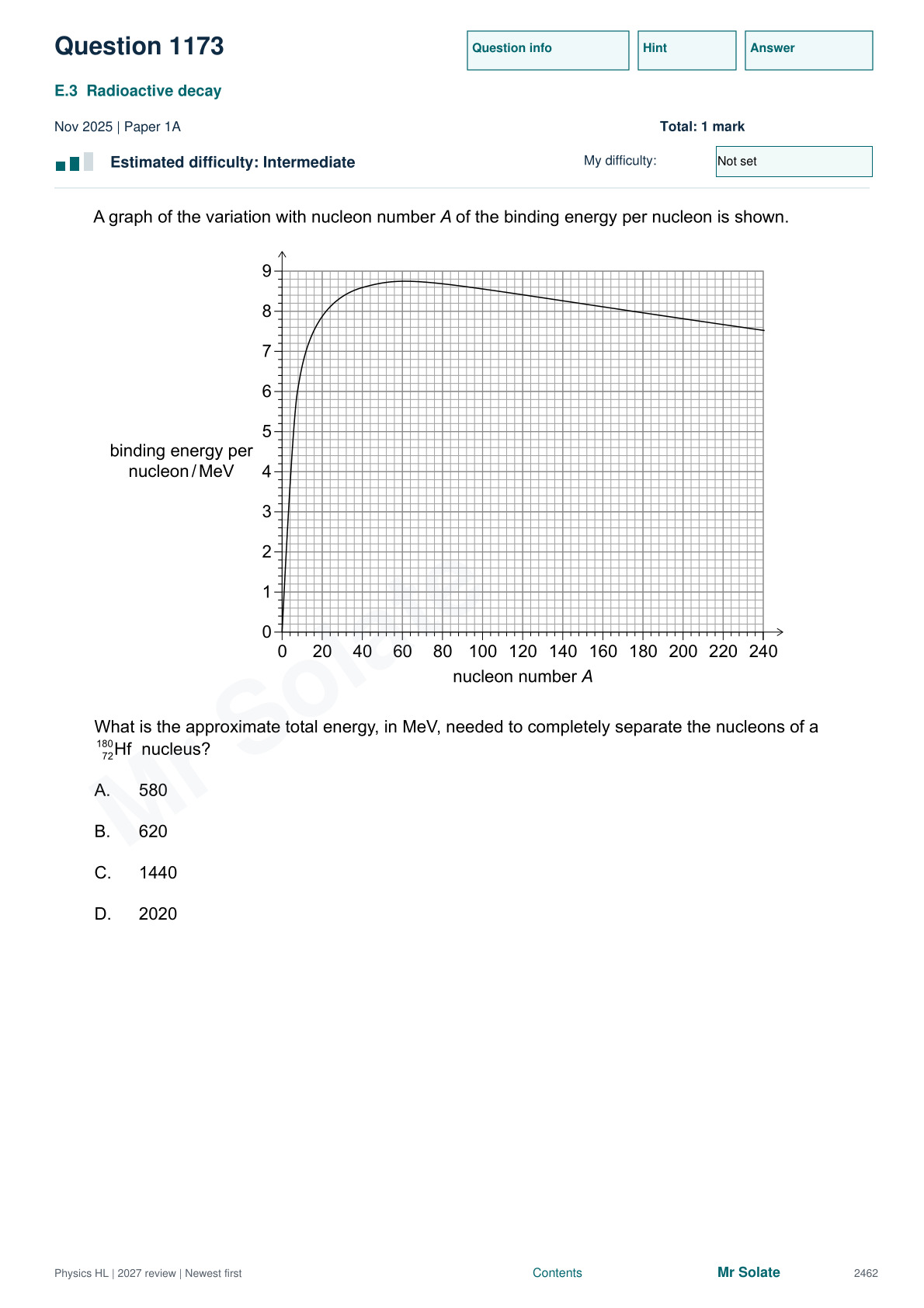
Question 1173
Converts binding energy per nucleon into total binding energy.
Compatibility: Current syllabus: Converts binding energy per nucleon into total binding energy.
View the original question
Original page images preserve the equations and diagrams. Write your response before revealing the reasoning.
Reveal the revision reasoning
At A=180, binding energy per nucleon is about 8 MeV. Total binding energy is therefore about 180×8=1440 MeV.
Editorial revision reasoning. Check the original answer for its marking detail.
All 65 questions in this topic
Close your notes first
Can you retrieve the method?
1. How does beta-minus decay change A and Z?
Check answer 1
A stays fixed and Z increases by one.
2. Why subtract background before finding half-life?
Check answer 2
Only the source contribution follows the source’s decay law.
3. What is the relation between decay constant and half-life?
Check answer 3
λ = ln2/T½.
Before you move on
- Write raw count, background and corrected count in separate columns.
- Check A and charge conservation before calculating a decay energy.
Your revision note
Record one missed cue, one corrected step and one question to retry. Saved only in this browser.