Start with the exam
What you need to be able to do
Thermal-transfer questions often hide the useful model inside a graph: a temperature slope measures heating rate, while a plateau measures latent-energy transfer. Decide whether the material changes temperature, changes phase or exchanges radiation before choosing an equation. In mixtures, energy gained by cooler components must be matched to energy lost by warmer components, with any calorimeter or surroundings included when relevant. Distinguish Celsius temperature differences, which equal kelvin differences, from absolute temperatures in radiation and gas equations, which must be in kelvin.
Spend 3 minutes reading the overview and diagram, 7 minutes learning the question patterns, 5 minutes writing out the worked example, and 5 minutes on a bank question or recall check. Take longer when you need to; the full bank is here for later practice.
Recognise → set up → write
How the questions are set
Split a heating or cooling process into stages
Recognise it: A heating curve, melting ice, boiling liquid or a changing mixture temperature is given.
- Label each stage: temperature change uses Q = mcΔT; a phase change at fixed temperature uses Q = mL. If ice begins below its melting point, warming the ice is a separate stage before melting.
- For a heater with approximately constant useful power, the slope satisfies dT/dt = P/(mc), and a plateau duration gives mL/P. Include heat loss if the data or question require it.
- For mixing, start with an energy balance and test whether the available energy is enough to complete the phase change. Do not assume all ice melts and a liquid final state exists before checking.
Energy lost by the warm water = energy used to melt the ice + energy used to warm the melted ice.
Temperature remains constant during a pure phase change even though internal energy changes.
Compare conduction paths and heat-loss biases
Recognise it: Bars, layers, insulation or a calorimetry experiment appears.
- Use conductive power P = kAΔT/L for a uniform layer under the specified steady conditions. Larger area increases transfer; larger thickness reduces it.
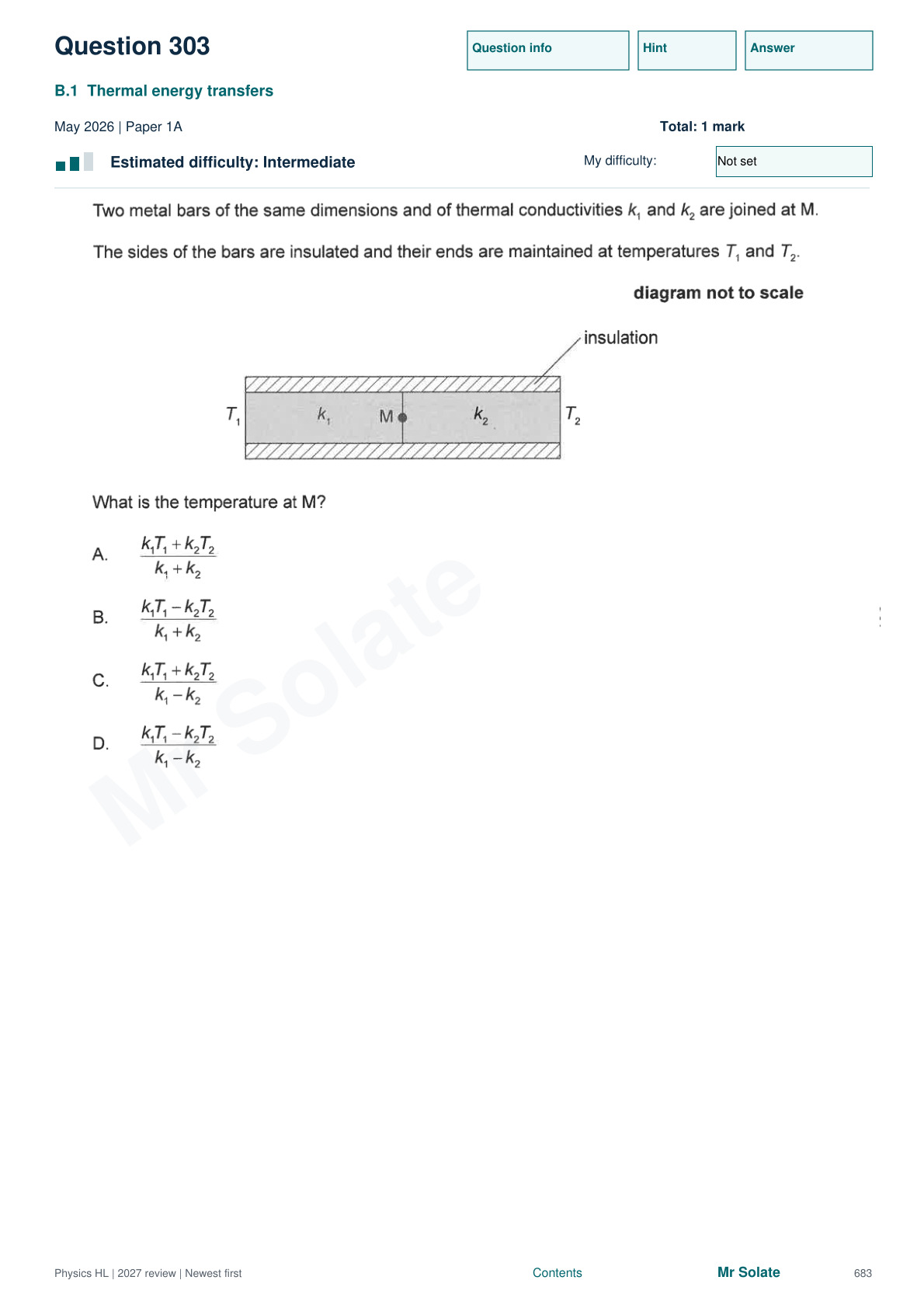
- For layers in series at steady state, the same power passes through each layer. Solve for the unknown junction temperature from equal powers rather than assuming equal temperature drops.
- In calorimetry, distinguish supplied electrical energy from energy retained by the measured sample. Unaccounted heat loss can make a heat-capacity estimate too large when total input energy is divided by the observed temperature rise.
At the junction in steady state, the rate entering equals the rate leaving, so k₁A₁ΔT₁/L₁ = k₂A₂ΔT₂/L₂.
A faster cooling rate is not automatically caused by a lower heat capacity; area, conductivity and temperature difference also matter.
Use spectrum and radiated-power information together
Recognise it: A black-body curve, star radius, emissivity or radiation balance is supplied.
- Read peak wavelength from the horizontal axis, then use λmaxT = constant. A taller intensity peak alone is not the temperature measurement required by Wien’s law.
- Use P = εσAT⁴ with absolute temperature and the correct radiating area. For a sphere, A = 4πR². Ratios often eliminate constants and avoid unnecessary large-number arithmetic.
- If surroundings matter, use net exchange, such as εσA(T⁴ − Tsurr⁴) under the stated model. Separate reflected light from thermal emission when interpreting an observed spectrum.
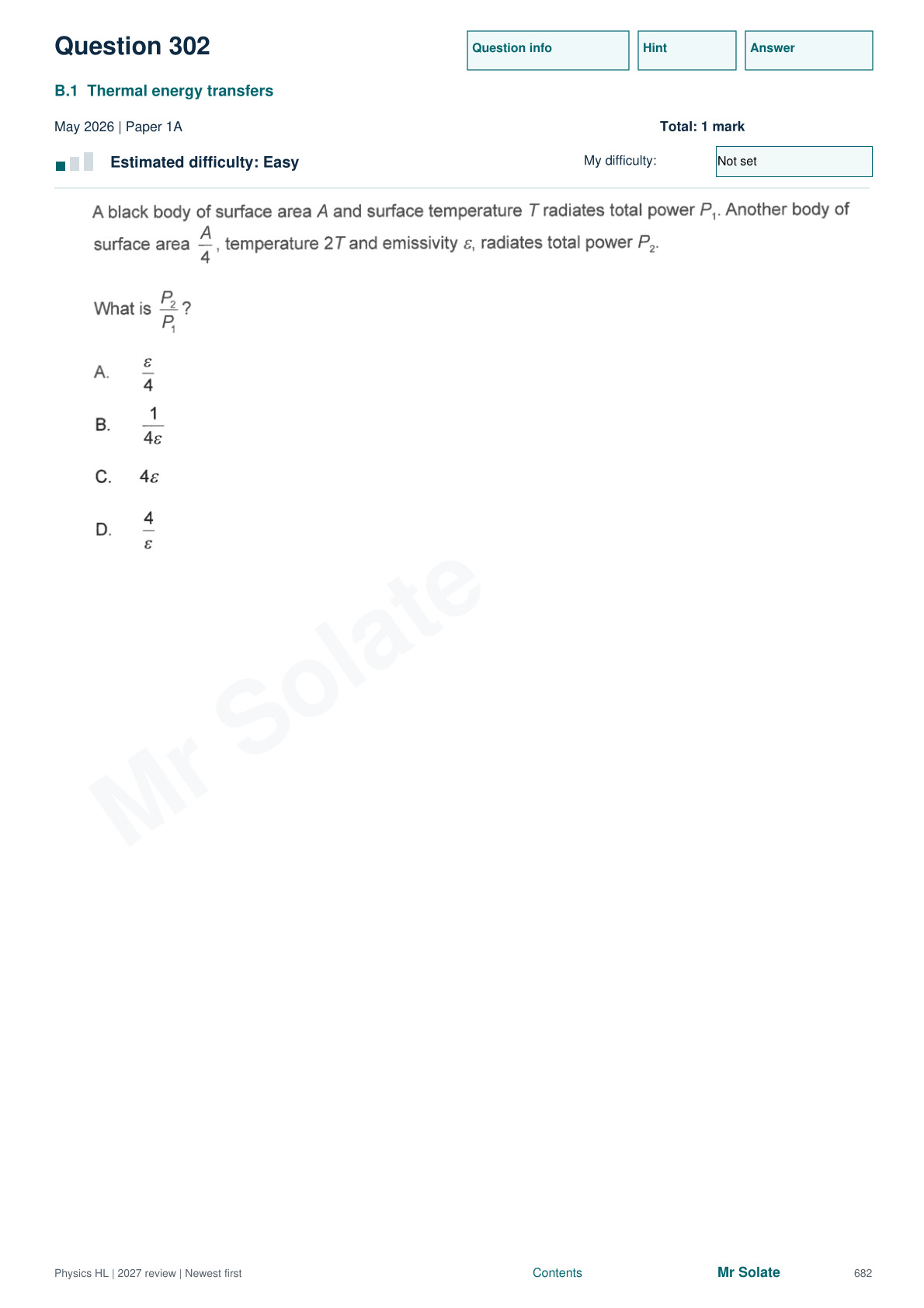
P₂/P₁ = (ε₂/ε₁)(A₂/A₁)(T₂/T₁)⁴, with both temperatures in kelvin.
Doubling temperature multiplies emitted power by sixteen at fixed area and emissivity, not by two.
Write it before you reveal it
A worked exam-style example
Original teaching example, created for this lesson.
A 200 W heater warms 0.50 kg of a liquid from 20°C to 40°C in 120 s. Assume negligible heat loss and negligible container heat capacity. Estimate its specific heat capacity.
Reveal the worked solution
- Energy supplied is Q = Pt = 200 × 120 = 24 000 J.
- The temperature rise is 20 K. Use Q = mcΔT, so c = 24 000/(0.50 × 20).
- The resulting value is 2400 J kg⁻¹ K⁻¹. If heat loss were substantial, less than 24 000 J would enter the liquid, so this calculation would overestimate its c.
Answer: c = 2.4 × 10³ J kg⁻¹ K⁻¹ under the stated assumptions.
Check: The graph slope would be 20/120 K s⁻¹, and P/(m × slope) gives the same c.
From your own collection
Apply it to past-paper questions
These questions anchor the patterns above. Attempt one without the answer, then compare your setup and conclusion with the reasoning. The linked reader contains the source answer and the question-specific syllabus review.
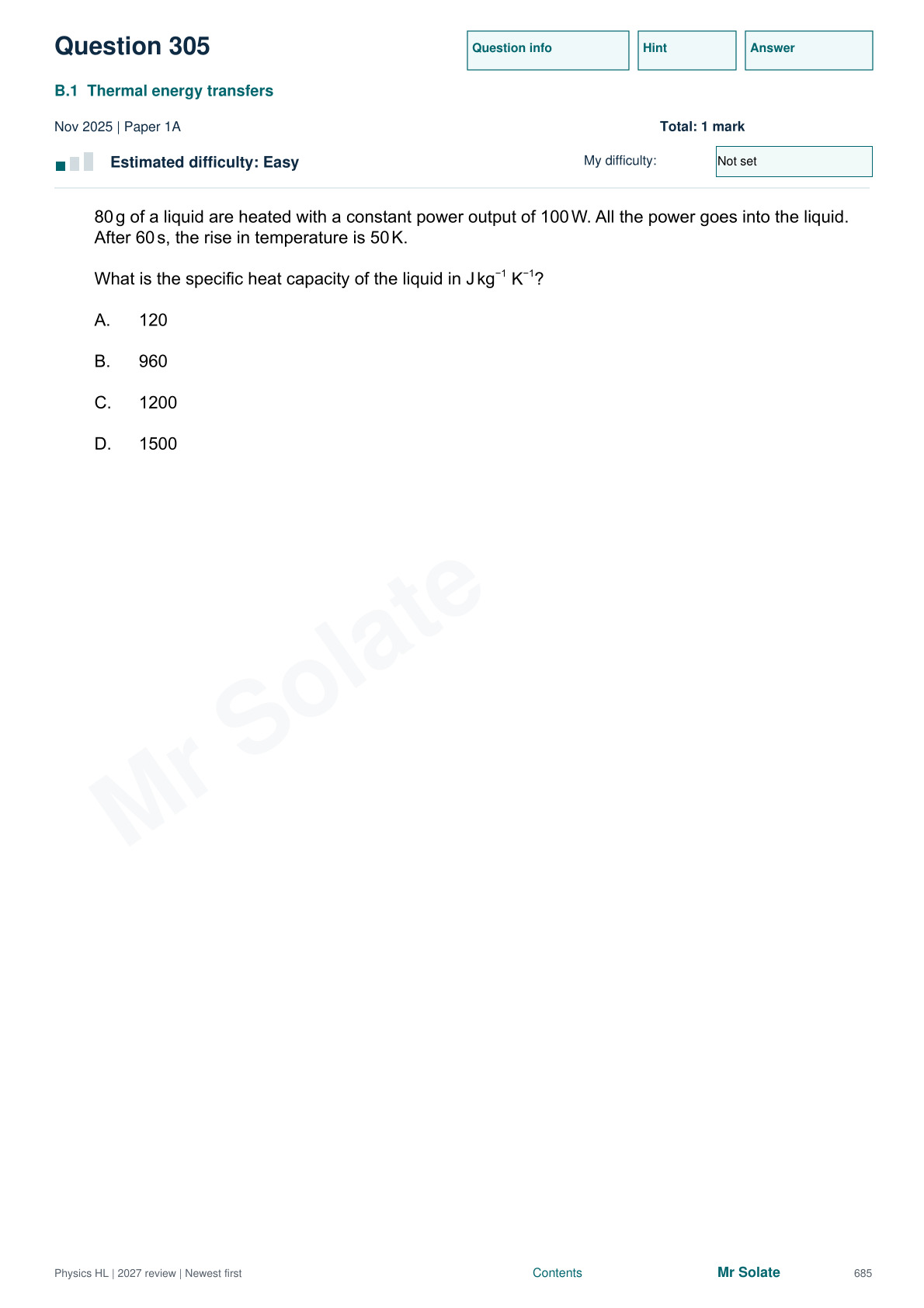
Question 305
Uses electrical heating energy and temperature rise.
Compatibility: Current syllabus: Uses electrical heating energy and temperature rise.
View the original question
Original page images preserve the equations and diagrams. Write your response before revealing the reasoning.
Reveal the revision reasoning
Q=Pt=100×60=6000 J. With m=0.080 kg and ΔT=50 K, c=Q/(mΔT)=1500 J kg−1 K−1, assuming the stated energy heats the material.
Editorial revision reasoning. Check the original answer for its marking detail.
Question 303
Balances conduction through two bars at their junction.
Compatibility: Current syllabus: Balances conduction through two bars at their junction.
View the original question
Original page images preserve the equations and diagrams. Write your response before revealing the reasoning.
Reveal the revision reasoning
Set k₁(T₁−T_M)=k₂(T_M−T₂). Rearrangement gives T_M=(k₁T₁+k₂T₂)/(k₁+k₂).
Editorial revision reasoning. Check the original answer for its marking detail.
Question 302
Scales radiation with area, emissivity and temperature.
Compatibility: Current syllabus: Scales radiation with area, emissivity and temperature.
View the original question
Original page images preserve the equations and diagrams. Write your response before revealing the reasoning.
Reveal the revision reasoning
The area factor is 1/4 and the temperature factor is 16. Thus P₂/P₁=4ε.
Editorial revision reasoning. Check the original answer for its marking detail.
All 57 questions in this topic
Close your notes first
Can you retrieve the method?
1. What equation describes a melting plateau?
Check answer 1
Q = mL, rather than mcΔT.
2. Which temperature scale belongs in Stefan–Boltzmann calculations?
Check answer 2
Kelvin, because the relation uses absolute temperature.
3. How does doubling a layer’s thickness affect conduction at fixed ΔT?
Check answer 3
It halves the conductive power if area and conductivity are unchanged.
Before you move on
- List each material and phase-change stage before writing a thermal balance.
- When an experimental value is biased, explain whether the numerator or denominator is affected.
Your revision note
Record one missed cue, one corrected step and one question to retry. Saved only in this browser.