Start with the exam
What you need to be able to do
Motion in electromagnetic fields questions connect force, energy and geometry. An electric field can do work on a moving charge; a magnetic force is perpendicular to velocity and does no work on a point charge. A magnetic field can therefore bend a path without changing speed. For an electron, reverse the force direction obtained for a positive charge. Many bank questions combine electric acceleration, a straight velocity-selector section and a curved magnetic section, so analyse each stage separately.
Spend 3 minutes reading the overview and diagram, 7 minutes learning the question patterns, 5 minutes writing out the worked example, and 5 minutes on a bank question or recall check. Take longer when you need to; the full bank is here for later practice.
Recognise → set up → write
How the questions are set
Turn potential energy into motion in an electric field
Recognise it: Accelerating voltage, parallel plates or a charged-particle deflection is given.
- Use ΔK = −qΔV, keeping the charge sign and direction of travel. For a particle accelerated from rest through a favourable potential difference magnitude V, ½mv² = |q|V in the nonrelativistic model.
- Between uniform plates, E = V/d and acceleration is qE/m. Resolve initial velocity into components; the component perpendicular to the force remains constant.
- Find time in the plate region from the unaffected component, then use accelerated motion for deflection. Check whether the particle strikes a plate before reaching the far edge.
The electric field changes kinetic energy by −qΔV; the transverse deflection follows from a = qE/m over the transit time.
Using the full plate voltage when the particle starts at the midpoint can double the available potential difference.
Use magnetic curvature and its direction
Recognise it: A particle enters a uniform magnetic field or a track radius is measured.
- For perpendicular entry, equate magnetic force |q|vB to mv²/r, giving r = mv/(|q|B). Use the component perpendicular to B for helical motion when relevant.
- Find direction with the positive-charge force rule and reverse it for negative charges. Draw the initial tangent and centre of curvature, not just a memorised clockwise label.
- Magnetic force does no work because it is perpendicular to velocity. If speed decreases through another interaction, the radius decreases at fixed B, mass and charge magnitude.
The magnetic force is perpendicular to the velocity, so it changes direction but not kinetic energy.
A magnetic field cannot supply the kinetic-energy gain attributed to the accelerating voltage.
Balance crossed fields or forces on currents
Recognise it: An undeflected beam, a velocity selector or a current-carrying rod appears.
- For an undeflected particle in crossed fields, electric and magnetic forces must oppose and have equal magnitudes: |q|E = |q|vB. Hence selected speed is E/B.
- The charge magnitude cancels, but force directions must still be compatible. A particle outside the selected speed deflects according to the larger force.
- For a wire, use F = BIL sinθ and conventional current. For two parallel wires, determine the magnetic field due to one before finding the force on the other; distinguish net force from torque for extended arrangements.
No deflection requires E = vB with opposing force directions, so the selected speed is independent of particle mass and charge magnitude.
Zero net force does not necessarily mean zero torque on an extended current-carrying object.
Write it before you reveal it
A worked exam-style example
Original teaching example, created for this lesson.
A proton enters a 0.20 T magnetic field perpendicularly at 4.0 × 10⁵ m s⁻¹. Find its orbit radius using m = 1.67 × 10⁻²⁷ kg and q = 1.60 × 10⁻¹⁹ C.
Reveal the worked solution
- Magnetic force supplies the centripetal resultant: qvB = mv²/r.
- Rearrange r = mv/(qB) = (1.67 × 10⁻²⁷ × 4.0 × 10⁵)/(1.60 × 10⁻¹⁹ × 0.20).
- This gives r = 2.09 × 10⁻² m. The speed remains unchanged because the force is perpendicular to velocity.
Answer: Radius ≈ 2.1 cm.
Check: Increasing B would reduce the radius; doubling speed at fixed B would double it, consistent with the formula.
From your own collection
Apply it to past-paper questions
These questions anchor the patterns above. Attempt one without the answer, then compare your setup and conclusion with the reasoning. The linked reader contains the source answer and the question-specific syllabus review.
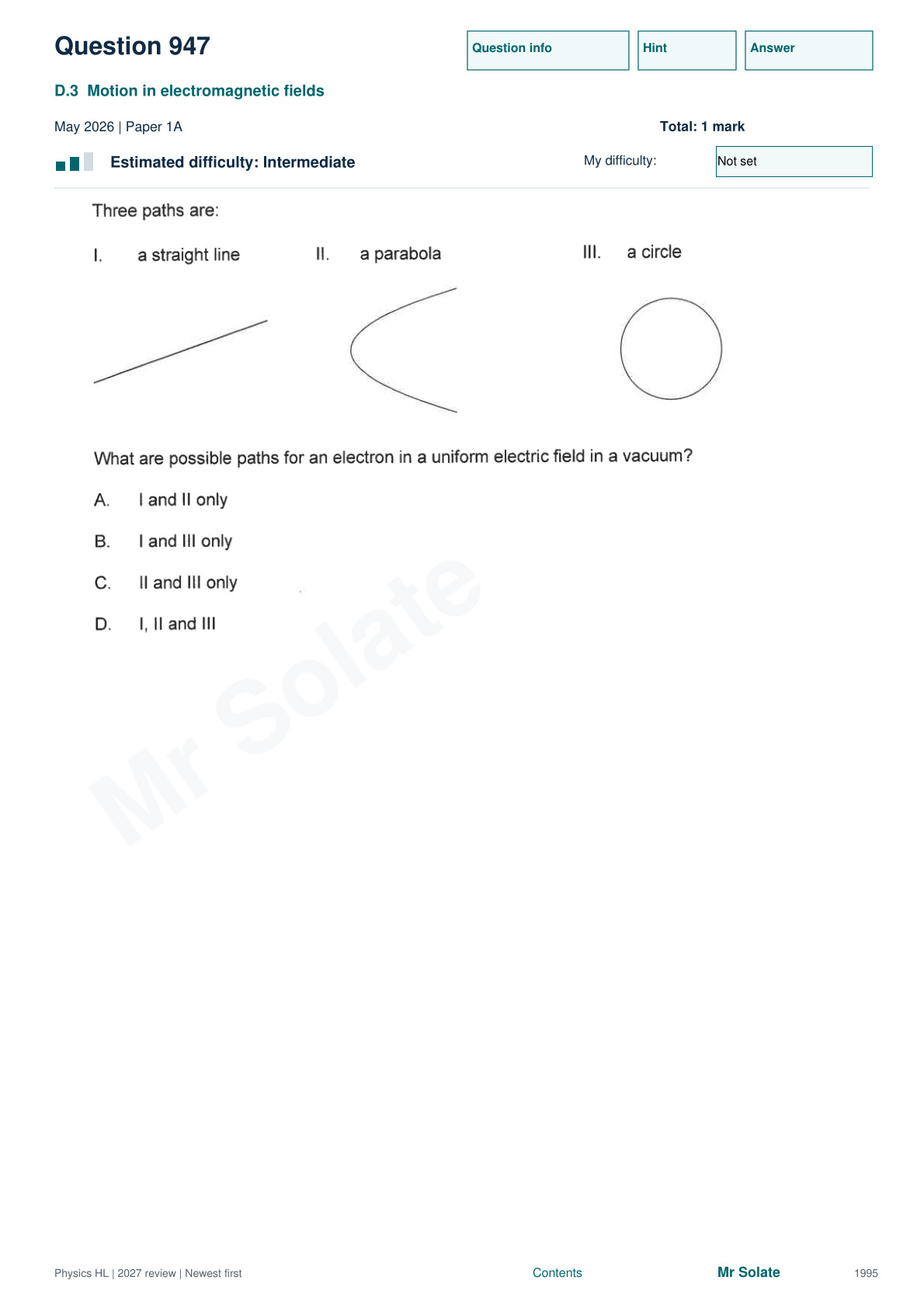
Question 947
Connects constant electric force to possible trajectories.
Compatibility: Current syllabus: Connects constant electric force to possible trajectories.
View the original question
Original page images preserve the equations and diagrams. Write your response before revealing the reasoning.
Reveal the revision reasoning
Motion parallel to the field can be straight. An initial transverse velocity gives a parabola. A circle needs a changing force direction and is impossible here.
Editorial revision reasoning. Check the original answer for its marking detail.
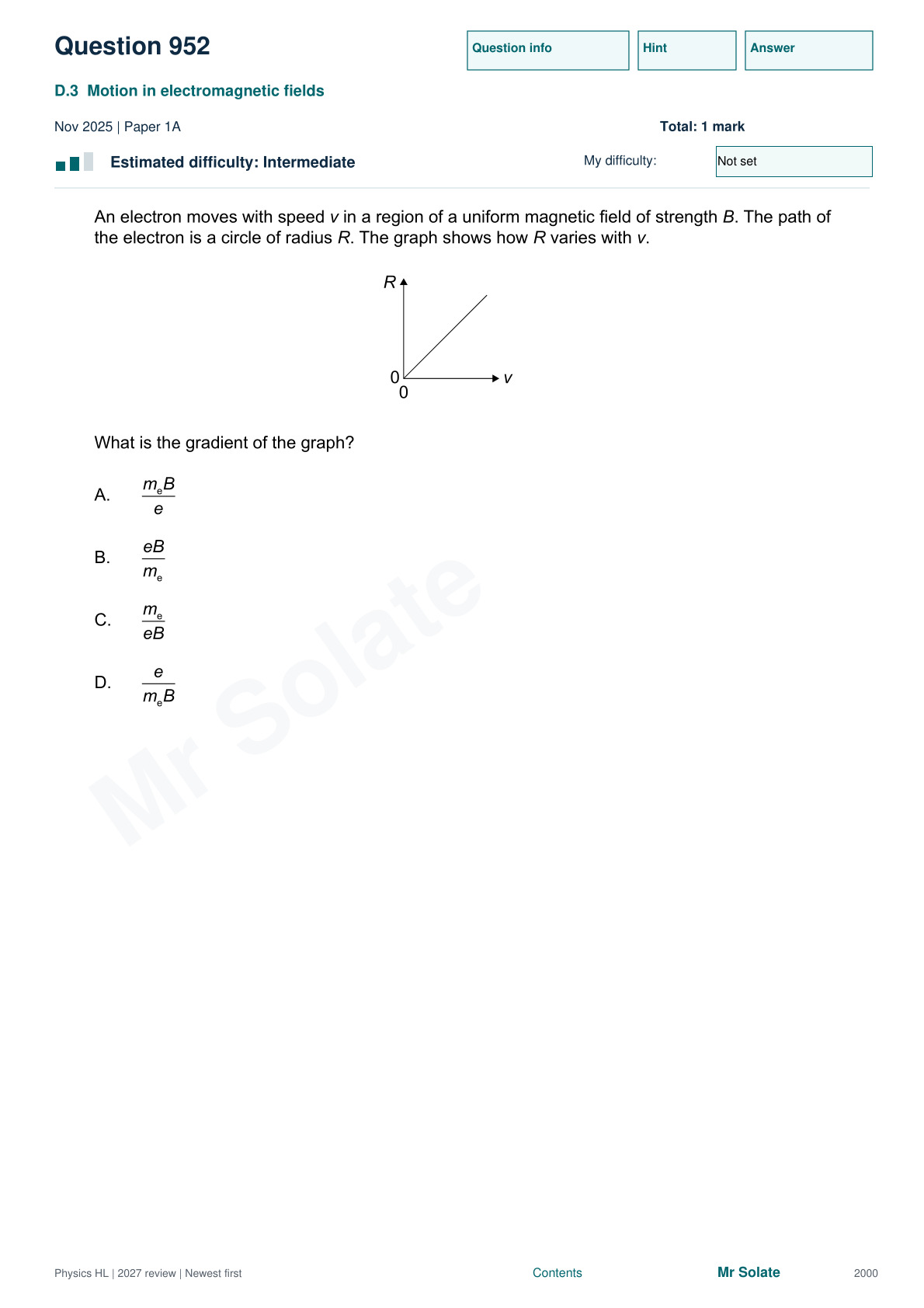
Question 952
Derives the radius–speed gradient for magnetic circular motion.
Compatibility: Current syllabus: Derives the radius–speed gradient for magnetic circular motion.
View the original question
Original page images preserve the equations and diagrams. Write your response before revealing the reasoning.
Reveal the revision reasoning
evB=m_ev²/R gives R=m_ev/(eB). Therefore the gradient of R against v is m_e/(eB), using the magnitude of electron charge.
Editorial revision reasoning. Check the original answer for its marking detail.
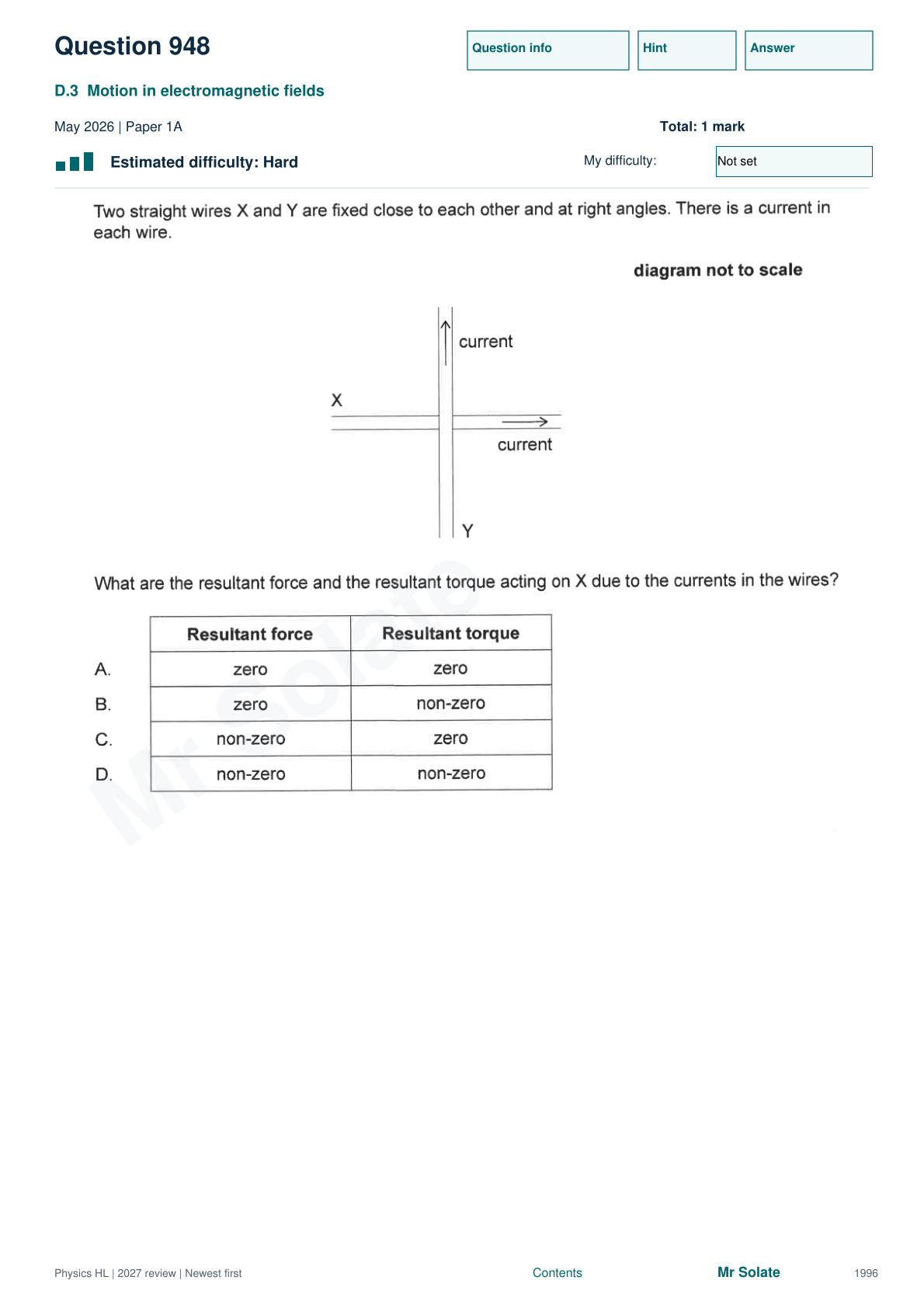
Question 948
Separates zero net force from nonzero torque on crossing wires.
Compatibility: Current syllabus: Separates zero net force from nonzero torque on crossing wires.
View the original question
Original page images preserve the equations and diagrams. Write your response before revealing the reasoning.
Reveal the revision reasoning
Y's magnetic field reverses across it. Equal halves of X experience opposite forces that cancel, but their moments add, giving a nonzero torque.
Editorial revision reasoning. Check the original answer for its marking detail.
All 48 questions in this topic
Close your notes first
Can you retrieve the method?
1. Does a uniform magnetic field do work on a point charge?
Check answer 1
No; its magnetic force is perpendicular to velocity.
2. What speed passes undeflected through a correctly oriented crossed-field selector?
Check answer 2
v = E/B.
3. What changes when particle charge changes sign?
Check answer 3
Electric and magnetic force directions reverse; curvature magnitude uses |q|.
Before you move on
- Divide a multi-region apparatus into electric acceleration, selection and magnetic bending stages.
- Sketch force directions before calculating a curvature radius.
Your revision note
Record one missed cue, one corrected step and one question to retry. Saved only in this browser.