Start with the exam
What you need to be able to do
Gravitation questions distinguish field, potential and energy. Field is force per unit mass and has direction; potential is potential energy per unit mass and adds as a scalar. Zero field does not imply zero potential. Distances in point-mass and spherical external-field equations are measured from the centre, not from the surface. Orbital questions often require total energy, which includes kinetic energy, rather than just the change in gravitational potential energy. In a comparison question, write the proportionality before inserting numbers. For example, g ∝ M/R² answers a different question from vescape ∝ √(M/R). State which mass, radius or density is held constant, then apply the ratio. This avoids importing an assumption from a different planet model.
Spend 3 minutes reading the overview and diagram, 7 minutes learning the question patterns, 5 minutes writing out the worked example, and 5 minutes on a bank question or recall check. Take longer when you need to; the full bank is here for later practice.
Recognise → set up → write
How the questions are set
Add fields and potentials in different ways
Recognise it: Two masses, a field-null point, equipotentials or a potential graph appears.
- Draw the direction of each gravitational field contribution. Along one line, assign signs before adding GM/r² terms; in two dimensions, add components.
- Add potentials as scalars using V = −GM/r with zero at infinity. Between two attracting masses, fields can cancel while both negative potential contributions remain.
- Read field from the negative potential gradient: gₓ = −dV/dx. A zero gradient identifies a zero field component; closely spaced equipotentials indicate a larger field magnitude for equal potential steps.
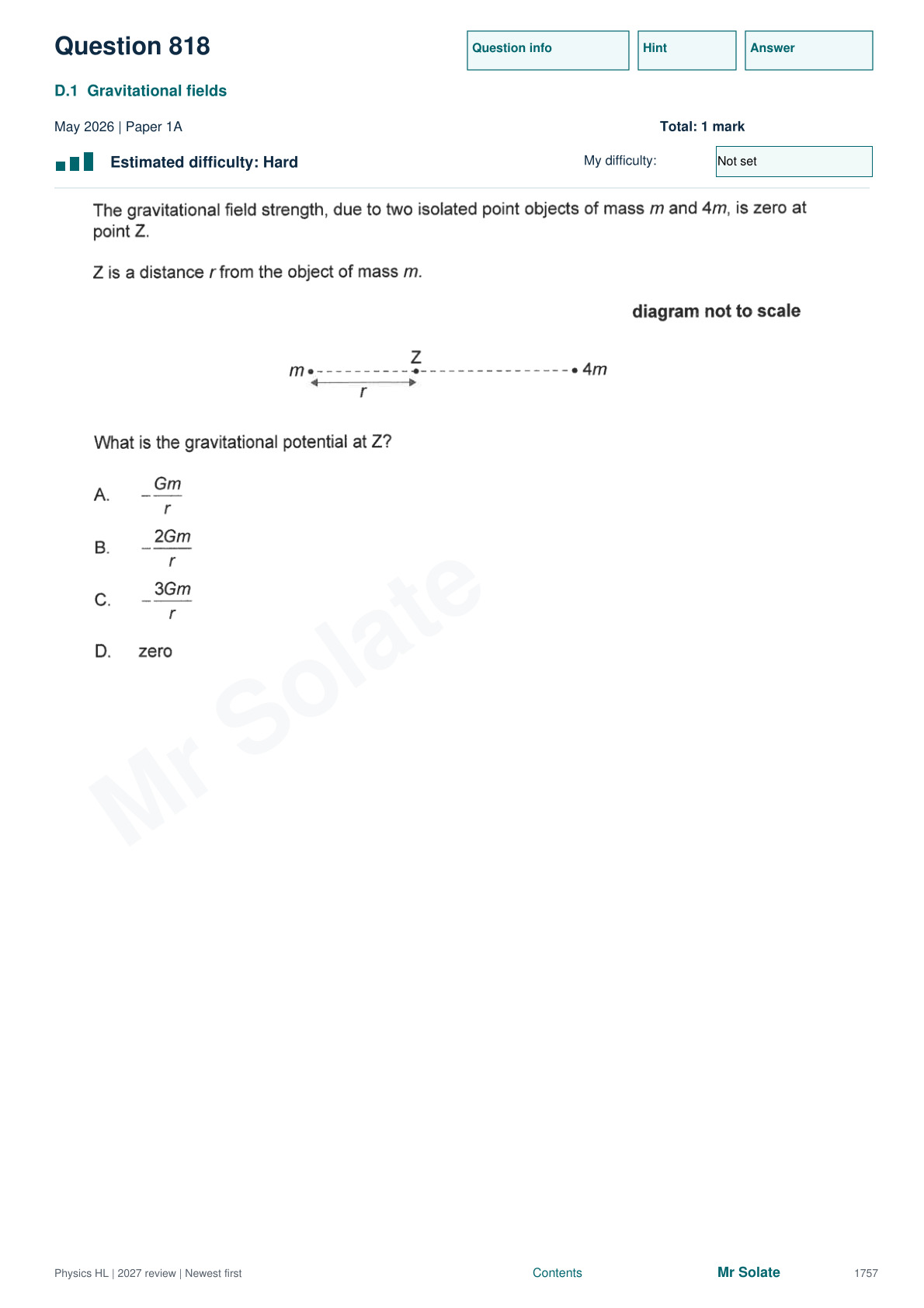
At this point the two field vectors cancel, but the scalar potentials add to a negative value.
Potential is not found by subtracting magnitudes merely because the fields point in opposite directions.
Derive orbit relationships from the inward force
Recognise it: A satellite radius, period, orbital mass or elliptical-orbit comparison is given.
- For a circular orbit, set GMm/r² = mv²/r, giving v² = GM/r. Use v = 2πr/T to obtain T² = 4π²r³/(GM).
- Use radius from the centre. When altitude is supplied, add the body’s radius before applying orbit equations. For Kepler comparisons of elliptical orbits, use the semi-major axis specified by the model.
- For a circular orbit, K = GMm/(2r), U = −GMm/r and E = −GMm/(2r). Increasing orbital radius makes total energy less negative even though speed decreases.
Gravity provides the inward resultant, so combining the force balance with the period relation gives T² ∝ r³.
The work required to change a circular orbit is its total-energy change, not its potential-energy change alone.
Use escape energy and scaling arguments
Recognise it: Escape speed, surface gravity, equal-density planets or launch energy is requested.
- For minimum escape to infinity with zero final speed, set initial total energy to zero: ½mv² − GMm/R = 0. This gives vescape = √(2GM/R).
- For equal-density spheres, mass scales as R³. Substitute that relation before comparing surface gravity or escape speed; holding mass fixed would be a different comparison.
- If several bodies contribute appreciably, add their potentials before evaluating the escape-energy requirement. Local field cancellation does not mean that no escape energy is needed.
The required escape kinetic energy is −mVinitial when the final potential and final kinetic energy are both zero.
Use a potential difference for a large height change; mgh assumes approximately uniform g.
Write it before you reveal it
A worked exam-style example
Original teaching example, created for this lesson.
A satellite moves in a circular orbit of radius 7.0 × 10⁶ m around a body with GM = 4.0 × 10¹⁴ m³ s⁻². Find its speed and period.
Reveal the worked solution
- Use v = √(GM/r) = √(4.0 × 10¹⁴/(7.0 × 10⁶)) = 7.56 × 10³ m s⁻¹.
- The orbit circumference is 2πr = 4.40 × 10⁷ m.
- T = 2πr/v = 5.82 × 10³ s, approximately 97 minutes.
Answer: Speed 7.6 km s⁻¹; period 5.8 × 10³ s ≈ 97 min.
Check: Substitution into T² = 4π²r³/(GM) gives the same period; the orbital radius is measured from the centre.
From your own collection
Apply it to past-paper questions
These questions anchor the patterns above. Attempt one without the answer, then compare your setup and conclusion with the reasoning. The linked reader contains the source answer and the question-specific syllabus review.
Question 818
Uses field cancellation before adding scalar potentials.
Compatibility: Current syllabus: Uses field cancellation before adding scalar potentials.
View the original question
Original page images preserve the equations and diagrams. Write your response before revealing the reasoning.
Reveal the revision reasoning
Gm/r²=4Gm/d² gives d=2r. Hence V=−Gm/r−4Gm/(2r)=−3Gm/r.
Editorial revision reasoning. Check the original answer for its marking detail.
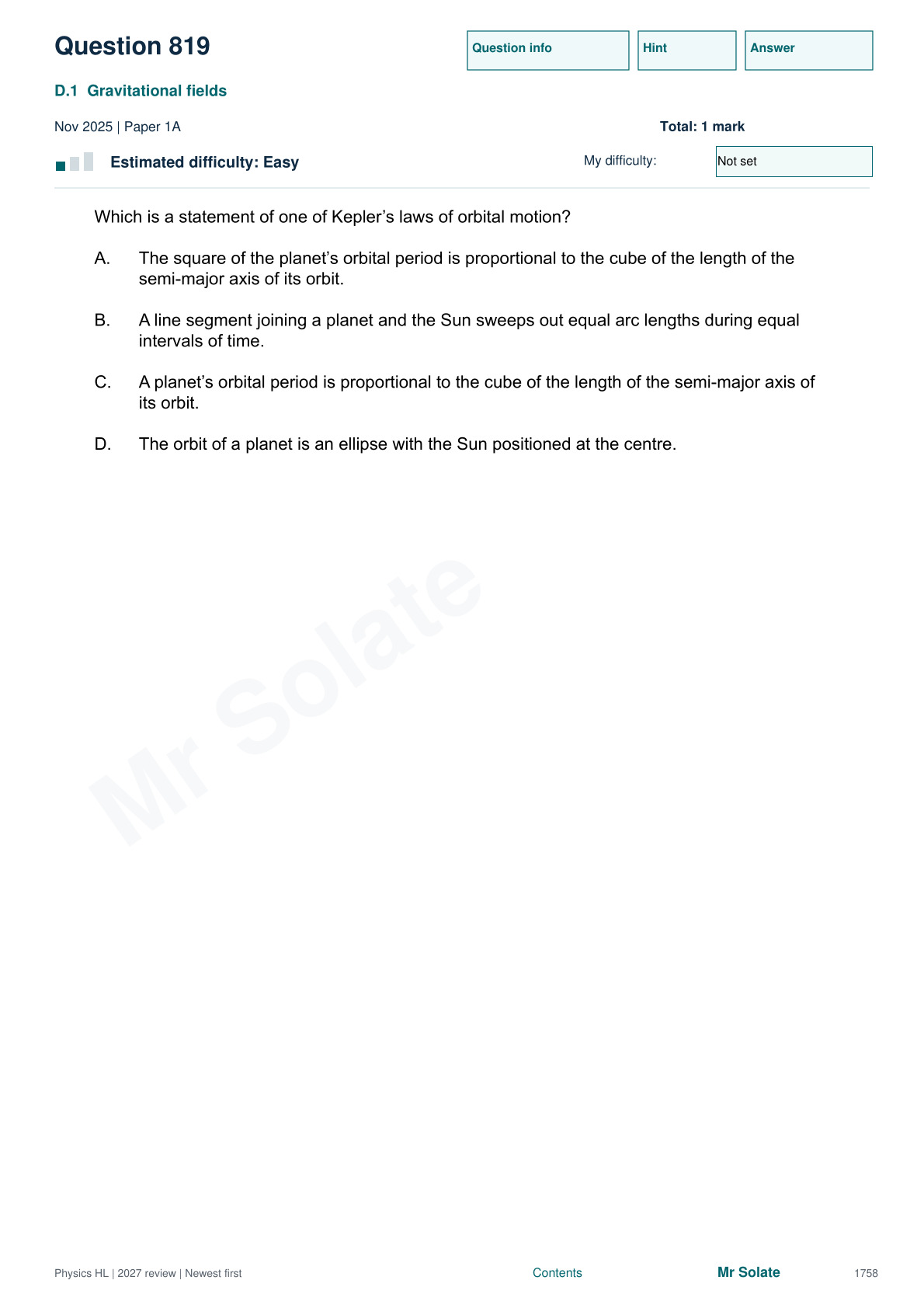
Question 819
Applies Kepler's third law to an elliptical orbit.
Compatibility: Current syllabus: Applies Kepler's third law to an elliptical orbit.
View the original question
Original page images preserve the equations and diagrams. Write your response before revealing the reasoning.
Reveal the revision reasoning
For bodies orbiting the same central mass, T² is proportional to a³, where a is the orbit's semi-major axis.
Editorial revision reasoning. Check the original answer for its marking detail.
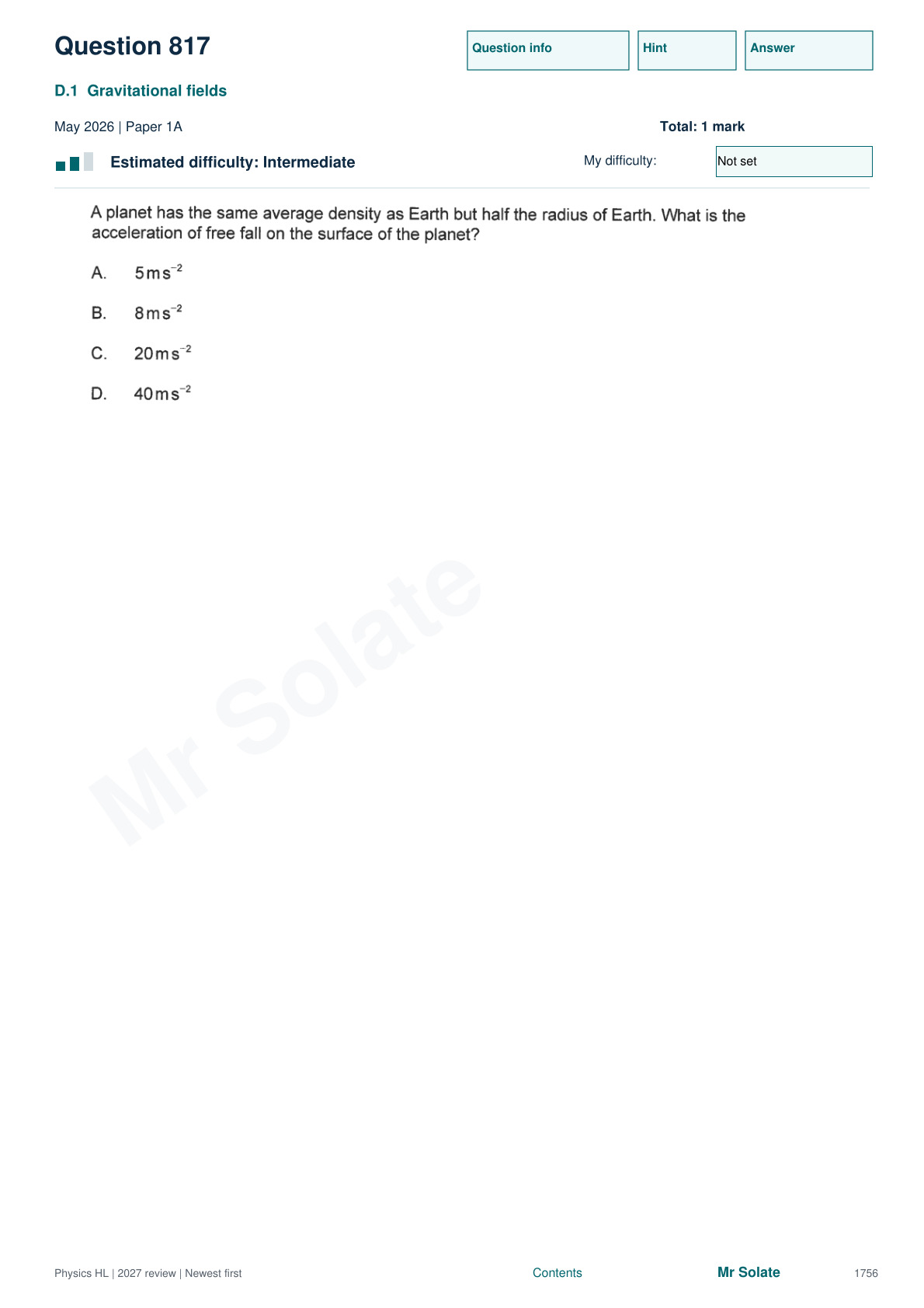
Question 817
Combines equal density with radius-dependent mass.
Compatibility: Current syllabus: Combines equal density with radius-dependent mass.
View the original question
Original page images preserve the equations and diagrams. Write your response before revealing the reasoning.
Reveal the revision reasoning
At constant density M is proportional to R³. Thus g=GM/R² is proportional to R. Half the radius gives about 5 m s−2.
Editorial revision reasoning. Check the original answer for its marking detail.
All 77 questions in this topic
Close your notes first
Can you retrieve the method?
1. Can gravitational field vanish while potential is negative?
Check answer 1
Yes; vector fields can cancel while negative scalar potentials add.
2. Which distance belongs in GM/r² outside a sphere?
Check answer 2
Distance from the sphere’s centre.
3. What happens to circular-orbit speed as radius increases?
Check answer 3
It decreases as r⁻¹ᐟ² for fixed central mass.
Before you move on
- Write units beside field (N kg⁻¹) and potential (J kg⁻¹) to keep them distinct.
- For orbital transfers, calculate total energy at both endpoints.
Your revision note
Record one missed cue, one corrected step and one question to retry. Saved only in this browser.