Start with the exam
What you need to be able to do
Kinematics questions reward a correct description of motion before arithmetic. The bank repeatedly changes the context—cars, dropped objects, projectiles and rebound experiments—but asks for the same decisions: which quantity is signed, whether acceleration is constant, and whether horizontal and vertical motion can be separated. Start by drawing the start and finish positions and naming a positive direction. A projectile’s zero vertical velocity at its highest point does not mean zero acceleration. Use the actual release velocity: an object released from a rising vehicle initially keeps the vehicle’s upward velocity.
Spend 3 minutes reading the overview and diagram, 7 minutes learning the question patterns, 5 minutes writing out the worked example, and 5 minutes on a bank question or recall check. Take longer when you need to; the full bank is here for later practice.
Recognise → set up → write
How the questions are set
Separate a projectile into two motions
Recognise it: A launch angle, cliff height, range or impact velocity is given.
- Resolve the launch speed: uₓ = u cos θ and uᵧ = u sin θ, with the angle measured from the horizontal. Write the vertical displacement relative to the launch point, not the ground automatically.
- Find the common flight time from the component with enough information. With negligible air resistance, horizontal acceleration is zero and vertical acceleration is −g for upward-positive axes. Substitute that same time into the other component.
- If asked for impact speed, combine the final velocity components with Pythagoras. If asked for direction, use their ratio and state whether the direction is above or below the horizontal.
Taking upward as positive, Δy = uᵧt − ½gt²; horizontally, x = uₓt. Both equations describe the same flight interval.
Do not use the total launch speed in a vertical equation or assume equal launch and landing heights.
Read a graph as a physical operation
Recognise it: A velocity, acceleration or displacement graph replaces a list of numbers.
- Identify both axes and their units. Gradient of displacement–time is velocity; gradient of velocity–time is acceleration. A graph shape alone is not enough: name the quantity whose rate changes.
- Find displacement from signed area under velocity–time, and change in velocity from signed area under acceleration–time. Split triangles, rectangles and sections below the axis rather than using a single guessed average.
- For distance travelled, add the magnitudes of velocity–time areas. For a curved graph, estimate a tangent for an instantaneous gradient and use the largest practical triangle on that tangent.
The signed area gives displacement; the sum of the absolute areas gives distance.
A graph crossing the time axis reverses velocity only if the vertical axis is velocity.
Choose the constant-acceleration relationship
Recognise it: Stopping distance, a drop time or a speed after a stated distance is requested.
- List u, v, a, t and s for one interval. Choose an equation containing the target and the known quantities; use v² = u² + 2as when time is absent.
- Keep signs through the substitution. For braking with forward-positive axes, acceleration is negative while stopping distance is positive. A doubled initial speed requires four times the stopping distance if braking acceleration is unchanged.
- Check the assumed model. Drag normally changes with speed, so a constant-g trajectory does not describe a dragged projectile exactly. Explain the direction of the resulting difference instead of silently keeping the ideal model.
With constant braking acceleration, 0 = u² + 2as, so the stopping distance is proportional to u².
Average speed is (u + v)/2 only for constant acceleration along the chosen straight-line motion.
Write it before you reveal it
A worked exam-style example
Original teaching example, created for this lesson.
A ball leaves a 20.0 m high platform horizontally at 8.00 m s⁻¹. Ignore drag and use g = 9.81 m s⁻². Find the flight time, range and impact speed.
Reveal the worked solution
- Choose downward-positive vertical motion: 20.0 = ½ × 9.81 × t². Thus t = 2.019 s.
- Horizontal speed stays 8.00 m s⁻¹, giving range x = 8.00 × 2.019 = 16.15 m.
- Vertical impact speed is 9.81 × 2.019 = 19.81 m s⁻¹. Combine perpendicular components: v = √(8.00² + 19.81²).
Answer: Time 2.02 s; range 16.2 m; impact speed 21.4 m s⁻¹.
Check: Energy independently gives v² = 8.00² + 2 × 9.81 × 20.0, agreeing with the component result.
From your own collection
Apply it to past-paper questions
These questions anchor the patterns above. Attempt one without the answer, then compare your setup and conclusion with the reasoning. The linked reader contains the source answer and the question-specific syllabus review.
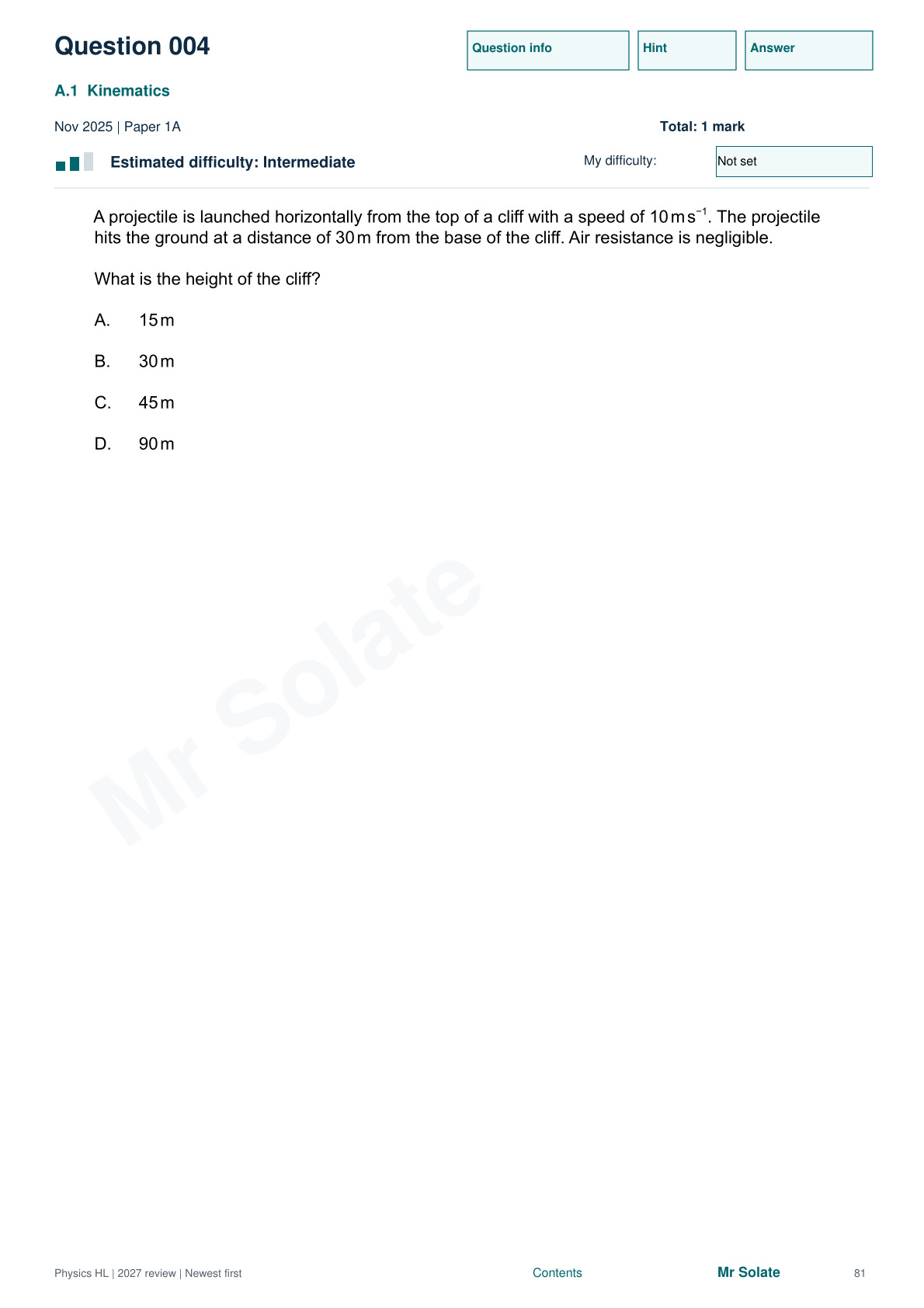
Question 4
Separates horizontal and vertical projectile motion.
Compatibility: Current syllabus: Separates horizontal and vertical projectile motion.
View the original question
Original page images preserve the equations and diagrams. Write your response before revealing the reasoning.
Reveal the revision reasoning
Horizontal motion gives t=30/10=3 s. Initial vertical speed is zero, so h=gt²/2=45 m using g=10 m s−2.
Editorial revision reasoning. Check the original answer for its marking detail.
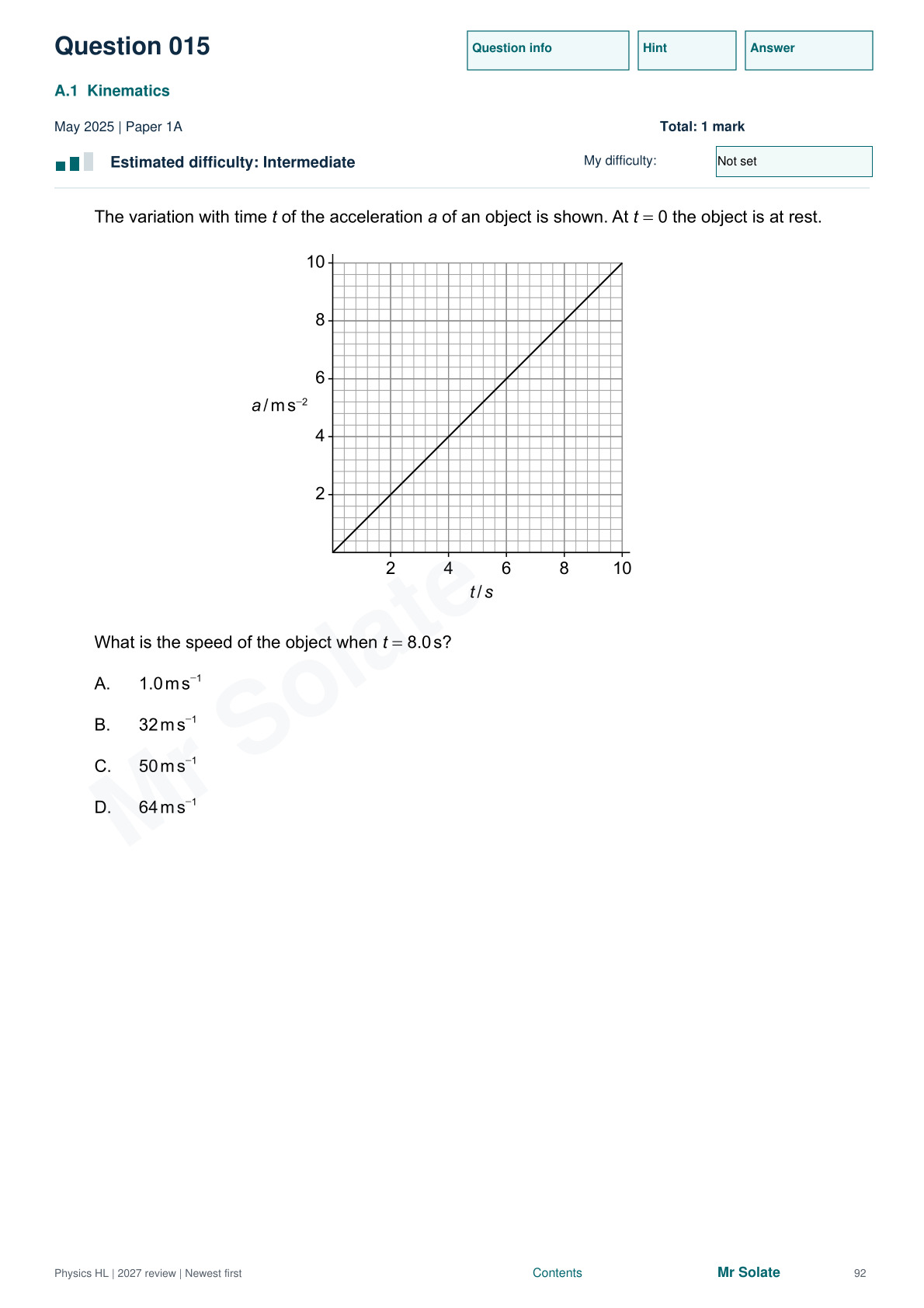
Question 15
Uses area under a linearly increasing acceleration graph.
Compatibility: Current syllabus: Uses area under a linearly increasing acceleration graph.
View the original question
Original page images preserve the equations and diagrams. Write your response before revealing the reasoning.
Reveal the revision reasoning
The triangular area is(1/2)×8×8=32 m s−1. The object starts at rest, so its speed is 32 m s−1.
Editorial revision reasoning. Check the original answer for its marking detail.
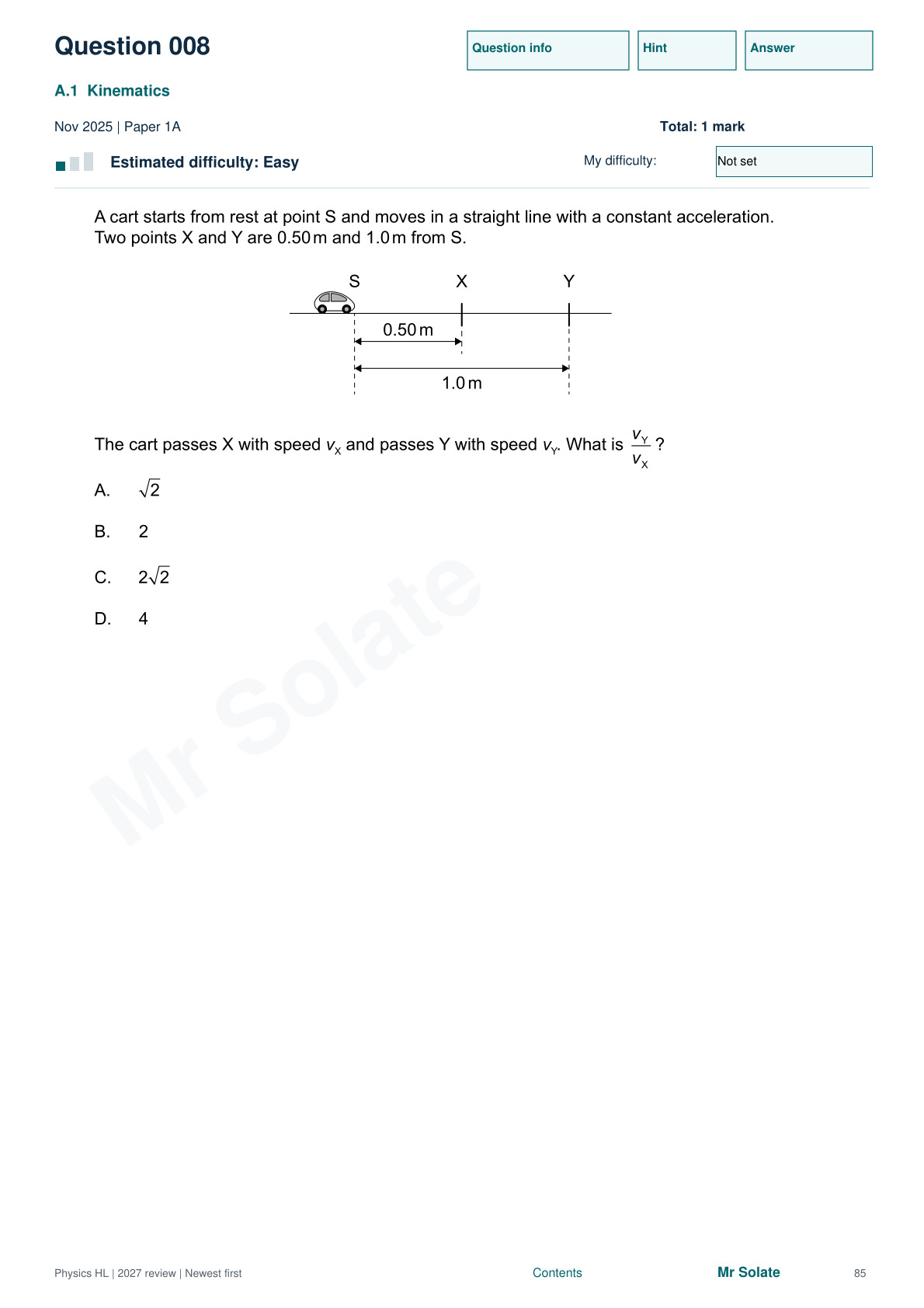
Question 8
Relates speed squared to distance under constant acceleration.
Compatibility: Current syllabus: Relates speed squared to distance under constant acceleration.
View the original question
Original page images preserve the equations and diagrams. Write your response before revealing the reasoning.
Reveal the revision reasoning
The distance doubles from 0.50 m to 1.0 m. Speed therefore increases by √2, giving v_Y/v_X=√2.
Editorial revision reasoning. Check the original answer for its marking detail.
All 50 questions in this topic
Close your notes first
Can you retrieve the method?
1. What remains nonzero at the highest point of an ideal projectile?
Check answer 1
Acceleration remains g downward; horizontal velocity also remains nonzero for a nonvertical launch.
2. What does area below the axis of a velocity–time graph mean?
Check answer 2
Negative displacement, contributing positively to total distance.
3. When does a fourfold stopping distance follow from doubling speed?
Check answer 3
When the magnitude of the constant braking acceleration remains the same.
Before you move on
- Before opening the solution, label a positive axis and write the vertical displacement explicitly.
- For graph questions, write “gradient” or “area” beside the requested quantity, including its units.
Your revision note
Record one missed cue, one corrected step and one question to retry. Saved only in this browser.