Start with the exam
What you need to be able to do
Energy questions in this bank often ask for the difference between available energy and useful energy, or between energy and the rate at which it is transferred. Define the system and draw an energy account before substituting values. Gravitational energy lost can become kinetic energy, elastic energy and thermal energy simultaneously. A motor’s input power is larger than useful mechanical output if efficiency is below one. A flow rate converts a one-object energy calculation into energy per second, but its time unit must match watts.
Spend 3 minutes reading the overview and diagram, 7 minutes learning the question patterns, 5 minutes writing out the worked example, and 5 minutes on a bank question or recall check. Take longer when you need to; the full bank is here for later practice.
Recognise → set up → write
How the questions are set
Account for work and dissipative transfer
Recognise it: A ramp, stopping distance, spring, rope or variable force graph is supplied.
- Write initial energy plus work supplied equal to final energy plus energy dissipated. Identify the start and end states rather than adding every formula associated with the diagram.
- Use mgh for a near-surface height change, ½mv² for kinetic energy and ½kx² for an ideal spring. Resistive work is force times path length for constant resistance; use area under force–displacement when force varies.
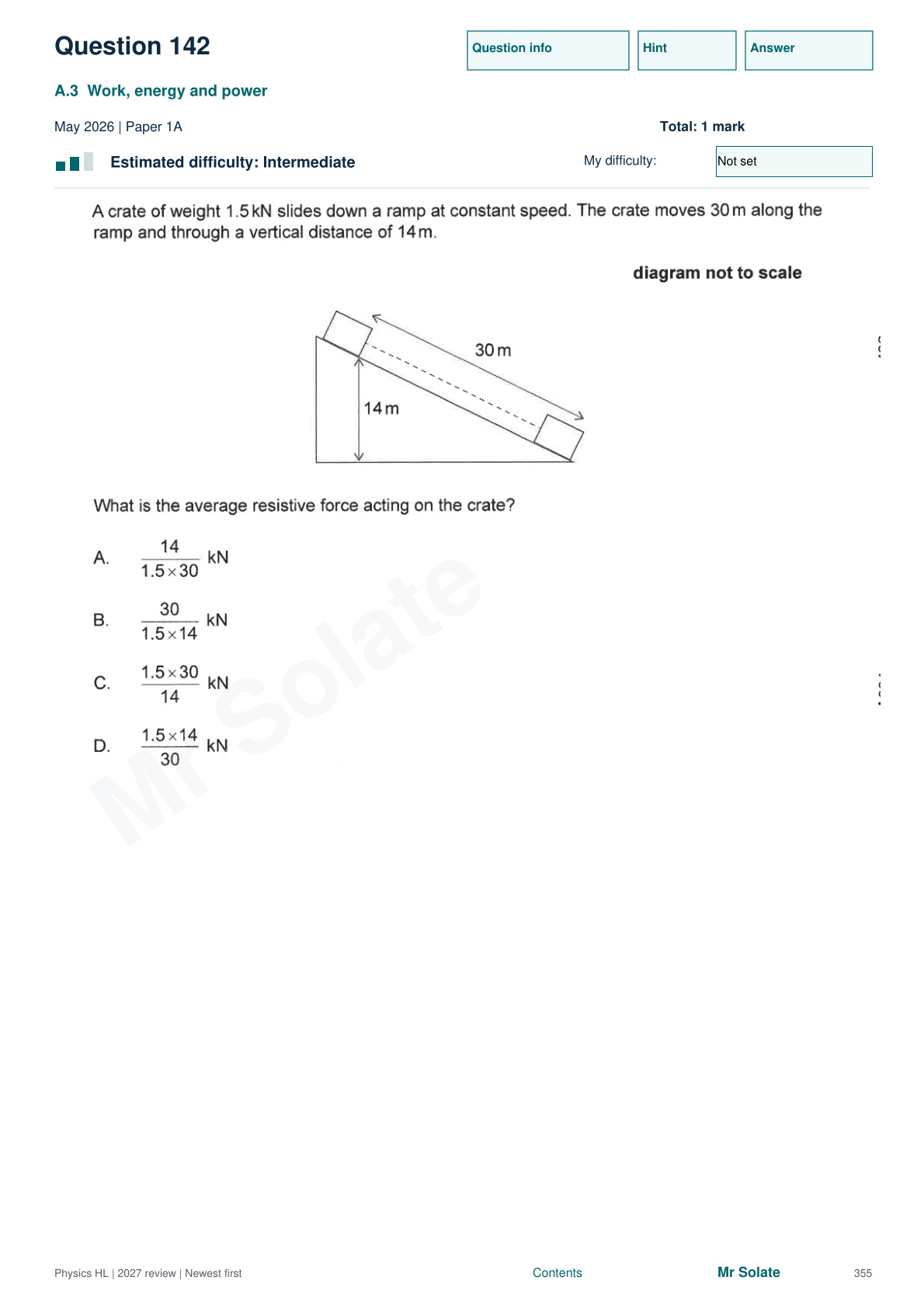
- If the object stops, final kinetic energy is zero but other energy terms may remain. On a slope, friction acts along the path, while gravitational energy depends on vertical height.
mgh = ½mv² + Ffriction s, where h is the vertical drop and s is the distance along the slope.
Do not replace a triangular force–extension area by the full rectangle Fx.
Turn energy into useful and input power
Recognise it: Lifting speed, efficiency, electrical supply or pumping water is given.
- Find useful energy per event, then multiply by the event rate, or use P = Fv when force and velocity are parallel and steady. For lifting mass flow, Puseful = ṁgh.
- Convert kilograms per minute to kilograms per second before calculating watts. Efficiency equals useful output divided by input; divide the useful requirement by efficiency to obtain the necessary input.
- Explain a larger input as the useful output plus dissipative transfers. If the question asks for time, energy divided by the relevant power is required; avoid mixing input energy with useful power without an efficiency factor.
Pinput = ṁgh/η; the mass flow rate is expressed in kg s⁻¹ and η as a decimal.
Multiplying useful power by efficiency gives a smaller value and cannot be the input requirement.
Use flow energy and graph areas carefully
Recognise it: Wind, a variable driving force or a reservoir changing height is described.
- For a stream, identify mass passing a section per second: ṁ = ρAv. Incoming kinetic power is ½ṁv². If outflow speed is given, subtract the outgoing kinetic-energy flux with a consistent mass-flow model.
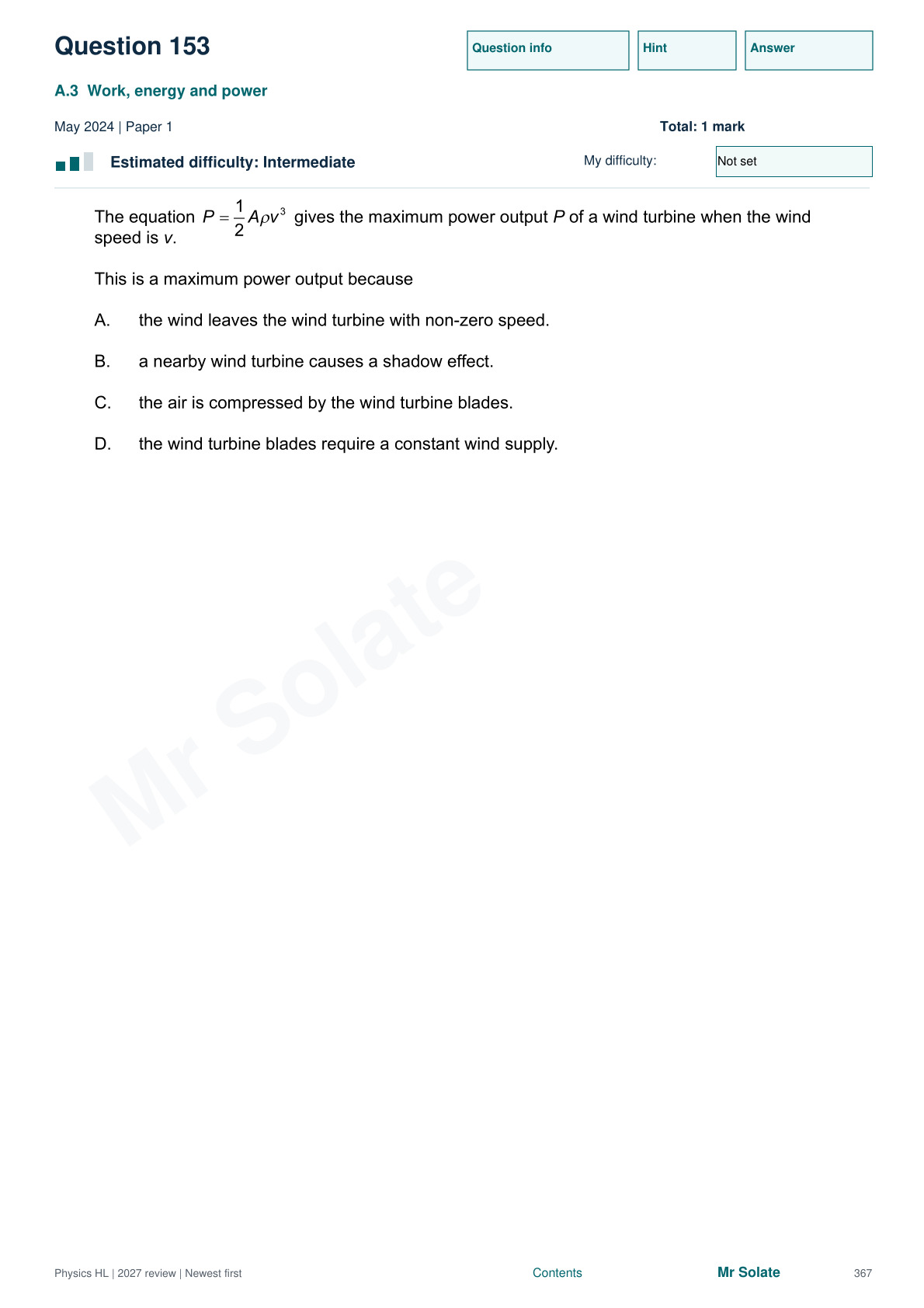
- A wind turbine cannot remove all kinetic energy while maintaining the assumed flow through it. In a reservoir, changing water level changes the height through which each portion moves; use an average height only when the geometry justifies it.
- When force varies with displacement, calculate work from the graph area first. A later constant-speed power calculation is a separate stage and uses the force at that operating speed.
Extracted power is the incoming kinetic-energy rate minus the outgoing rate, not simply the kinetic energy of one parcel.
Energy in joules and power in watts are different targets, even when the same quantities appear in their equations.
Write it before you reveal it
A worked exam-style example
Original teaching example, created for this lesson.
A pump raises 12.0 kg of water each minute through 8.0 m. Its efficiency is 60%. Find the minimum electrical input power for this model.
Reveal the worked solution
- Convert the rate: ṁ = 12.0/60 = 0.200 kg s⁻¹.
- Useful gravitational power = 0.200 × 9.81 × 8.0 = 15.696 W.
- η = Puseful/Pinput, therefore Pinput = 15.696/0.60 = 26.16 W.
Answer: Electrical input power ≈ 26 W.
Check: The input exceeds the useful 15.7 W; about 10.5 W is dissipated. Dimensions kg s⁻¹ × m s⁻² × m give watts.
From your own collection
Apply it to past-paper questions
These questions anchor the patterns above. Attempt one without the answer, then compare your setup and conclusion with the reasoning. The linked reader contains the source answer and the question-specific syllabus review.
Question 142
Balances gravitational energy loss with resistive work.
Compatibility: Current syllabus: Balances gravitational energy loss with resistive work.
View the original question
Original page images preserve the equations and diagrams. Write your response before revealing the reasoning.
Reveal the revision reasoning
Gravitational energy decreases by 1.5×14 kJ. Resistive work is F×30, giving F=1.5×14/30 kN.
Editorial revision reasoning. Check the original answer for its marking detail.
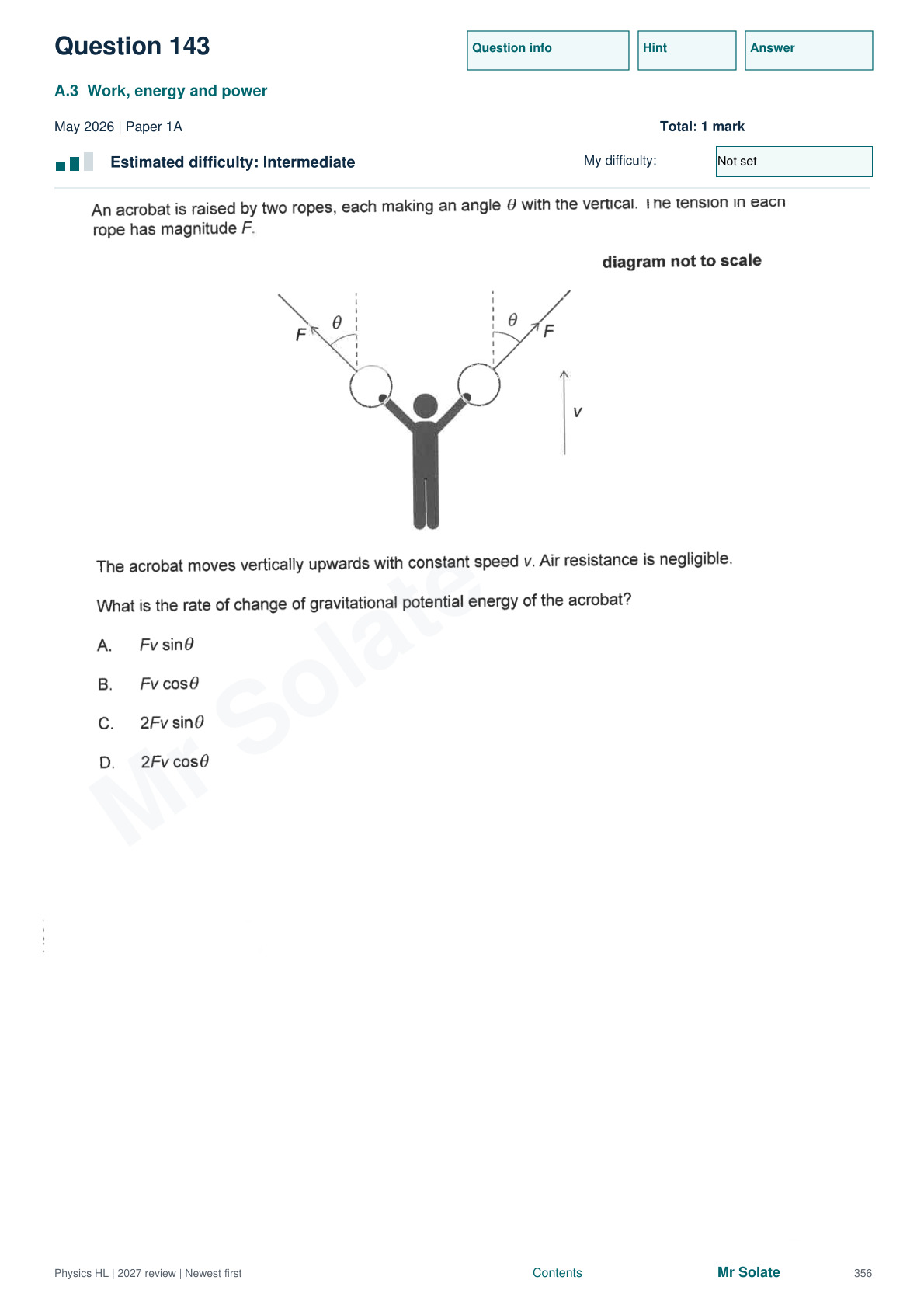
Question 143
Resolves two tensions before calculating lifting power.
Compatibility: Current syllabus: Resolves two tensions before calculating lifting power.
View the original question
Original page images preserve the equations and diagrams. Write your response before revealing the reasoning.
Reveal the revision reasoning
Constant speed gives mg=2F cosθ. The increase in gravitational energy per second is mgv=2Fv cosθ.
Editorial revision reasoning. Check the original answer for its marking detail.
Question 153
Recognizes why not all incoming wind kinetic energy is extractable.
Compatibility: Current A.3 energy reasoning solves this supplied wind-power context. The wind-turbine power expression is given, so no legacy formula needs memorizing.
View the original question
Original page images preserve the equations and diagrams. Write your response before revealing the reasoning.
Reveal the revision reasoning
The given expression counts all incoming kinetic-energy flux. Since the outgoing air retains nonzero speed, some kinetic energy remains and real output is smaller.
Editorial revision reasoning. Check the original answer for its marking detail.
All 40 questions in this topic
Close your notes first
Can you retrieve the method?
1. What does area under a force–displacement graph represent?
Check answer 1
Work done by the force component parallel to displacement.
2. Why is slope length different from height in an energy balance?
Check answer 2
Friction acts through path length; gravity depends on vertical displacement.
3. What happens to input power if efficiency decreases at fixed useful output?
Check answer 3
Input power increases because Pinput = Puseful/η.
Before you move on
- Put units on all rates before choosing a power equation.
- Use an energy balance to explain where the missing mechanical energy has gone.
Your revision note
Record one missed cue, one corrected step and one question to retry. Saved only in this browser.