Start with the exam
What you need to be able to do
Quantum questions ask you to separate energy per photon from the number of photons arriving per second. In the photoelectric effect, frequency sets the maximum available electron kinetic energy, while intensity at fixed frequency controls photon arrival rate and can affect emitted current. An electron may need some photon energy to escape the material, so subtract the work function before calculating speed. Matter-wave questions use momentum, which must be obtained from the appropriate kinetic-energy model. When comparing experimental observations, state which wave or photon prediction is being tested. A threshold frequency and immediate emission at low intensity concern energy delivery to individual electrons. Diffraction of particles concerns their wavelength. Simply saying “wave–particle duality” does not identify the evidence or the inference.
Spend 3 minutes reading the overview and diagram, 7 minutes learning the question patterns, 5 minutes writing out the worked example, and 5 minutes on a bank question or recall check. Take longer when you need to; the full bank is here for later practice.
Recognise → set up → write
How the questions are set
Use the photoelectric energy balance
Recognise it: Threshold frequency, work function, stopping voltage or current–voltage curves appear.
- Write Kmax = hf − φ. Emission requires hf ≥ φ in the simple one-photon model. Below threshold, raising intensity does not make each photon more energetic.
- Use eVstop = Kmax for the magnitude of the stopping potential. A graph of Kmax against frequency has gradient h, while stopping potential against frequency has gradient h/e.
- Separate current from maximum energy. At fixed above-threshold frequency, increasing intensity increases photon rate and can increase saturation current, but does not increase stopping voltage in the ideal model.
The increased intensity raises the photon arrival rate, while each photon still has energy hf; therefore the maximum electron kinetic energy is unchanged.
Check the plotted voltage sign convention before identifying a stopping intercept.
Calculate matter wavelength from momentum
Recognise it: Electron diffraction, accelerating voltage or a particle wavelength is given.
- Use λ = h/p. For a nonrelativistic particle, p = √(2mK). If accelerated from rest through a potential difference, K = |q|V.
- Combine to get λ = h/√(2m|q|V) when the stated assumptions hold. A fourfold voltage gives half the wavelength, not a quarter.
- If a high-energy relation is supplied, use it rather than forcing the nonrelativistic formula. Connect wavelength to diffraction angle or characteristic target size only with the geometry or criterion specified.
The accelerating potential determines kinetic energy, which determines momentum; the de Broglie wavelength is then h/p.
Do not use photon momentum p = E/c for a slow massive electron.
Account for photon energy and momentum in scattering
Recognise it: A Compton shift, photon recoil or radiation pressure is described.
- For Compton scattering by a free electron initially at rest, use Δλ = h/(mec)(1 − cosθ). The scattered photon has a longer wavelength and lower energy.
- Find recoil-electron kinetic energy from the loss of photon energy when the stated isolated model permits it. Momentum is a vector, so its conservation must include scattering directions.
- For a photon beam on a surface, momentum transfer per photon depends on absorption or reflection. Multiply momentum transfer by arrival rate to obtain force, using consistent energy and time units.
The photon loses energy as its wavelength increases; that energy becomes electron kinetic energy in the free-electron scattering model.
Conserving scalar photon energy alone cannot determine a scattering direction because momentum conservation is vectorial.
Write it before you reveal it
A worked exam-style example
Original teaching example, created for this lesson.
Light of photon energy 4.0 eV strikes a metal with work function 2.3 eV. Find maximum photoelectron kinetic energy and stopping-potential magnitude.
Reveal the worked solution
- Apply the energy balance: Kmax = 4.0 − 2.3 = 1.7 eV.
- Stopping potential satisfies eVstop = Kmax. An electron losing 1.7 eV through a retarding field requires a potential-difference magnitude of 1.7 V.
- Doubling intensity at this fixed frequency would increase photon rate, but Kmax and the ideal stopping voltage would remain unchanged.
Answer: Maximum kinetic energy 1.7 eV; stopping-potential magnitude 1.7 V.
Check: The photon energy exceeds the work function, so emission is allowed. Electron energy is less than the photon energy.
From your own collection
Apply it to past-paper questions
These questions anchor the patterns above. Attempt one without the answer, then compare your setup and conclusion with the reasoning. The linked reader contains the source answer and the question-specific syllabus review.
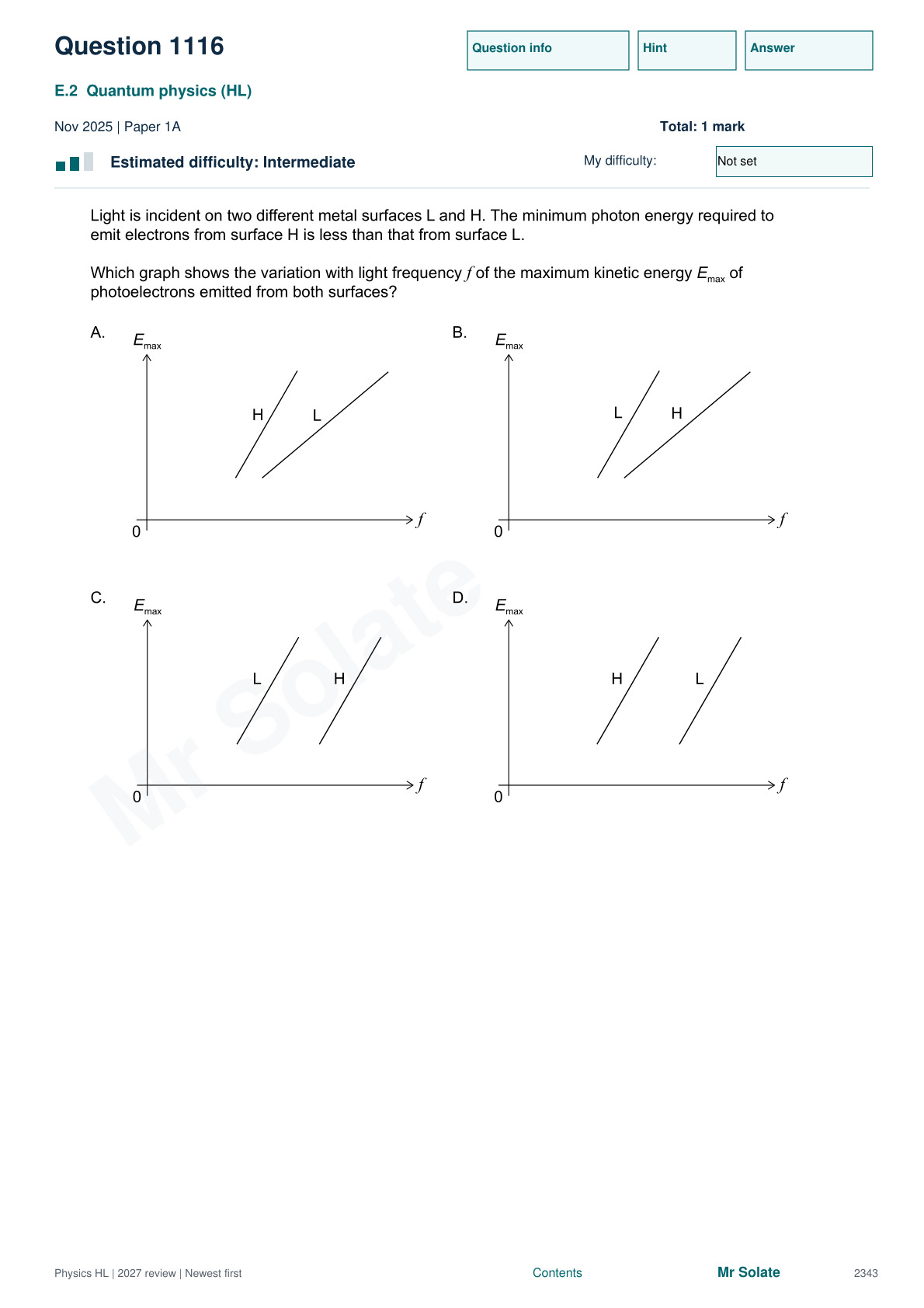
Question 1116
Separates work-function effects from the universal graph gradient.
Compatibility: Current syllabus: Separates work-function effects from the universal graph gradient.
View the original question
Original page images preserve the equations and diagrams. Write your response before revealing the reasoning.
Reveal the revision reasoning
E_max=hf−φ. H has lower work function, so its threshold frequency lies to the left of L, while both lines remain parallel. This is graph D.
Editorial revision reasoning. Check the original answer for its marking detail.
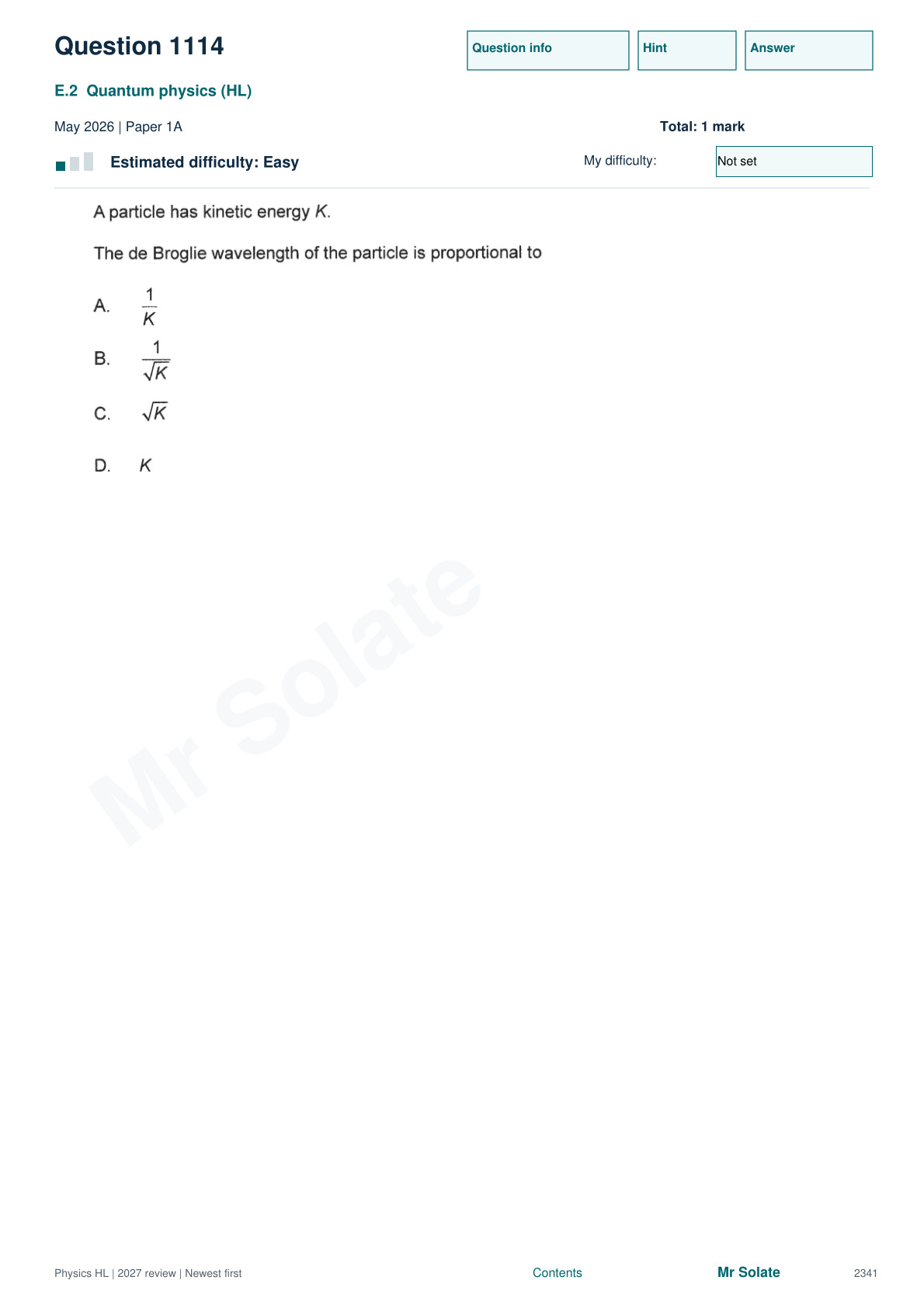
Question 1114
Combines de Broglie wavelength and kinetic energy.
Compatibility: Current syllabus: Combines de Broglie wavelength and kinetic energy.
View the original question
Original page images preserve the equations and diagrams. Write your response before revealing the reasoning.
Reveal the revision reasoning
For fixed mass, λ=h/√(2mK). Wavelength is proportional to 1/√K.
Editorial revision reasoning. Check the original answer for its marking detail.
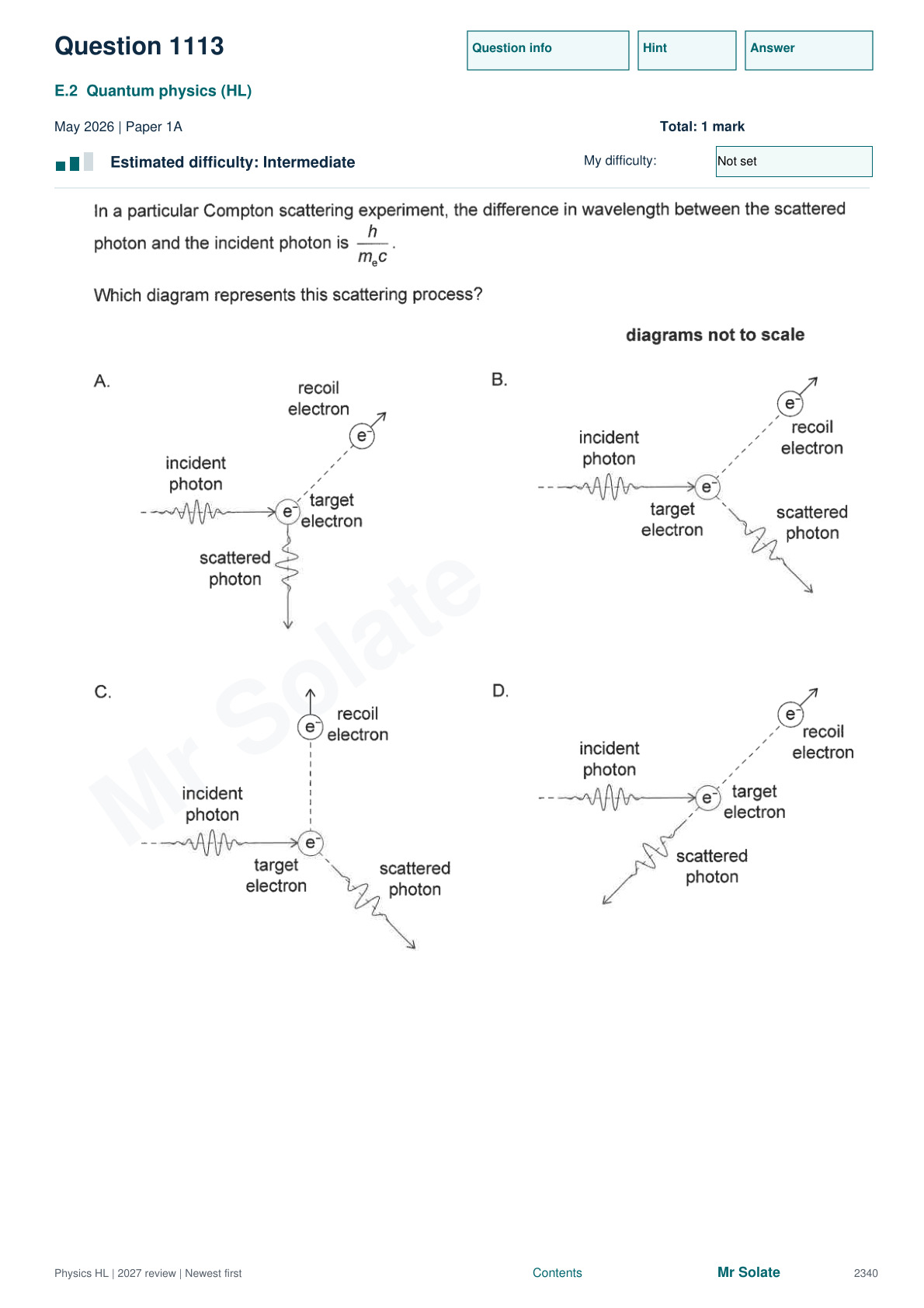
Question 1113
Infers a photon scattering angle from its Compton shift.
Compatibility: Current syllabus: Infers a photon scattering angle from its Compton shift.
View the original question
Original page images preserve the equations and diagrams. Write your response before revealing the reasoning.
Reveal the revision reasoning
Δλ=h/(m_ec) requires 1−cosθ=1, so θ=90°. Check the outgoing photon direction, not the electron direction.
Editorial revision reasoning. Check the original answer for its marking detail.
All 57 questions in this topic
Close your notes first
Can you retrieve the method?
1. Can intensity alone overcome a below-threshold frequency in the simple photoelectric model?
Check answer 1
No; each photon still has insufficient energy.
2. How does nonrelativistic electron wavelength scale with accelerating voltage?
Check answer 2
λ ∝ V⁻¹ᐟ².
3. What happens to scattered photon energy when Compton wavelength increases?
Check answer 3
It decreases because E = hc/λ.
Before you move on
- Label whether a graph shows electron energy, stopping voltage or current.
- Write energy per photon separately from photons per second.
Your revision note
Record one missed cue, one corrected step and one question to retry. Saved only in this browser.