Start with the exam
What you need to be able to do
Doppler questions test which object moves relative to which reference. For sound, wave speed is defined relative to the medium. A moving source changes wavelength in the medium, while a moving observer changes the rate of meeting wavefronts. For low-speed astronomical spectral shifts, the fractional wavelength change gives radial speed relative to light speed. The sign and the radial component matter: approaching motion produces a blueshift, recession a redshift.
Spend 3 minutes reading the overview and diagram, 7 minutes learning the question patterns, 5 minutes writing out the worked example, and 5 minutes on a bank question or recall check. Take longer when you need to; the full bank is here for later practice.
Recognise → set up → write
How the questions are set
Separate moving-source and moving-observer effects
Recognise it: A train, siren, detector or wavefront diagram is supplied.
- Mark source and observer velocities relative to the medium. First decide whether they approach or recede, then predict whether the detected frequency rises or falls.
- For a stationary observer and an approaching source, wavelength ahead is (v − us)/f and detected frequency is fv/(v − us). For an approaching observer and stationary source, use f′ = f(v + uo)/v.
- For both moving, combine the corresponding numerator and denominator signs consistently. Check the physical prediction after substitution rather than memorising a sign without a diagram.
The source moves closer between successive emissions, compressing the wavefront spacing ahead of it while the wave speed in air stays unchanged.
Source motion does not increase the speed of sound through still air.
Extract radial speed from a spectral line
Recognise it: A measured and reference wavelength, redshift or rotating star is given.
- Identify the rest wavelength λ₀ and compute Δλ = λobserved − λ₀. Use vᵣ/c ≈ Δλ/λ₀ only in the small-speed regime specified by the problem.
- A positive Δλ indicates recession and a negative value approach under this convention. Convert nanometres consistently; their units cancel in the fractional ratio.
- The result is radial speed, not necessarily the full velocity. For rotating or orbiting sources, the observed extrema depend on the line-of-sight component and geometry.
The line is shifted to a longer wavelength, so the source is receding; vᵣ ≈ cΔλ/λ₀.
Use the rest wavelength in the denominator, and do not interpret a transverse component as fully measured by a first-order radial shift.
Treat reflection and changing motion in stages
Recognise it: A moving reflector, an oscillating object or frequency varying with time appears.
- For reflection from a moving object, the object first acts as a moving observer receiving the incident wave, then as a moving source returning it. Apply the two Doppler steps.
- At speeds small compared with the wave speed, the reflected fractional frequency change is approximately twice the radial speed divided by wave speed. State that this is an approximation.
- For an oscillating reflector, maximum frequency shifts correspond to maximum radial speed, often at equilibrium for SHM. Direction reverses the shift, while turning points have zero instantaneous radial speed.
The reflected signal undergoes a Doppler change on reception and again on re-emission, giving a doubled first-order shift.
A maximum displacement is not a maximum-speed point of an SHM reflector.
Write it before you reveal it
A worked exam-style example
Original teaching example, created for this lesson.
A spectral line has rest wavelength 500.0 nm and is observed at 500.4 nm. Estimate the source’s radial speed and direction using the small-shift approximation.
Reveal the worked solution
- Δλ = 500.4 − 500.0 = 0.4 nm. The fractional shift is 0.4/500.0 = 8.0 × 10⁻⁴.
- vᵣ ≈ 3.00 × 10⁸ × 8.0 × 10⁻⁴ = 2.4 × 10⁵ m s⁻¹.
- The wavelength increased, so the source is receding along the line of sight.
Answer: Radial recession speed 2.4 × 10⁵ m s⁻¹, or 240 km s⁻¹.
Check: vᵣ/c = 0.0008 is small, supporting the low-speed approximation.
From your own collection
Apply it to past-paper questions
These questions anchor the patterns above. Attempt one without the answer, then compare your setup and conclusion with the reasoning. The linked reader contains the source answer and the question-specific syllabus review.
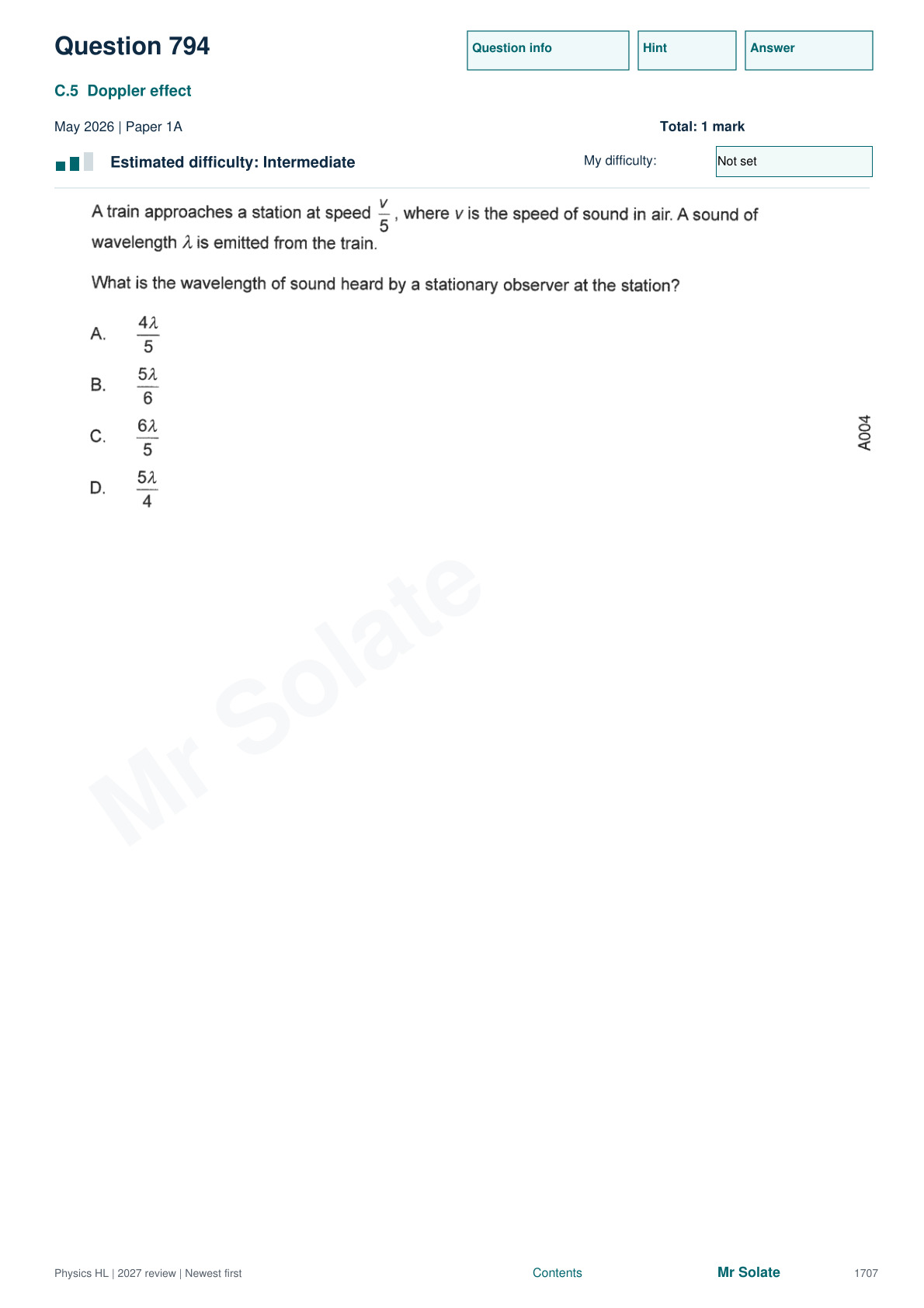
Question 794
Finds compressed wavefront spacing ahead of the train.
Compatibility: Current syllabus: Finds compressed wavefront spacing ahead of the train.
View the original question
Original page images preserve the equations and diagrams. Write your response before revealing the reasoning.
Reveal the revision reasoning
In one period the source advances λ/5. The wavelength ahead is λ−λ/5=4λ/5.
Editorial revision reasoning. Check the original answer for its marking detail.
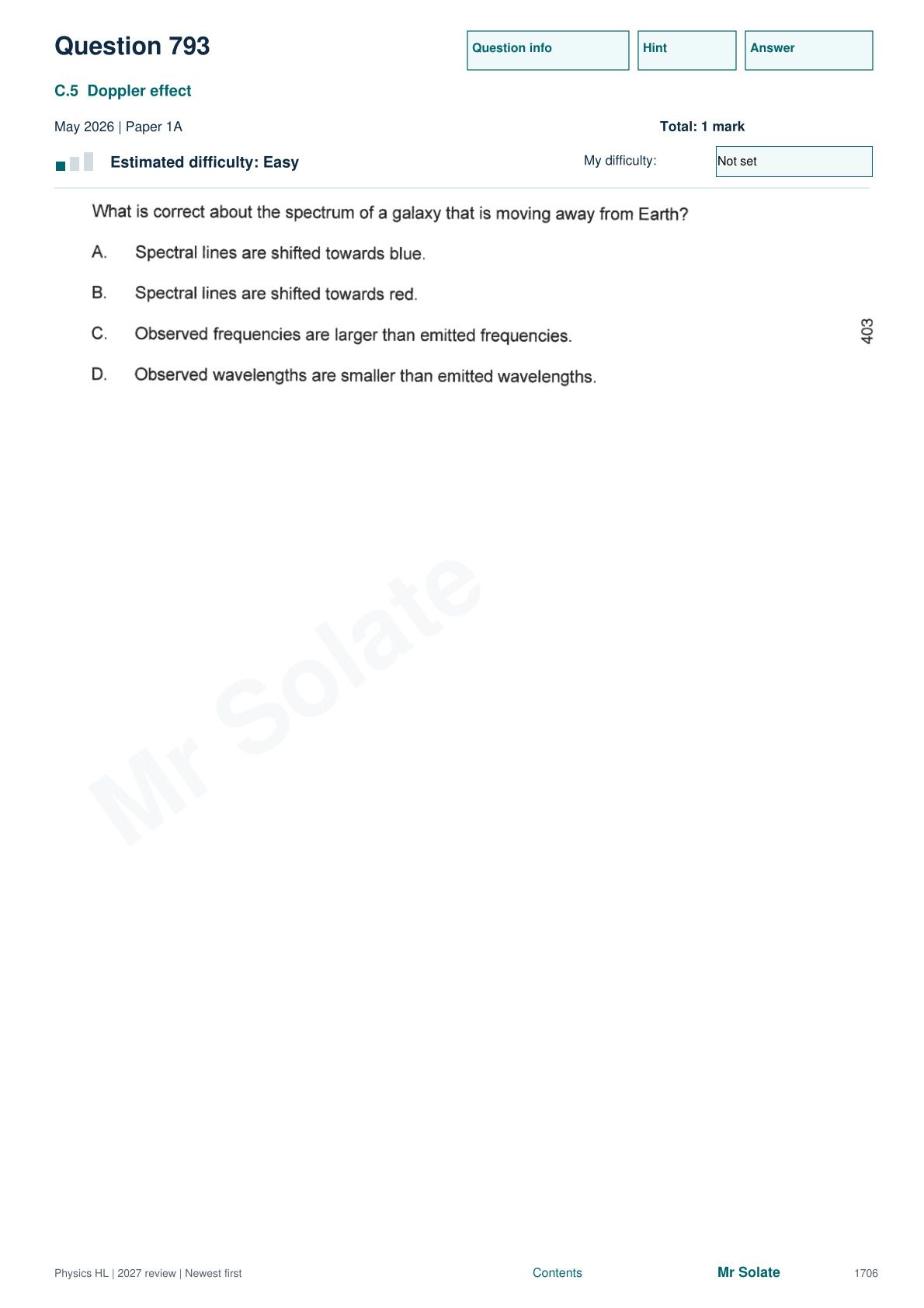
Question 793
Identifies a receding galaxy's Doppler shift.
Compatibility: Current syllabus: Identifies a receding galaxy's Doppler shift.
View the original question
Original page images preserve the equations and diagrams. Write your response before revealing the reasoning.
Reveal the revision reasoning
Spectral lines shift to longer wavelengths and lower frequencies: a redshift.
Editorial revision reasoning. Check the original answer for its marking detail.
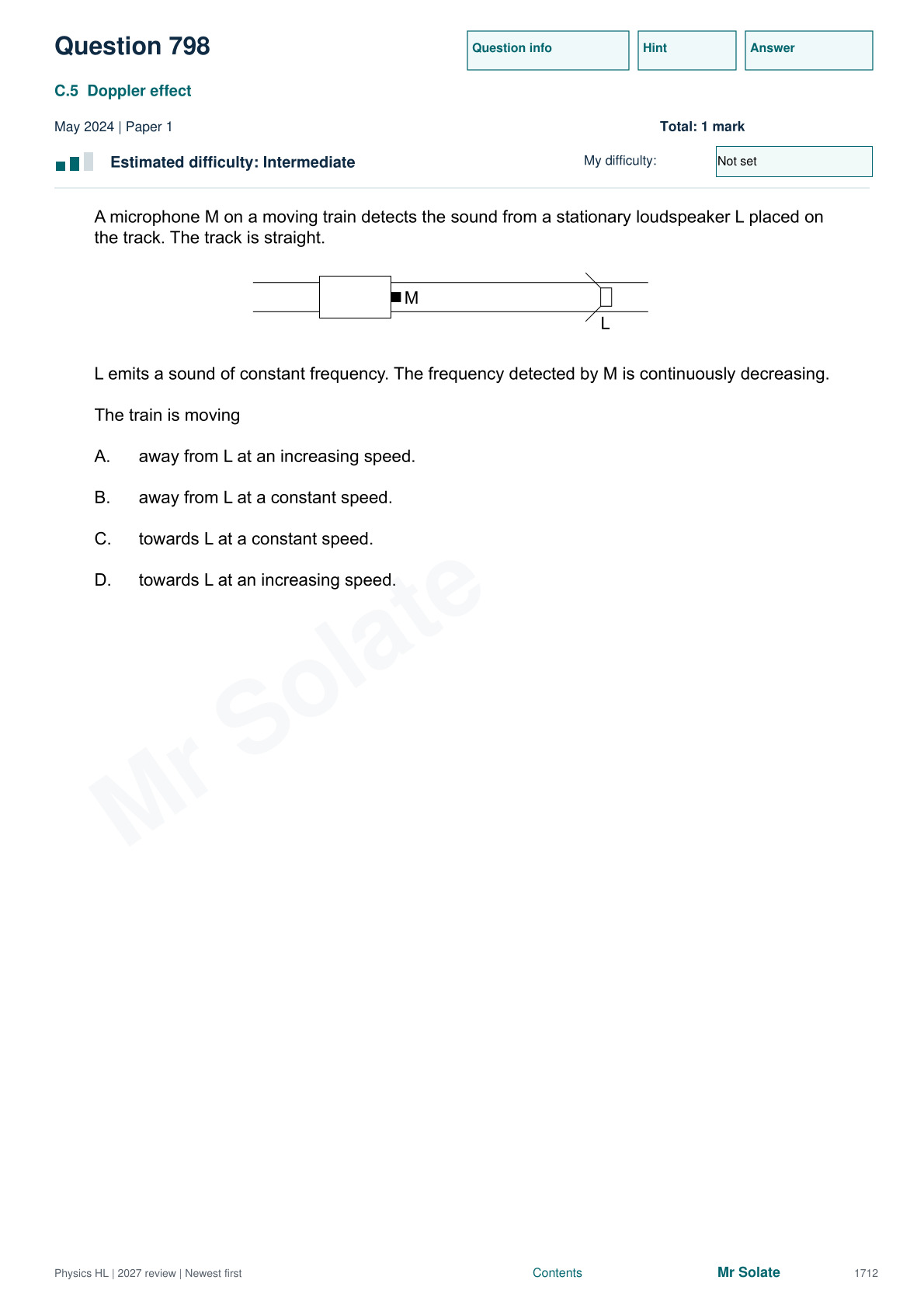
Question 798
Infers changing observer motion from a continuously falling received frequency.
Compatibility: Current syllabus: Infers changing observer motion from a continuously falling received frequency.
View the original question
Original page images preserve the equations and diagrams. Write your response before revealing the reasoning.
Reveal the revision reasoning
Moving away faster progressively lowers the detected frequency. Thus the train recedes from the loudspeaker with increasing speed.
Editorial revision reasoning. Check the original answer for its marking detail.
All 24 questions in this topic
Close your notes first
Can you retrieve the method?
1. What changes ahead of a moving sound source in still air?
Check answer 1
Wavefront spacing and detected frequency, while sound speed in the air remains the same.
2. Does a redshift identify the full three-dimensional velocity?
Check answer 2
No; the simple Doppler calculation gives the radial component.
3. Why does a moving reflector give two shifts?
Check answer 3
It receives as a moving observer and returns the wave as a moving source.
Before you move on
- Predict higher or lower frequency before inserting signs.
- State the reference frame, radial direction and approximation used.
Your revision note
Record one missed cue, one corrected step and one question to retry. Saved only in this browser.