Start with the exam
What you need to be able to do
Gas-law questions combine macroscopic measurements with microscopic explanations. Decide whether the gas amount is fixed and whether temperature, volume or pressure stays constant. Use kelvin before taking ratios. Pressure can be explained through molecular momentum transfer, while average translational kinetic energy depends on temperature. Equal masses of different gases generally contain different numbers of particles, so the word “equal” must be attached to the correct quantity: mass, moles, particle number, volume or temperature. Before a numerical calculation, write which quantities are controlled. A sealed rigid container fixes both particle number and volume; an open heated container can lose particles, so the same temperature increase does not justify the same pressure change. This distinction is often the entire explanation mark.
Spend 3 minutes reading the overview and diagram, 7 minutes learning the question patterns, 5 minutes writing out the worked example, and 5 minutes on a bank question or recall check. Take longer when you need to; the full bank is here for later practice.
Recognise → set up → write
How the questions are set
Use the gas law with a controlled amount
Recognise it: Two states, joined containers, gas density or a pressure–temperature graph is given.
- Write pV = nRT or pV = NkBT. Choose moles or particle number consistently; use N = nNA if conversion is needed.
- For fixed amount, compare pV/T between states. For joined containers, conserve total gas amount and account for each initial temperature rather than simply averaging pressures.
- Read absolute pressure and absolute temperature. If an atmosphere acts on a piston or liquid column, the gas pressure may include atmospheric pressure plus a pressure difference.
For the same trapped sample, p₁V₁/T₁ = p₂V₂/T₂, with both temperatures in kelvin.
Equal gas masses do not imply equal n; n = mass/molar mass.
Turn a linear graph into a physical constant
Recognise it: Pressure is plotted against temperature, reciprocal volume or another transformed axis.
- Rewrite the physical equation in the form y = mx + c using exactly the plotted variables. For p against 1/V at fixed temperature and amount, the gradient is nRT.
- Read scale factors on both axes and convert before calculating the gradient’s units. Use two well-separated points on the fitted line, not necessarily raw data points.
- Explain the intercept or a changed gradient physically. A nonzero Celsius-temperature intercept can be expected, whereas an unexpected offset in a kelvin model can indicate a systematic effect or model limitation.
Since p = (nR/V)T, the p–T gradient is nR/V for fixed gas amount and volume.
The gradient is determined by which variable is vertical; inverting the plotted relationship inverts the relevant coefficient.
Explain pressure and internal energy microscopically
Recognise it: A compression, equal-temperature comparison or kinetic-theory derivation is requested.
- Pressure results from repeated molecular collisions with the walls and their rate of momentum transfer. In the ideal model, wall collisions are elastic.
- At equal temperature, average translational kinetic energy is the same for different gases, but typical molecular speeds differ because ½m〈v²〉 = 3kBT/2. Lighter molecules have larger rms speeds.
- For a monatomic ideal gas, U = 3nRT/2. Rapid compression with negligible heat transfer does work on the gas, increasing internal energy and temperature; volume change alone does not fix U without a temperature condition.
Compression does work on the gas; with negligible heat loss, its internal energy and mean molecular kinetic energy increase.
An ideal gas has no intermolecular potential-energy contribution in this model, but its molecules still carry kinetic energy.
Write it before you reveal it
A worked exam-style example
Original teaching example, created for this lesson.
A fixed sample of gas occupies 2.0 × 10⁻³ m³ at 100 kPa and 300 K. It is compressed to 1.5 × 10⁻³ m³ and warmed to 360 K. Find the final pressure.
Reveal the worked solution
- Use fixed-amount state comparison: p₂ = p₁(V₁/V₂)(T₂/T₁).
- The volume factor is 2.0/1.5 = 4/3; the temperature factor is 360/300 = 1.2.
- Therefore p₂ = 100 × (4/3) × 1.2 = 160 kPa.
Answer: Final pressure 160 kPa.
Check: Both compression and warming increase pressure. Their combined factor is 1.60, consistent with the result.
From your own collection
Apply it to past-paper questions
These questions anchor the patterns above. Attempt one without the answer, then compare your setup and conclusion with the reasoning. The linked reader contains the source answer and the question-specific syllabus review.
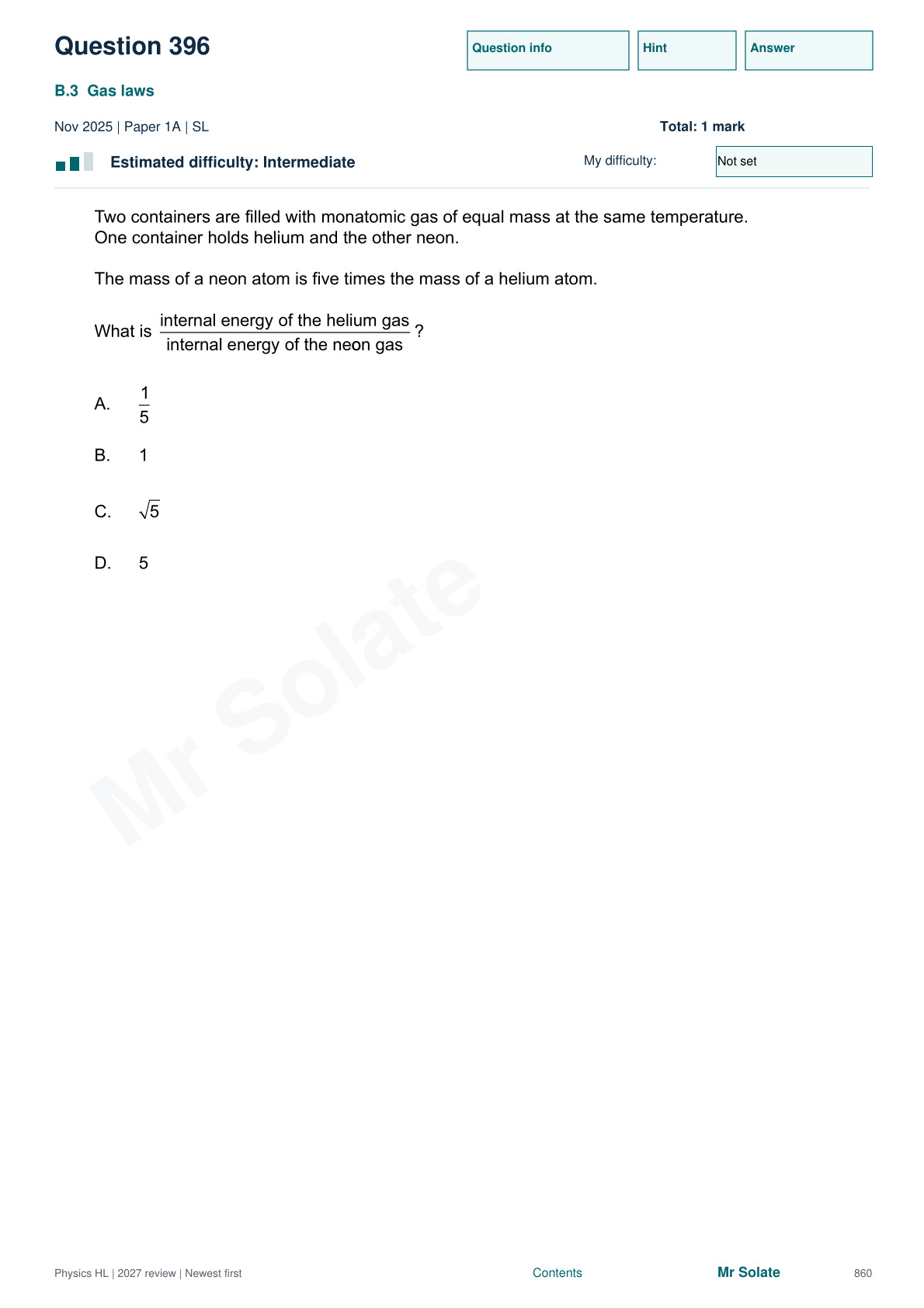
Question 396
Equal gas masses contain different particle numbers.
Compatibility: This is an SL source question testing concepts shared with the current Physics HL syllabus. Equal gas masses contain different particle numbers.
View the original question
Original page images preserve the equations and diagrams. Write your response before revealing the reasoning.
Reveal the revision reasoning
Internal energy is 3NkT/2. For equal total masses, helium has five times as many atoms because each atom has one fifth the mass. Its internal energy is therefore five times that of the neon gas.
Editorial revision reasoning. Check the original answer for its marking detail.
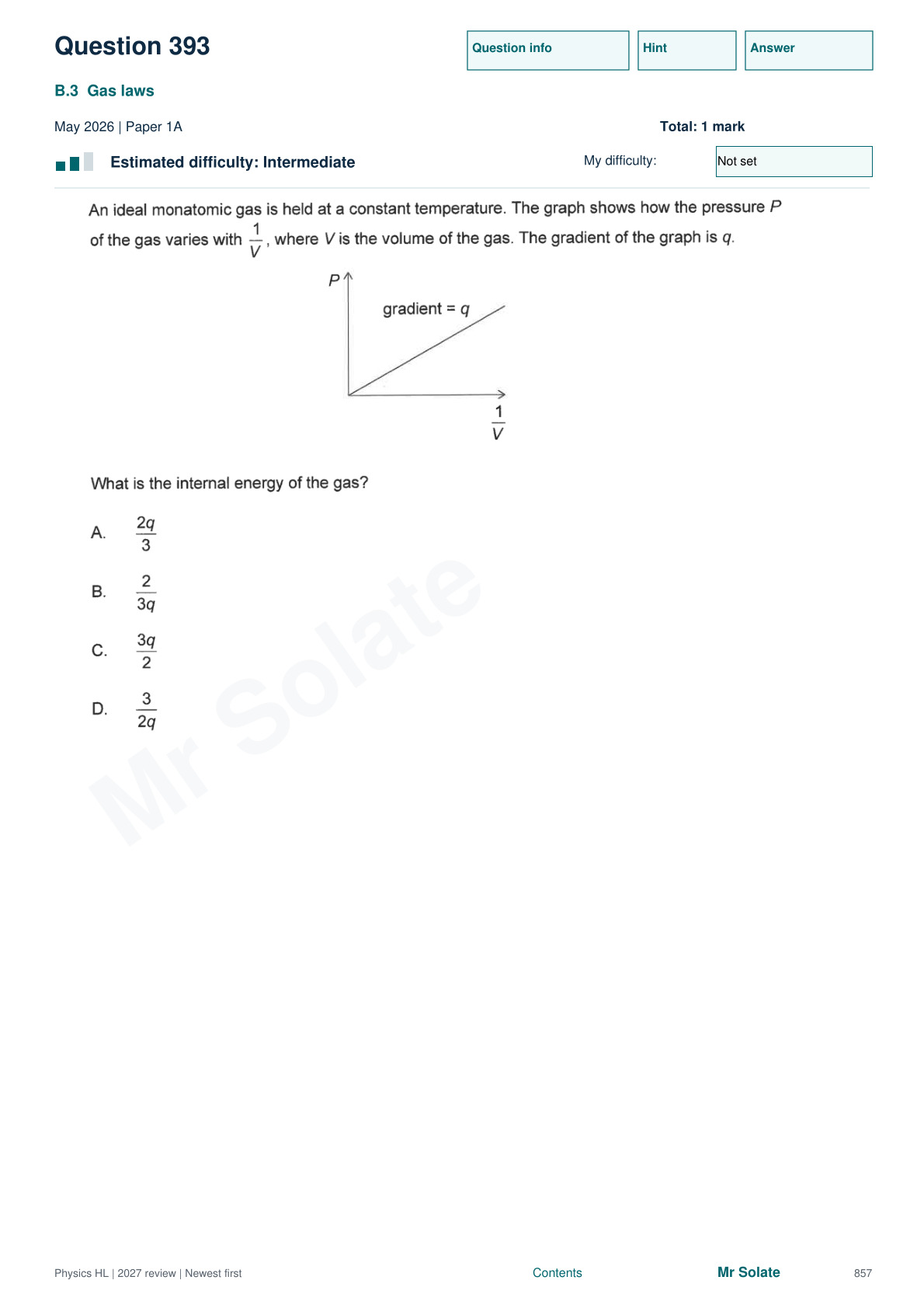
Question 393
Connects a reciprocal-volume gradient to monatomic internal energy.
Compatibility: Current syllabus: Connects a reciprocal-volume gradient to monatomic internal energy.
View the original question
Original page images preserve the equations and diagrams. Write your response before revealing the reasoning.
Reveal the revision reasoning
P=(nRT)/V, so q=nRT. Monatomic internal energy U=3nRT/2=3q/2.
Editorial revision reasoning. Check the original answer for its marking detail.
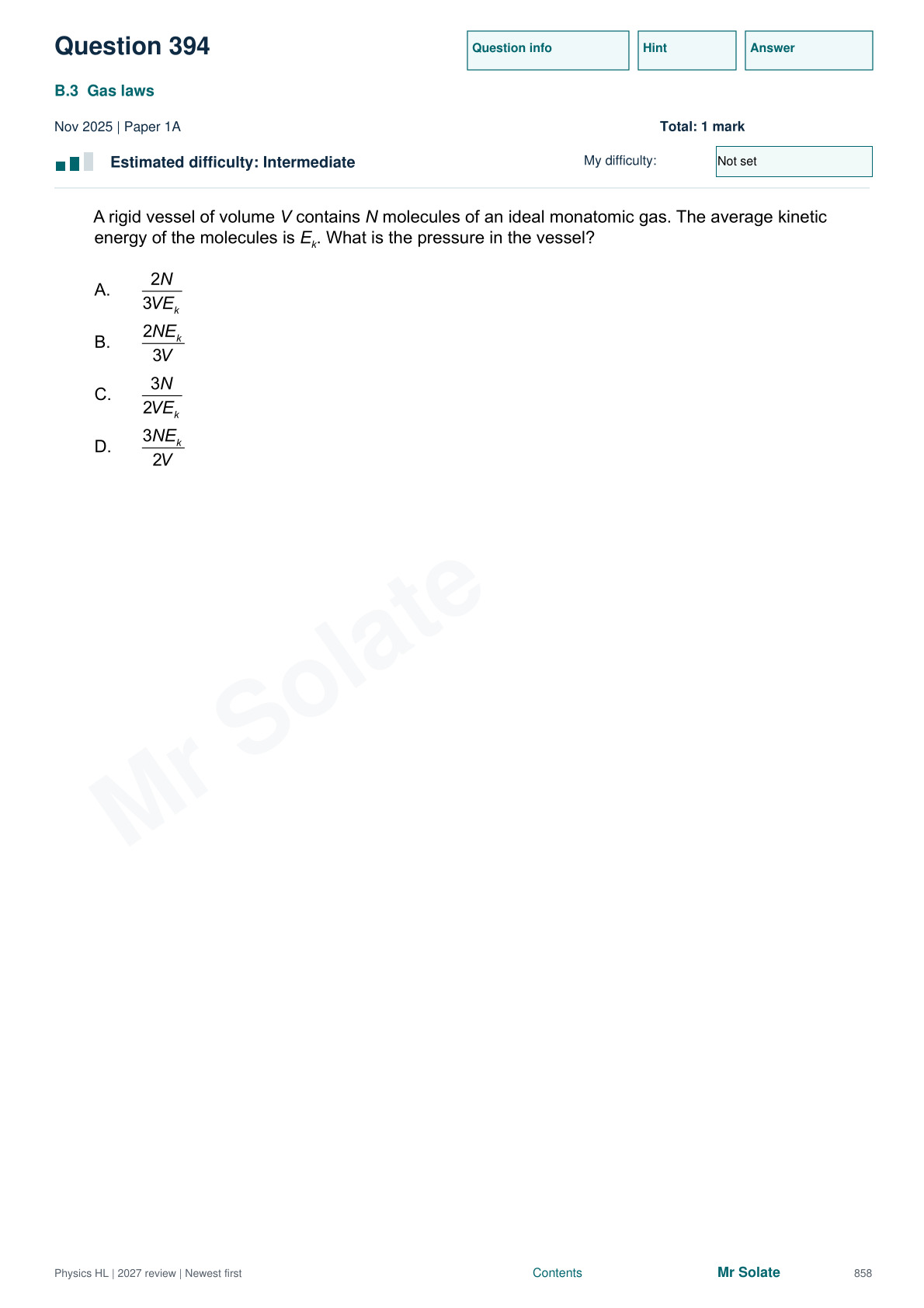
Question 394
Connects kinetic theory pressure with molecular kinetic energy.
Compatibility: Current syllabus: Connects kinetic theory pressure with molecular kinetic energy.
View the original question
Original page images preserve the equations and diagrams. Write your response before revealing the reasoning.
Reveal the revision reasoning
pV=Nm⟨v²⟩/3 and E_k=m⟨v²⟩/2, hence p=2NE_k/(3V).
Editorial revision reasoning. Check the original answer for its marking detail.
All 44 questions in this topic
Close your notes first
Can you retrieve the method?
1. What is equal for different ideal gases at the same temperature?
Check answer 1
Mean translational kinetic energy per molecule.
2. What temperature belongs in pV/T?
Check answer 2
Absolute temperature in kelvin.
3. What microscopic process produces gas pressure?
Check answer 3
Molecular momentum transfer to the walls during collisions.
Before you move on
- Circle whether gas amount is fixed, leaking or shared between containers.
- For every graph, write the rearranged gas law immediately below the axis labels.
Your revision note
Record one missed cue, one corrected step and one question to retry. Saved only in this browser.