Start with the exam
What you need to be able to do
Standing-wave questions are best started with the boundary conditions. A fixed string end is a displacement node. A closed pipe end is also a displacement node, while an open pipe end is approximately a displacement antinode. Pressure patterns in air are the reverse, so name the variable being sketched. Resonance questions ask how a driven system responds when driving frequency approaches its natural frequency, and how damping changes the response curve and energy loss.
Spend 3 minutes reading the overview and diagram, 7 minutes learning the question patterns, 5 minutes writing out the worked example, and 5 minutes on a bank question or recall check. Take longer when you need to; the full bank is here for later practice.
Recognise → set up → write
How the questions are set
Fit allowed modes to the boundaries
Recognise it: A string, open pipe, closed–open pipe or harmonic number is supplied.
- Mark the displacement condition at both ends before drawing the mode. Adjacent nodes are λ/2 apart; a node to its nearest antinode is λ/4.
- For fixed–fixed strings or open–open pipes, L = nλ/2 and fₙ = nv/(2L). For an ideal closed–open pipe, L = (2n − 1)λ/4, allowing odd multiples of its fundamental.
- Count intervals, not just visible bulges. If a water surface closes one end of an air column, the air column has closed–open boundary conditions even if the physical tube originally had two open ends.
The closed end is a displacement node and the open end an antinode, so the fundamental has L = λ/4.
The third allowed mode of a closed–open pipe is its fifth harmonic, not its third harmonic.
Explain formation, phase and imperfect nodes
Recognise it: Two snapshots, a detector scan or incident/reflected waves are shown.
- Describe superposition of waves of the same frequency travelling in opposite directions. In the ideal equal-amplitude case, nodes remain stationary with zero displacement amplitude.
- Particles between the same neighbouring pair of nodes oscillate in phase. Particles in adjacent loops oscillate in antiphase. A snapshot at zero displacement does not mean zero amplitude everywhere.
- Unequal incident and reflected amplitudes produce minima that are not zero, so avoid calling them perfect nodes. Use the observed spacing of minima or maxima to determine half a wavelength.
Adjacent loops oscillate in antiphase, while all points within one loop reach their positive extremes together.
Every point passing through equilibrium at one instant is not a node; a node stays at zero displacement.
Read damping and resonance as energy behaviour
Recognise it: A resonance peak, decaying envelope or repeated driving force is given.
- Locate the driving frequency at maximum response and compare it with the natural frequency using the stated damping model. Stronger damping lowers and broadens the displacement-amplitude peak.
- A free damped oscillator loses mechanical energy to surroundings. If stiffness stays fixed, energy is proportional to amplitude squared, so an amplitude ratio is not an energy ratio.
- Connect resonance to repeated energy transfer with favourable timing. In a practical situation, changing a repeated loading frequency or increasing damping can reduce the response; explain which part of the curve changes.
Increasing damping removes more energy per cycle, reducing the peak amplitude and making the resonance response broader.
A lower amplitude alone does not imply a different oscillation frequency; inspect period separately.
Write it before you reveal it
A worked exam-style example
Original teaching example, created for this lesson.
An air column is closed at one end and has length 0.85 m. Use sound speed 340 m s⁻¹ and ignore end correction. Find its first three allowed resonant frequencies.
Reveal the worked solution
- For the fundamental, λ₁ = 4L = 3.40 m, so f₁ = 340/3.40 = 100 Hz.
- A closed–open column supports odd harmonics: f = f₁, 3f₁, 5f₁, …
- Therefore the first three allowed frequencies are 100, 300 and 500 Hz.
Answer: 100 Hz, 300 Hz and 500 Hz.
Check: The corresponding lengths contain 1, 3 and 5 quarter-wavelengths, each starting at a node and ending at an antinode.
From your own collection
Apply it to past-paper questions
These questions anchor the patterns above. Attempt one without the answer, then compare your setup and conclusion with the reasoning. The linked reader contains the source answer and the question-specific syllabus review.
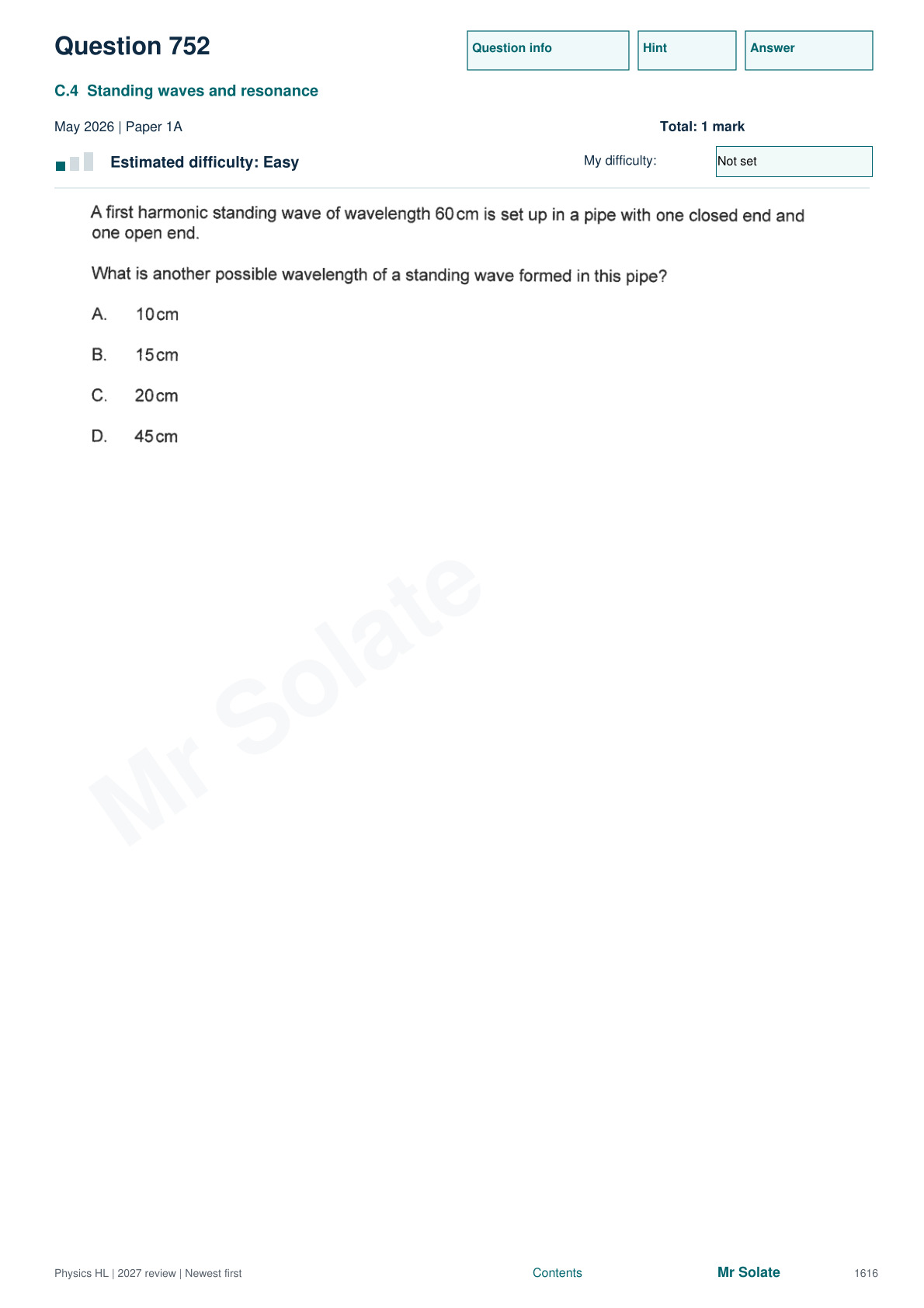
Question 752
Uses odd harmonics for a closed-open pipe.
Compatibility: Current syllabus: Uses odd harmonics for a closed-open pipe.
View the original question
Original page images preserve the equations and diagrams. Write your response before revealing the reasoning.
Reveal the revision reasoning
Allowed wavelengths are 60/n cm for odd n. The third harmonic therefore has wavelength 20 cm.
Editorial revision reasoning. Check the original answer for its marking detail.
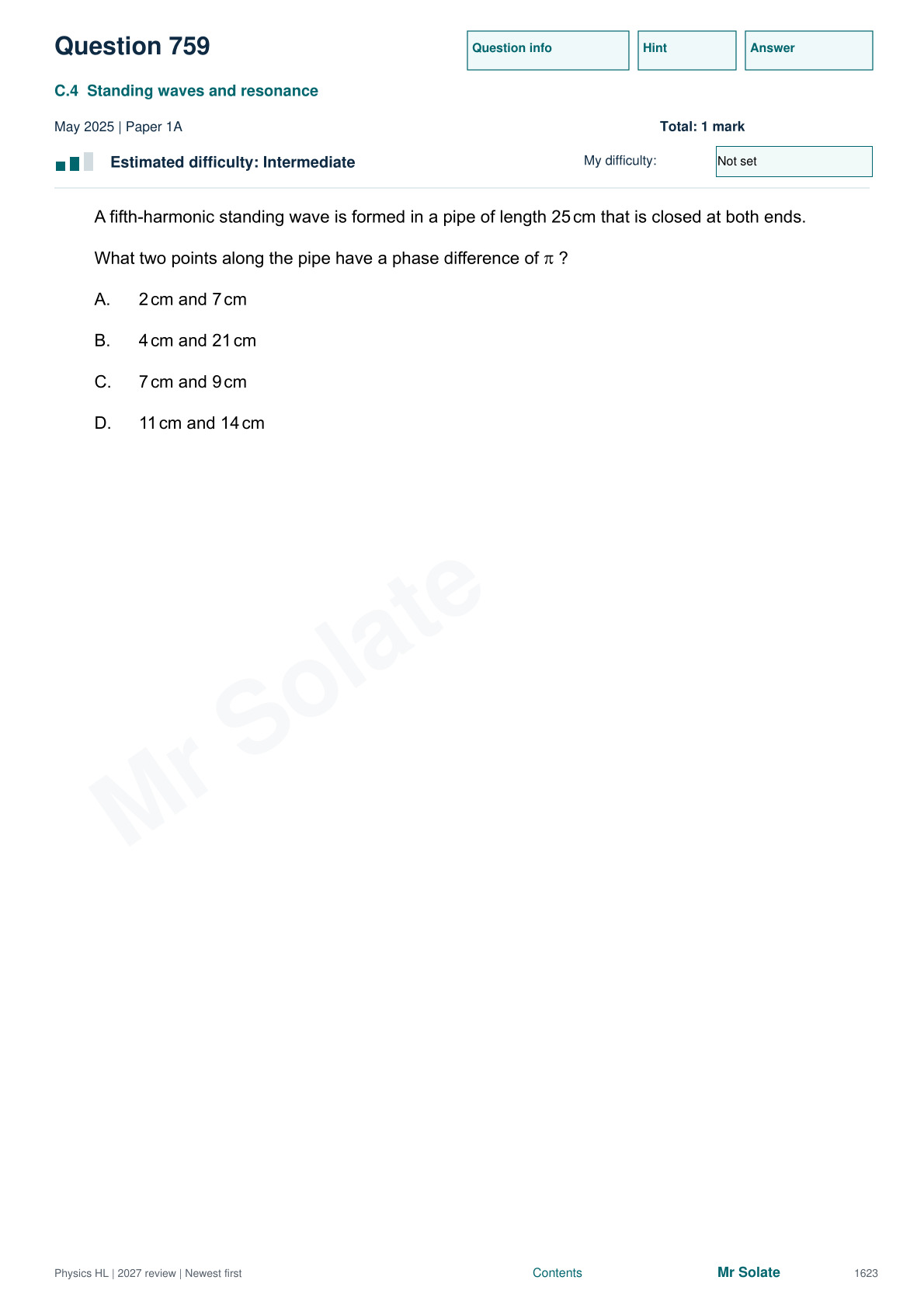
Question 759
Uses adjacent standing-wave loops to infer phase.
Compatibility: Current syllabus: Uses adjacent standing-wave loops to infer phase.
View the original question
Original page images preserve the equations and diagrams. Write your response before revealing the reasoning.
Reveal the revision reasoning
In the fifth harmonic of a25 cm closed-closed pipe, nodes are5 cm apart. Positions2 and 7 cm lie in adjacent loops and differ byπ.
Editorial revision reasoning. Check the original answer for its marking detail.
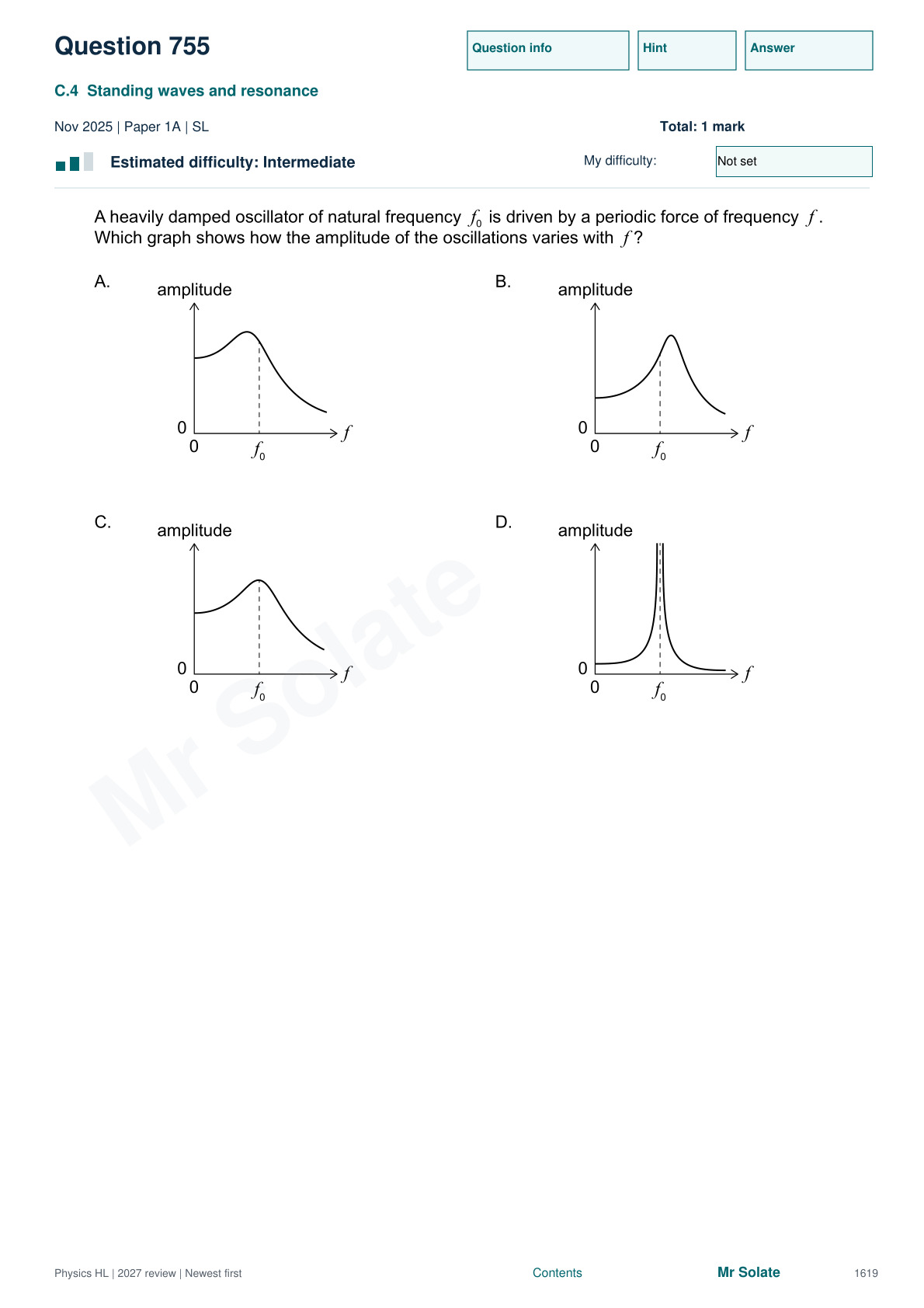
Question 755
Reads both broadening and frequency shift in a damped resonance graph.
Compatibility: This is an SL source question testing concepts shared with the current Physics HL syllabus. Reads both broadening and frequency shift in a damped resonance graph.
View the original question
Original page images preserve the equations and diagrams. Write your response before revealing the reasoning.
Reveal the revision reasoning
Select the broad response with its maximum below the undamped natural frequency f0, graph A. A narrow tall peak describes weak damping; a peak above f0 has the wrong direction of shift for the displacement response.
Editorial revision reasoning. Check the original answer for its marking detail.
All 41 questions in this topic
Close your notes first
Can you retrieve the method?
1. What is the spacing between neighbouring displacement nodes?
Check answer 1
λ/2.
2. How do particles in adjacent standing-wave loops compare in phase?
Check answer 2
They are in antiphase.
3. If amplitude falls to 80%, what fraction of energy remains?
Check answer 3
0.80² = 0.64, assuming unchanged oscillator parameters.
Before you move on
- Write “displacement” or “pressure” on an air-column sketch.
- Draw the boundary conditions before assigning a harmonic number.
Your revision note
Record one missed cue, one corrected step and one question to retry. Saved only in this browser.