Start with the exam
What you need to be able to do
Circuit questions frequently redraw familiar series and parallel connections into unfamiliar shapes. Follow conducting nodes rather than the appearance of the drawing. Ideal wires joining two points make them one node. Parallel components share potential difference; series components share current when no junction lies between them. For real cells, distinguish emf from terminal voltage: increasing total current increases internal voltage loss. A changed load can therefore alter the voltage across another branch even if that branch’s own resistance is unchanged.
Spend 3 minutes reading the overview and diagram, 7 minutes learning the question patterns, 5 minutes writing out the worked example, and 5 minutes on a bank question or recall check. Take longer when you need to; the full bank is here for later practice.
Recognise → set up → write
How the questions are set
Reduce the network by nodes, then recover currents
Recognise it: Several resistors, hidden parallel connections or an added branch appear.
- Mark nodes with the same potential and redraw the network simply. Combine only genuinely series or parallel elements, using Rseries = ΣR and 1/Rparallel = Σ(1/R).
- Find total current from the complete external resistance and source model. Then work backwards to find branch voltages and currents, applying junction conservation.
- For power, choose the expression matching known quantities: IV, I²R or V²/R. At fixed voltage a smaller resistance dissipates more power; at fixed current a larger resistance does.
These resistors connect to the same two nodes, so they have the same potential difference and their currents add at the junction.
Equal-looking branches do not imply equal currents when their resistances differ.
Include internal resistance and operating conditions
Recognise it: Emf, terminal voltage, a V–I graph, non-ohmic lamp or a potentiometer is supplied.
- Use Vterminal = ε − Ir for a discharging cell, where I is total cell current. A graph of terminal voltage against current has intercept ε and gradient −r.
- If a parallel load is added, recompute total current and terminal voltage before claiming an existing branch stays unchanged. For a non-ohmic device, use its characteristic rather than treating resistance as constant at every operating point.
- A null potentiometer measures emf without drawing current from the tested cell in the ideal model. A loaded voltmeter measurement can differ because internal resistance causes a drop.
The increased total current produces a larger Ir loss, reducing the terminal voltage available to the external circuit.
The current in Ir is the cell’s total current, not one branch current.
Connect wire geometry, heating and uncertainty
Recognise it: A reshaped wire, resistivity measurement, diameter data or thermal load is given.
- Use R = ρL/A with the cross-sectional area carrying current. For a cylindrical wire, A = πd²/4; this is different from the lateral surface area that loses heat.
- If volume is conserved while length changes, area changes inversely with length, so resistance can scale as L². Do not hold diameter constant while also claiming fixed volume.
- In a derived resistivity, track uncertainties through products and powers. Diameter uncertainty contributes twice its fractional value to area. Inspect anomalous measurements before averaging and explain how heating changes resistance when relevant.
Since the wire volume AL is constant, A ∝ 1/L and R = ρL/A ∝ L² for unchanged resistivity.
Milliamperes on a graph must be converted before reading a slope in ohms.
Write it before you reveal it
A worked exam-style example
Original teaching example, created for this lesson.
A cell of emf 12.0 V and internal resistance 1.0 Ω powers 6.0 Ω and 3.0 Ω resistors in parallel. Find total current, terminal voltage and the current in the 6.0 Ω branch.
Reveal the worked solution
- External resistance is (1/6 + 1/3)⁻¹ = 2.0 Ω. Including the cell gives 3.0 Ω total.
- Total current is 12.0/3.0 = 4.0 A. Terminal voltage is 12.0 − 4.0 × 1.0 = 8.0 V.
- The 6.0 Ω branch current is 8.0/6.0 = 1.33 A; the other branch carries 2.67 A.
Answer: Total current 4.0 A; terminal voltage 8.0 V; 6.0 Ω branch current 1.33 A.
Check: Branch currents sum to 4.0 A. External power 32 W plus internal heating 16 W equals source power εI = 48 W.
From your own collection
Apply it to past-paper questions
These questions anchor the patterns above. Attempt one without the answer, then compare your setup and conclusion with the reasoning. The linked reader contains the source answer and the question-specific syllabus review.
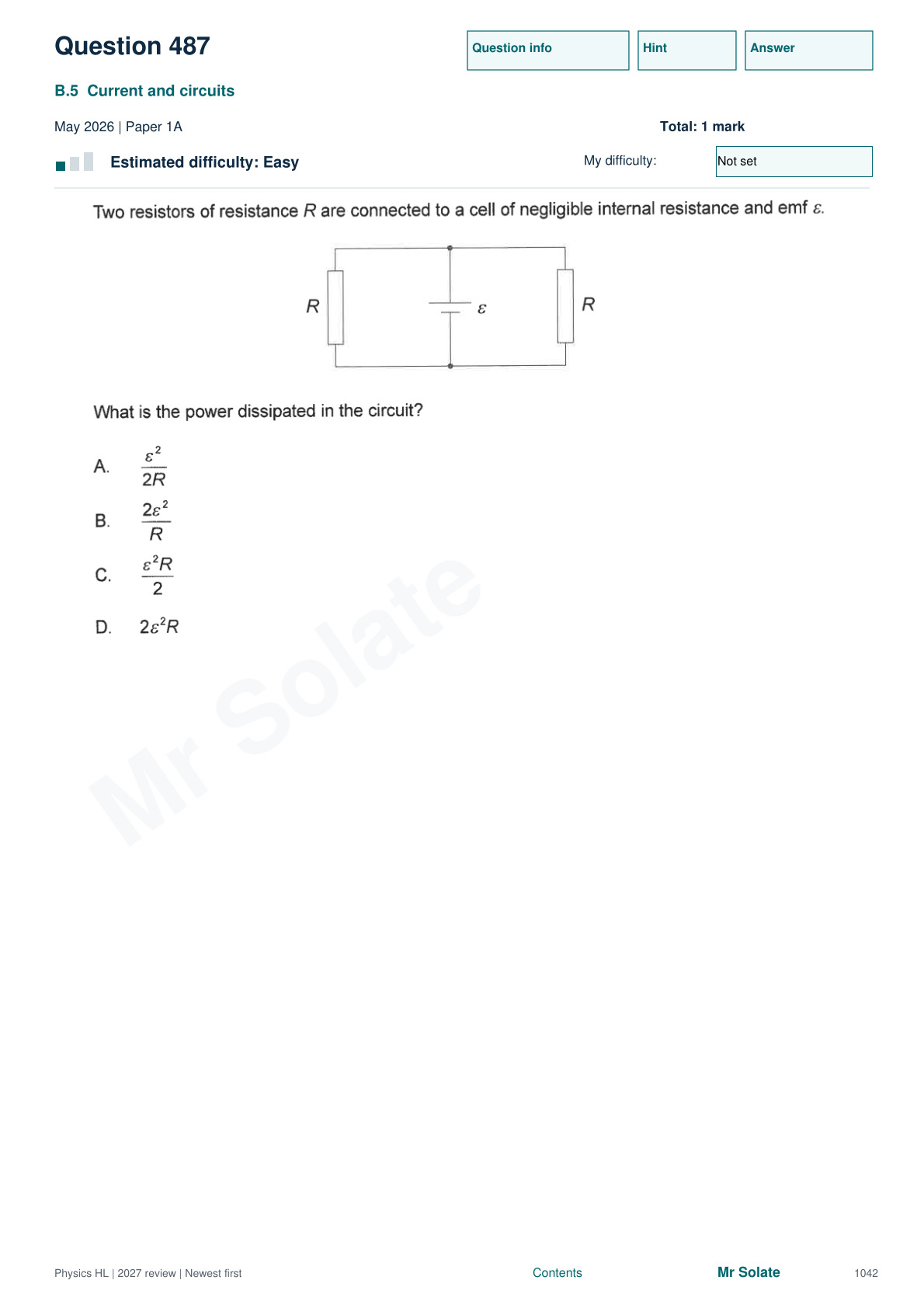
Question 487
Recognizes two parallel resistor branches.
Compatibility: Current syllabus: Recognizes two parallel resistor branches.
View the original question
Original page images preserve the equations and diagrams. Write your response before revealing the reasoning.
Reveal the revision reasoning
Both resistors have potential difference ε, each dissipating ε²/R. Total power is 2ε²/R.
Editorial revision reasoning. Check the original answer for its marking detail.
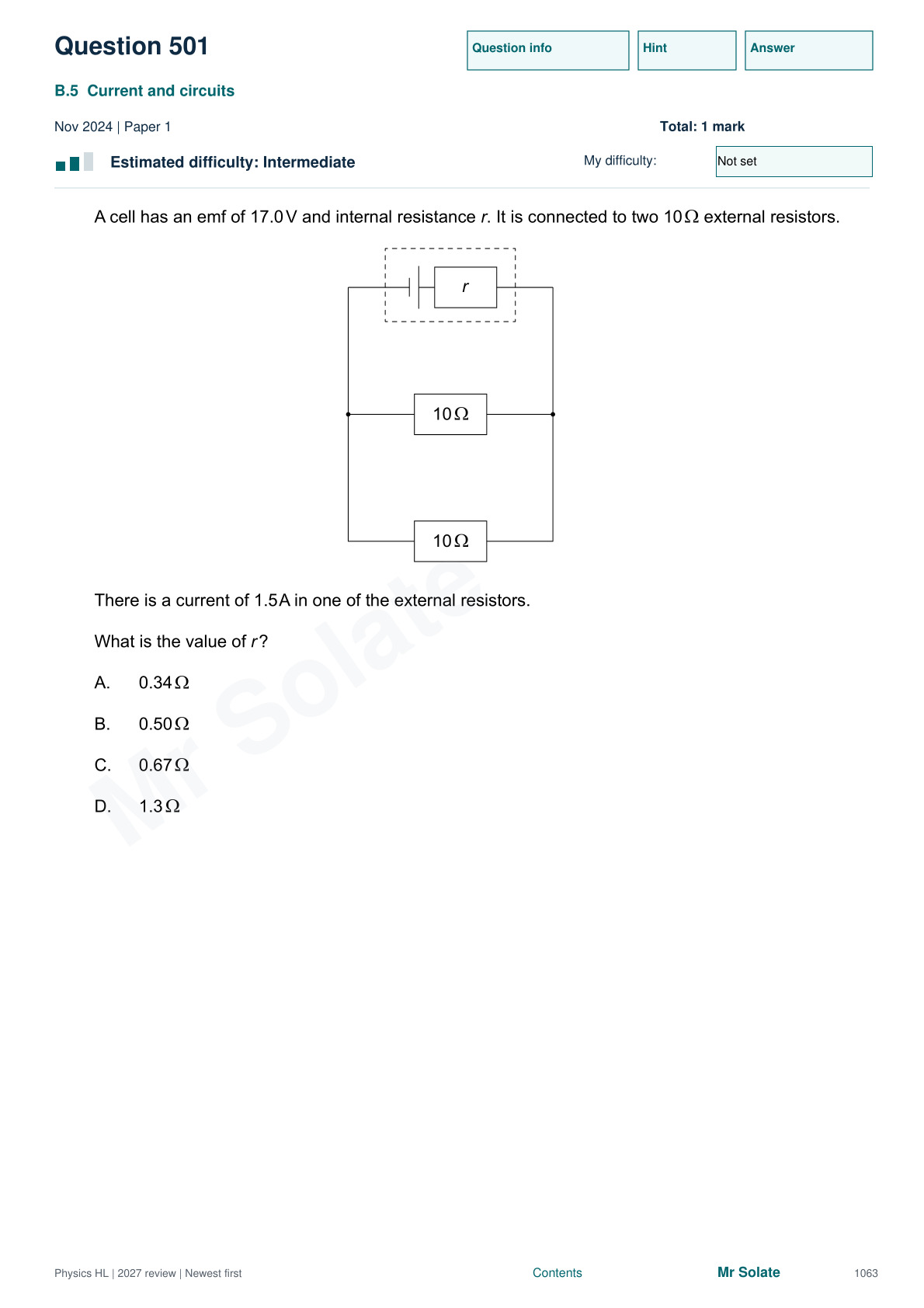
Question 501
Uses branch current to find terminal voltage and total current.
Compatibility: Current syllabus: Uses branch current to find terminal voltage and total current.
View the original question
Original page images preserve the equations and diagrams. Write your response before revealing the reasoning.
Reveal the revision reasoning
Each has 15 V across it. The cell's lost voltage is 17−15=2 V and total current is 3 A, so r=2/3≈0.67 Ω.
Editorial revision reasoning. Check the original answer for its marking detail.
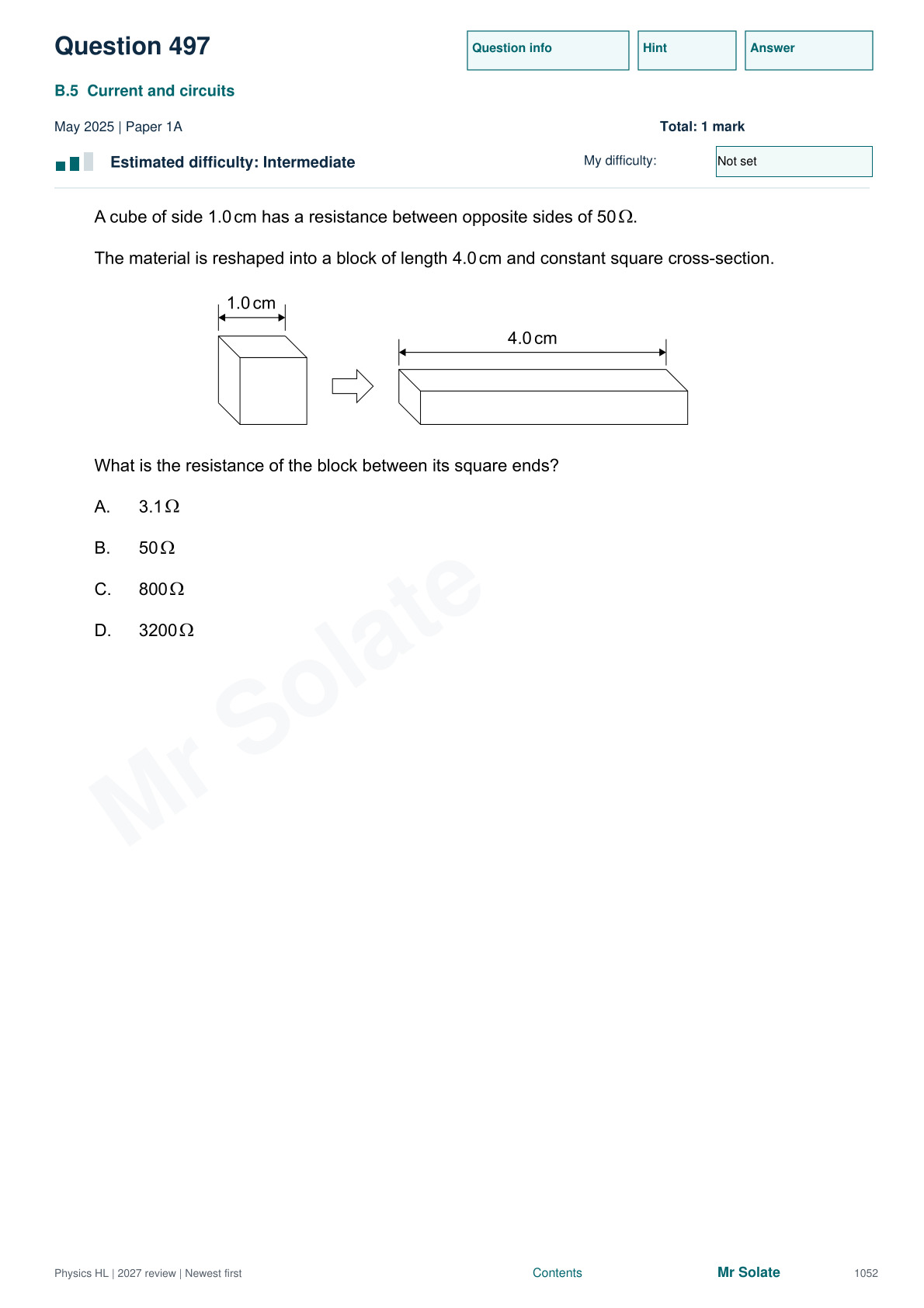
Question 497
Uses volume conservation while reshaping a conductor.
Compatibility: Current syllabus: Uses volume conservation while reshaping a conductor.
View the original question
Original page images preserve the equations and diagrams. Write your response before revealing the reasoning.
Reveal the revision reasoning
Four times the length leaves one quarter of the area. R=ρL/A therefore increases16-fold, from 50 Ω to 800 Ω.
Editorial revision reasoning. Check the original answer for its marking detail.
All 69 questions in this topic
Close your notes first
Can you retrieve the method?
1. What must parallel resistors share?
Check answer 1
The same two nodes and therefore the same potential difference.
2. What is the gradient of terminal voltage versus current?
Check answer 2
−r for the simple discharging-cell model.
3. Why does wire diameter uncertainty count twice in area?
Check answer 3
Cross-sectional area is proportional to diameter squared.
Before you move on
- Label nodes and currents before reducing a complex-looking circuit.
- For each power comparison, state whether current or voltage is held fixed.
Your revision note
Record one missed cue, one corrected step and one question to retry. Saved only in this browser.