Start with the exam
What you need to be able to do
Wave-model questions often place two similar-looking graphs side by side: displacement against position and displacement against time. The first gives wavelength; the second gives period. They are not interchangeable snapshots. The disturbance travels while particles oscillate locally, so particle velocity and wave speed describe different motions. For an electromagnetic wave, the electric field, magnetic field and propagation direction are mutually perpendicular; for a mechanical transverse wave, displacement is perpendicular to propagation.
Spend 3 minutes reading the overview and diagram, 7 minutes learning the question patterns, 5 minutes writing out the worked example, and 5 minutes on a bank question or recall check. Take longer when you need to; the full bank is here for later practice.
Recognise → set up → write
How the questions are set
Extract wavelength, period and speed from axes
Recognise it: Two wave graphs, an oscilloscope trace or a sinusoidal profile is given.
- Read the horizontal-axis label before measuring any spacing. On a position graph, the distance between equivalent points is λ; on a time graph, it is T.
- Convert milliseconds, centimetres or other scaled units before using f = 1/T and v = fλ. Amplitude is measured vertically from equilibrium.
- Use more than one cycle when the graph allows it, then divide by the number of cycles to reduce reading uncertainty. A constant vertical offset changes the equilibrium reference, not the wavelength.
The position graph gives λ, while the time graph gives T, so wave speed is λ/T.
Distance between adjacent zero crossings is usually λ/2, not a full wavelength.
Infer particle motion from a travelling profile
Recognise it: A propagation arrow and a displacement snapshot are shown.
- Imagine the entire profile shifted a small distance in the stated propagation direction. Compare the new displacement at the same fixed particle position.
- For a wave travelling in +x, local particle velocity has the opposite sign to the spatial slope: ∂y/∂t = −v∂y/∂x. For propagation in −x, the signs match.
- At a crest or trough, instantaneous particle velocity is zero, though particle acceleration is generally nonzero. At a zero crossing, particle speed is greatest for a sinusoidal wave.
As the profile moves right, the displacement at this fixed position decreases, so the particle is moving downward at that instant.
A particle on the medium does not travel horizontally with the wave profile in the transverse-wave model.
Link the wave model to particle SHM and energy
Recognise it: Particle acceleration, intensity, wave type or electromagnetic directions are requested.
- For a sinusoidal travelling wave, each particle executes SHM about its equilibrium position. Use a = −ω²y and maximum particle speed ωA, not the propagation speed fλ.
- Intensity is energy transferred per unit area per unit time. In a fixed medium for comparable sinusoidal waves, intensity scales with amplitude squared; specify unchanged conditions when using that ratio.
- For an electromagnetic wave, draw E and B perpendicular to each other and to propagation. For longitudinal mechanical waves, distinguish particle displacement from the locations of compressions and rarefactions.
The particle’s maximum oscillation speed is ωA, whereas the disturbance propagates at fλ.
A larger amplitude does not automatically mean a larger propagation speed in the same linear medium.
Write it before you reveal it
A worked exam-style example
Original teaching example, created for this lesson.
A sinusoidal wave snapshot shows crest spacing 0.80 m. At a fixed position, successive crests arrive 0.20 s apart. The amplitude is 0.030 m. Find wave speed and maximum particle speed.
Reveal the worked solution
- The graph information gives λ = 0.80 m and T = 0.20 s, so f = 5.0 Hz.
- Wave speed is fλ = 5.0 × 0.80 = 4.0 m s⁻¹.
- Particle angular frequency is 2πf = 31.4 rad s⁻¹. Maximum particle speed is ωA = 31.4 × 0.030 = 0.94 m s⁻¹.
Answer: Wave speed 4.0 m s⁻¹; maximum particle speed 0.94 m s⁻¹.
Check: Both have speed units but describe different motions; there is no requirement that they be equal.
From your own collection
Apply it to past-paper questions
These questions anchor the patterns above. Attempt one without the answer, then compare your setup and conclusion with the reasoning. The linked reader contains the source answer and the question-specific syllabus review.
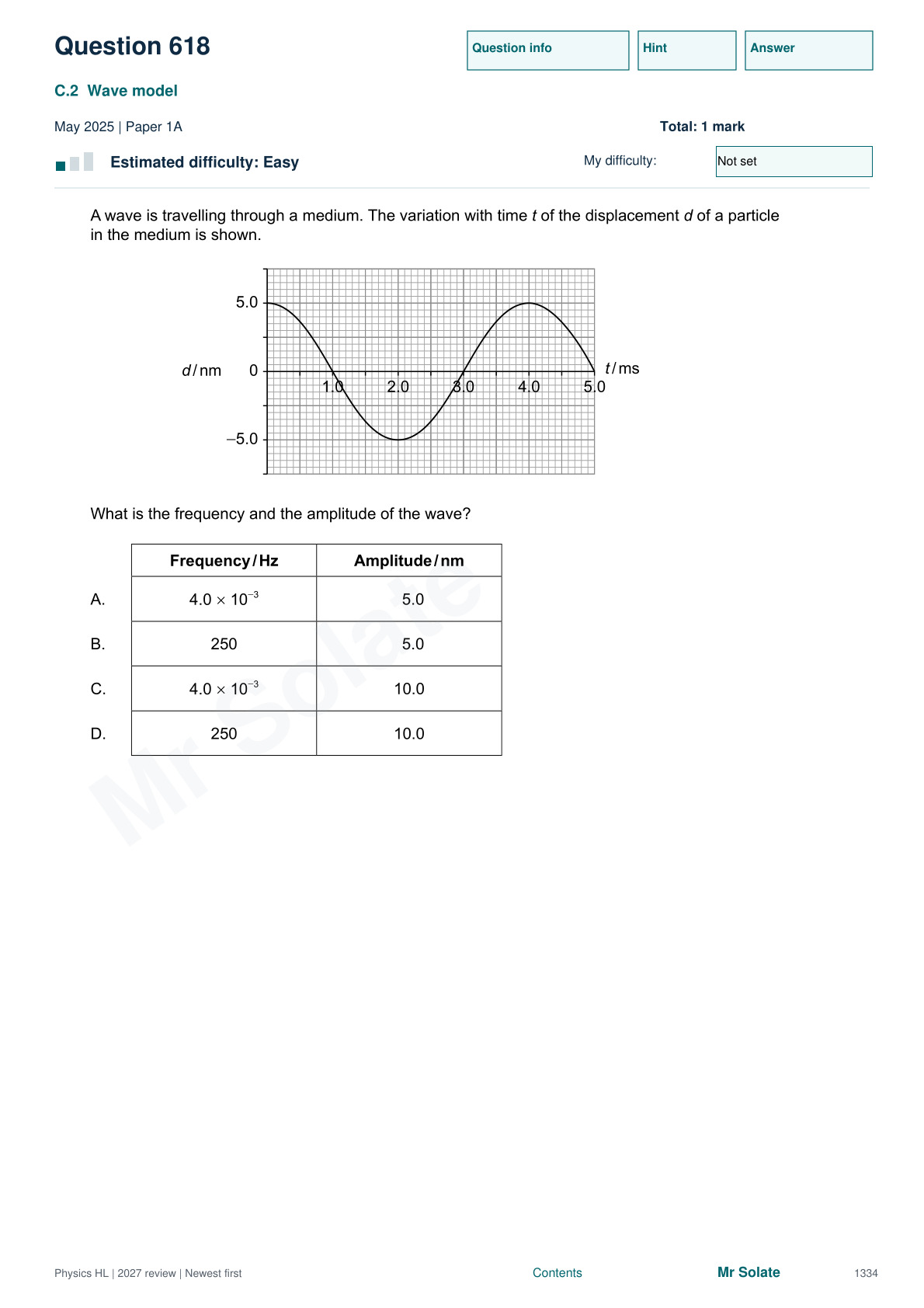
Question 618
Reads period and amplitude with millisecond conversion.
Compatibility: Current syllabus: Reads period and amplitude with millisecond conversion.
View the original question
Original page images preserve the equations and diagrams. Write your response before revealing the reasoning.
Reveal the revision reasoning
The period is 4.0 ms, giving 250 Hz. Amplitude is 5.0 nm, not10 nm.
Editorial revision reasoning. Check the original answer for its marking detail.
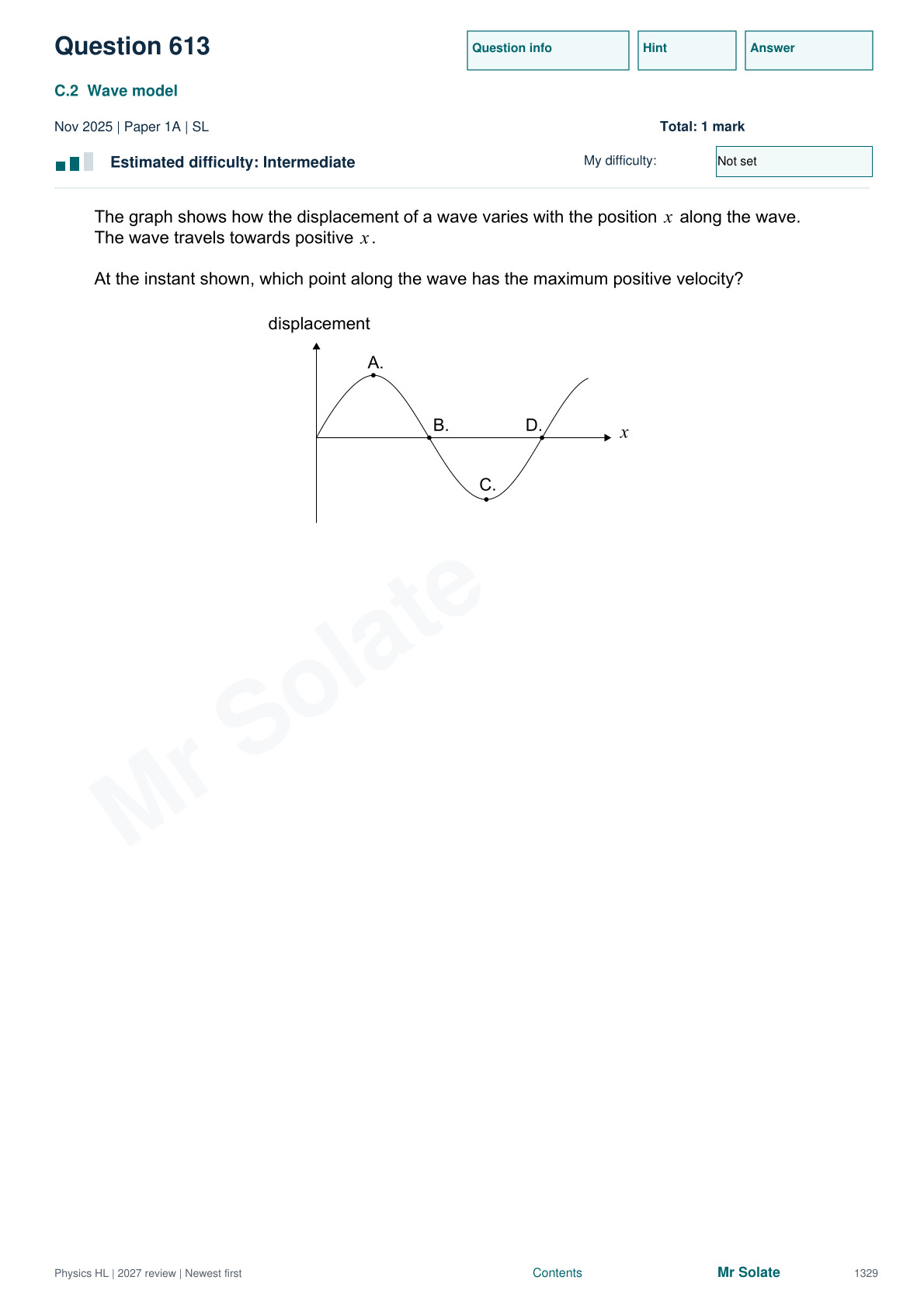
Question 613
Infers particle motion from a travelling-wave snapshot.
Compatibility: This is an SL source question testing concepts shared with the current Physics HL syllabus. Infers particle motion from a travelling-wave snapshot.
View the original question
Original page images preserve the equations and diagrams. Write your response before revealing the reasoning.
Reveal the revision reasoning
For a right-moving wave, the local displacement increases where the spatial slope is negative. The largest positive particle velocity is at the equilibrium crossing with negative slope, point B; crests and troughs have zero instantaneous particle velocity.
Editorial revision reasoning. Check the original answer for its marking detail.
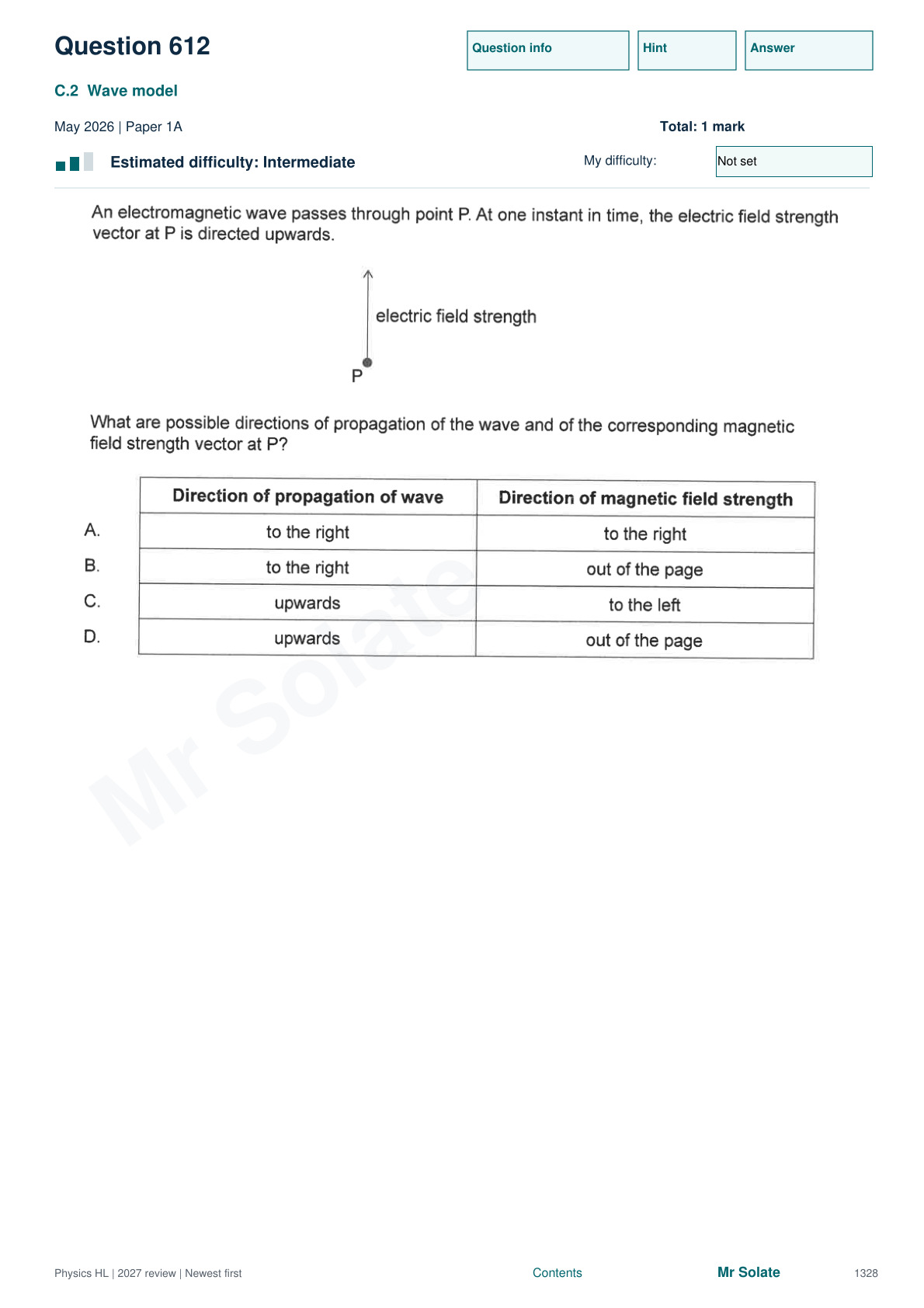
Question 612
Checks mutually perpendicular electromagnetic-wave directions.
Compatibility: Current syllabus: Checks mutually perpendicular electromagnetic-wave directions.
View the original question
Original page images preserve the equations and diagrams. Write your response before revealing the reasoning.
Reveal the revision reasoning
An upward electric field permits neither upward propagation nor an upward magnetic field. Rightward propagation with magnetic field out of the page satisfies the perpendicular directions.
Editorial revision reasoning. Check the original answer for its marking detail.
All 43 questions in this topic
Close your notes first
Can you retrieve the method?
1. Which graph gives wavelength directly?
Check answer 1
Displacement against position at a fixed time.
2. A right-moving wave has positive local spatial slope. Which way is the particle moving?
Check answer 2
Downward, because time derivative and spatial slope have opposite signs.
3. What changes when amplitude doubles in a fixed linear wave model?
Check answer 3
Intensity becomes four times as large; propagation speed need not change.
Before you move on
- Write “snapshot” or “one particle over time” above each graph.
- Keep particle velocity and propagation velocity in separate lines of working.
Your revision note
Record one missed cue, one corrected step and one question to retry. Saved only in this browser.