Start with the exam
What you need to be able to do
Electric and magnetic field questions require signs, geometry and a clear definition of the test object. Electric field direction is the force direction on a positive test charge; an electron accelerates oppositely. Potential is a scalar, while field is a vector. On a conductor in electrostatic equilibrium, the internal electric field is zero and the potential is constant, which need not be zero. For magnetic fields around wires, use conventional current rather than electron drift direction.
Spend 3 minutes reading the overview and diagram, 7 minutes learning the question patterns, 5 minutes writing out the worked example, and 5 minutes on a bank question or recall check. Take longer when you need to; the full bank is here for later practice.
Recognise → set up → write
How the questions are set
Superpose electric fields and potentials
Recognise it: Two or more charges, a null point, a centre point or equipotential contours appear.
- Draw each electric field contribution away from positive charges and toward negative charges. Calculate magnitudes with k|Q|/r² and add signed components.
- For potential, include the sign of each source charge in V = kQ/r and add scalars. A zero potential does not guarantee a zero field and vice versa.
- Use Eₓ = −dV/dx to read direction and magnitude from a potential graph. Field lines cross equipotentials at right angles and point toward decreasing potential.
The electric field is the vector sum of the individual fields; potential is the algebraic sum of kQ/r.
Equal distances do not make fields add as scalars when their directions differ.
Connect charge, potential and conductor behaviour
Recognise it: Touching spheres, grounding, induction or an electron moving between potentials is described.
- For isolated conductors brought into contact, conserve total charge and impose equal final potential. Equal potential does not imply equal charge when the conductors have different sizes.
- In electrostatic equilibrium, field inside a conductor is zero, so potential is constant throughout its interior. Charge redistribution creates that condition; grounding permits charge exchange with Earth.
- For a charge moving through a potential change, ΔU = qΔV and electric-field work is −qΔV. Keep the sign of q: an electron’s energy change reverses the positive-charge result.
The connected conductors reach a common potential while their total charge is conserved.
Removing an earth connection before removing an inducing object can leave a net charge; the order matters.
Use magnetic direction rules with conventional current
Recognise it: A straight wire, two wire cross-sections, poles or field directions are shown.
- Convert electron flow into opposite conventional-current direction before applying a right-hand grip rule. The field circles a straight current-carrying wire.
- At the requested point, draw the tangent direction of each magnetic field contribution and then add vectors. A dot means out of the page and a cross into the page.
- For magnets, external field lines run from north to south and do not cross. Equal-looking field strengths can reinforce or cancel depending on local direction, not merely wire separation.
Using conventional current, the right-hand grip rule gives the field direction at the point; the resultant follows by vector addition.
A current direction into the page is not itself the direction of the circular magnetic field around the wire.
Write it before you reveal it
A worked exam-style example
Original teaching example, created for this lesson.
Two charges, +2.0 nC and −2.0 nC, are 0.40 m apart. Find electric field magnitude and electric potential at their midpoint. Use k = 8.99 × 10⁹ N m² C⁻².
Reveal the worked solution
- The midpoint is 0.20 m from each charge. Each field has magnitude kQ/r² = 8.99 × 10⁹ × 2.0 × 10⁻⁹/0.20² = 449.5 N C⁻¹.
- Both fields point from the positive charge toward the negative charge, so they add: E = 899 N C⁻¹.
- Potentials cancel because they have equal magnitudes and opposite signs: V = k(2.0 nC)/0.20 + k(−2.0 nC)/0.20 = 0.
Answer: Field ≈ 9.0 × 10² N C⁻¹ toward the negative charge; potential 0 V.
Check: Zero potential does not mean zero field: potential changes spatially through the midpoint.
From your own collection
Apply it to past-paper questions
These questions anchor the patterns above. Attempt one without the answer, then compare your setup and conclusion with the reasoning. The linked reader contains the source answer and the question-specific syllabus review.
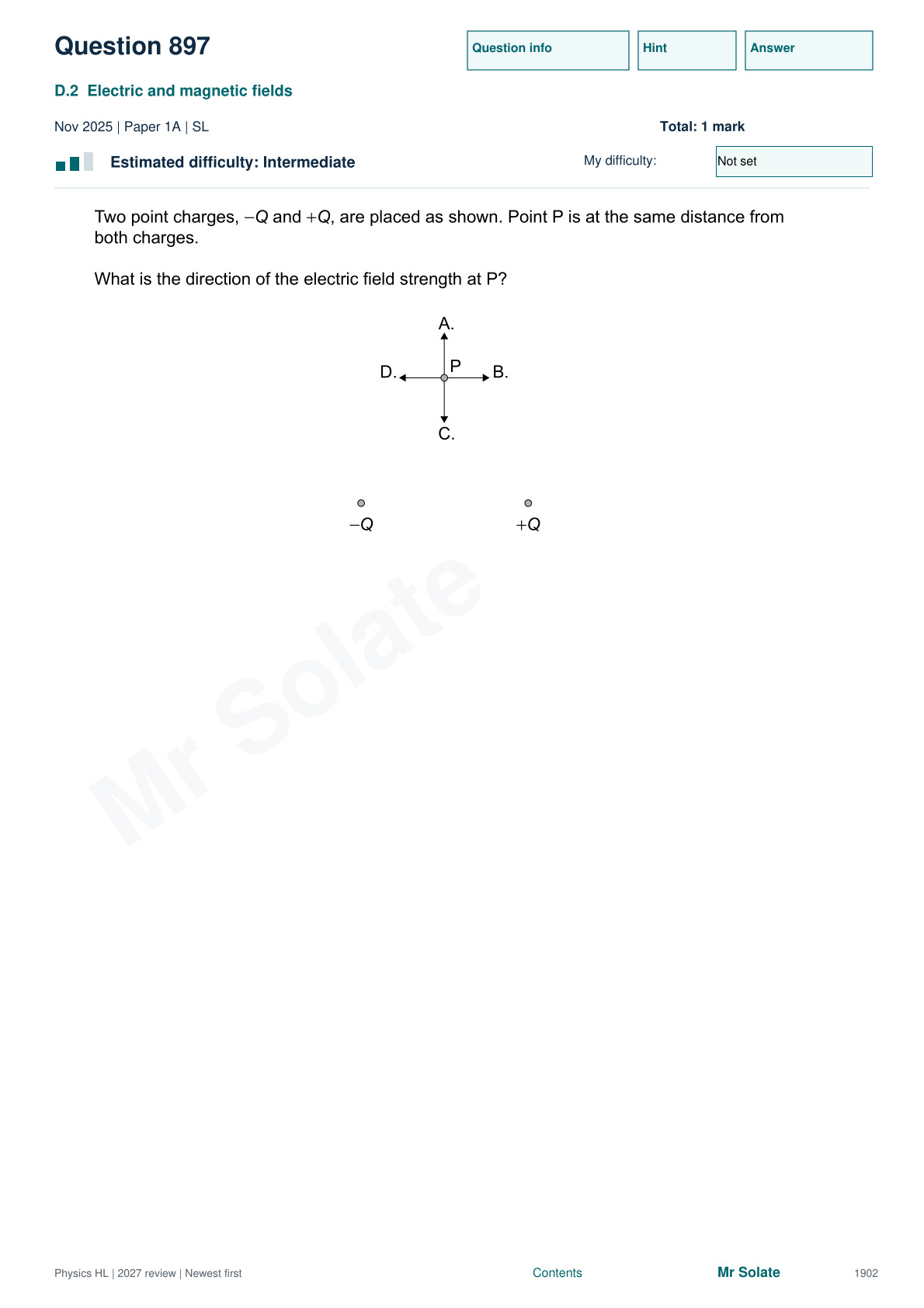
Question 897
Combines equal-magnitude electric-field vectors.
Compatibility: This is an SL source question testing concepts shared with the current Physics HL syllabus. Combines equal-magnitude electric-field vectors.
View the original question
Original page images preserve the equations and diagrams. Write your response before revealing the reasoning.
Reveal the revision reasoning
At equidistant P, the two fields have equal magnitudes. Their vertical components cancel while their leftward components add. The resultant points left, direction D.
Editorial revision reasoning. Check the original answer for its marking detail.
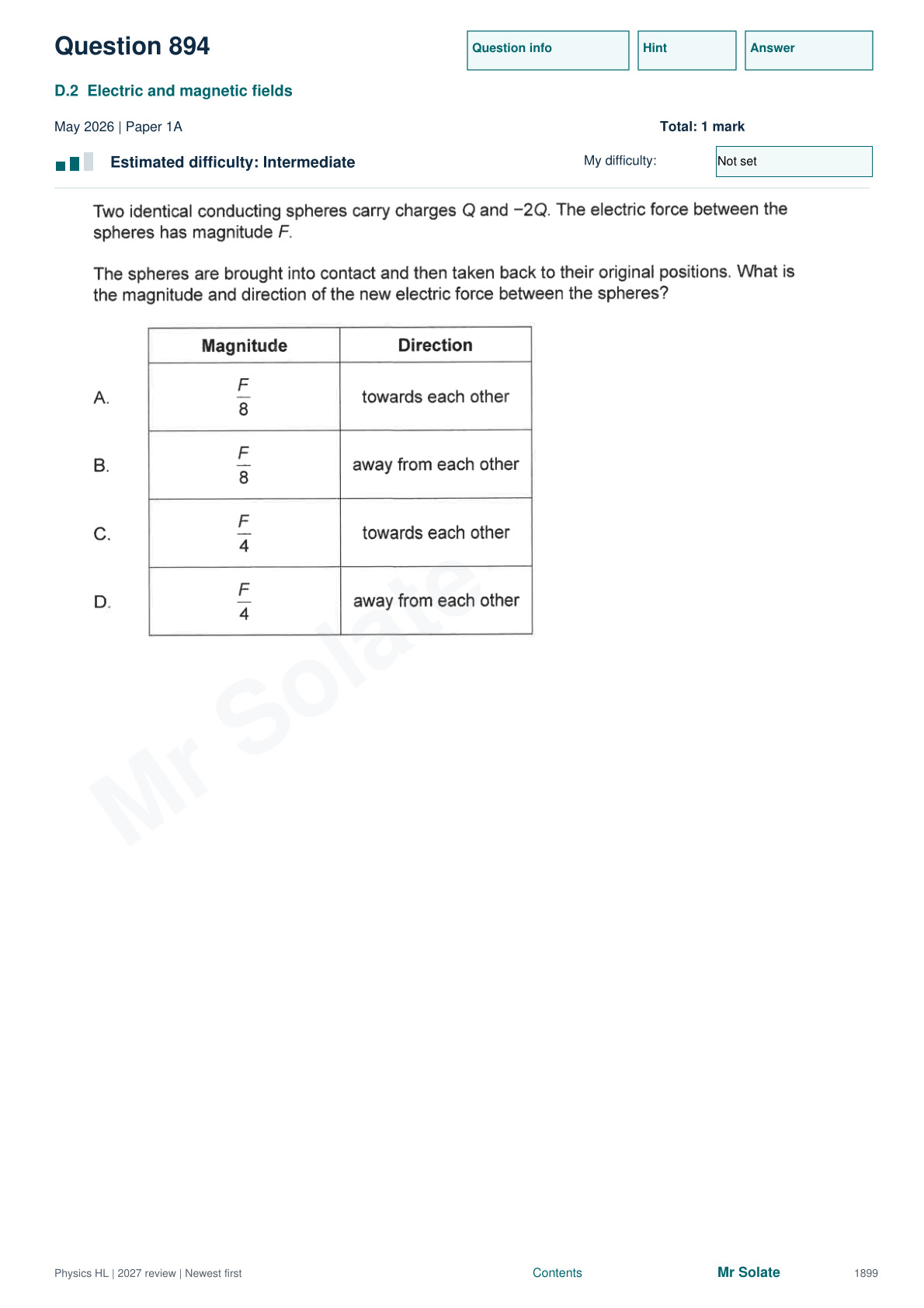
Question 894
Tracks charge sharing and compares Coulomb forces.
Compatibility: Current syllabus: Tracks charge sharing and compares Coulomb forces.
View the original question
Original page images preserve the equations and diagrams. Write your response before revealing the reasoning.
Reveal the revision reasoning
Total charge −Q divides equally to −Q/2 each. Their charge product is one eighth the original magnitude, so the new force is F/8 and repulsive.
Editorial revision reasoning. Check the original answer for its marking detail.
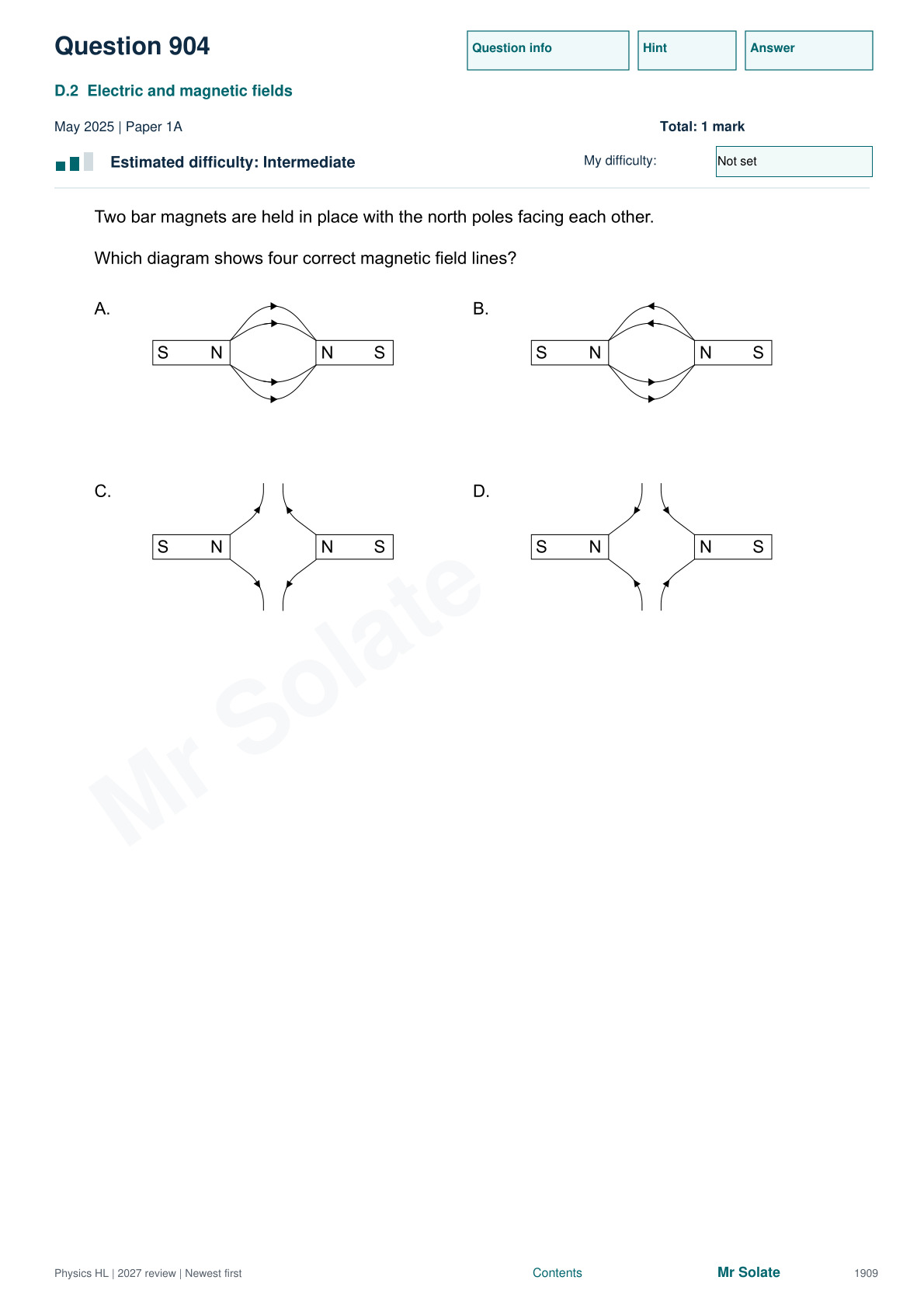
Question 904
Checks field-line arrows for facing north poles.
Compatibility: Current syllabus: Checks field-line arrows for facing north poles.
View the original question
Original page images preserve the equations and diagrams. Write your response before revealing the reasoning.
Reveal the revision reasoning
The lines bend outward, away from the gap, with arrows away from each north pole. A line cannot join one north pole to the other.
Editorial revision reasoning. Check the original answer for its marking detail.
All 53 questions in this topic
Close your notes first
Can you retrieve the method?
1. Which way does an electron accelerate in an electric field?
Check answer 1
Opposite to the field direction.
2. What is constant inside a conductor in electrostatic equilibrium?
Check answer 2
Electric potential; the internal electric field is zero.
3. What direction should be used for the wire-field rule?
Check answer 3
Conventional current, opposite to electron drift.
Before you move on
- Draw field arrows before adding numerical magnitudes.
- Keep field, potential and potential energy on separate lines with their units.
Your revision note
Record one missed cue, one corrected step and one question to retry. Saved only in this browser.