Start with the exam
What you need to be able to do
Wave-phenomena questions mix geometry with phase. Before using an equation, identify whether the relevant angle is measured from a normal, a surface, the central axis or a grating. For interference, compare phase difference rather than simply whether the rays look symmetric. For diffraction, distinguish a one-sided angle to a minimum from the full width of the central maximum. The bank contains older optical extensions; the attached compatibility notes identify which subparts need extra background.
Spend 3 minutes reading the overview and diagram, 7 minutes learning the question patterns, 5 minutes writing out the worked example, and 5 minutes on a bank question or recall check. Take longer when you need to; the full bank is here for later practice.
Recognise → set up → write
How the questions are set
Use the correct angles at a boundary
Recognise it: Refraction, a critical angle, layered media or optical fibres appear.
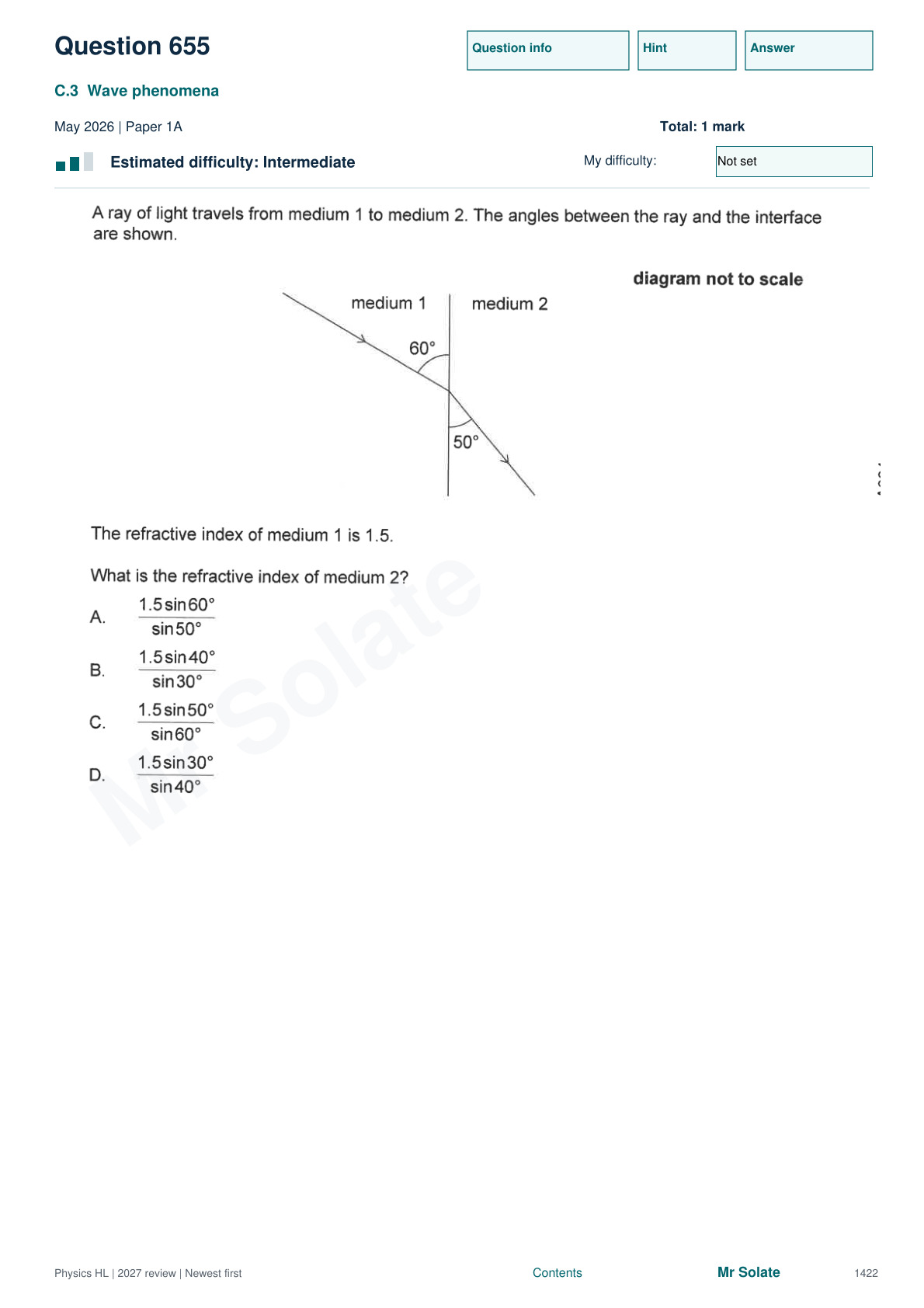
- Draw the normal at the point where the ray crosses the boundary. Convert a surface angle into its complement before applying n₁sinθ₁ = n₂sinθ₂.
- Frequency remains fixed by the source across a stationary boundary. Speed and wavelength change together because v = fλ. Bending toward the normal means a lower speed in the second medium.
- For total internal reflection, check that the ray travels from higher to lower refractive index and that incidence exceeds the critical angle. Use sinθc = nlower/nhigher.
Frequency is unchanged at the boundary, so the reduced speed produces a proportionally reduced wavelength.
The angle between a ray and the surface is not the incidence angle used in Snell’s law.
Convert path difference into interference conditions
Recognise it: Two sources, fringes, phase offsets or different amplitudes are given.
- For coherent in-phase sources, maxima occur at path difference mλ and minima at (m + ½)λ. If sources have an initial phase difference, add it to the phase gained through the path difference.
- For a double slit at small angles, fringe spacing is λD/d. Distinguish slit separation d from individual slit width, which controls the diffraction envelope.
- Add amplitudes with phase before squaring to get intensity. Unequal amplitudes give a nonzero minimum even for opposite phase; incoherent sources add intensities rather than stable amplitudes.
The path difference produces a phase difference of 2πΔr/λ; including the source phase determines whether the waves reinforce or oppose.
A minimum need not have zero intensity when the two wave amplitudes differ.
Read a diffraction pattern and count orders
Recognise it: A single slit, grating line density or central maximum width appears.
- Convert grating line density into spacing: d = 1/(lines per metre). Apply d sinθ = mλ to each order and require |sinθ| ≤ 1.
- Count both positive and negative orders and include the central maximum when asked for total maxima. For a spectrum, check the wavelength limit that determines whether an entire order is visible.
- For a single slit, the first minimum satisfies sinθ ≈ λ/a. The full central width on a distant screen is approximately 2Dλ/a; do not confuse it with one fringe spacing.
The maximum allowed integer order is the greatest m satisfying mλ ≤ d; total symmetric maxima are 2mmax + 1.
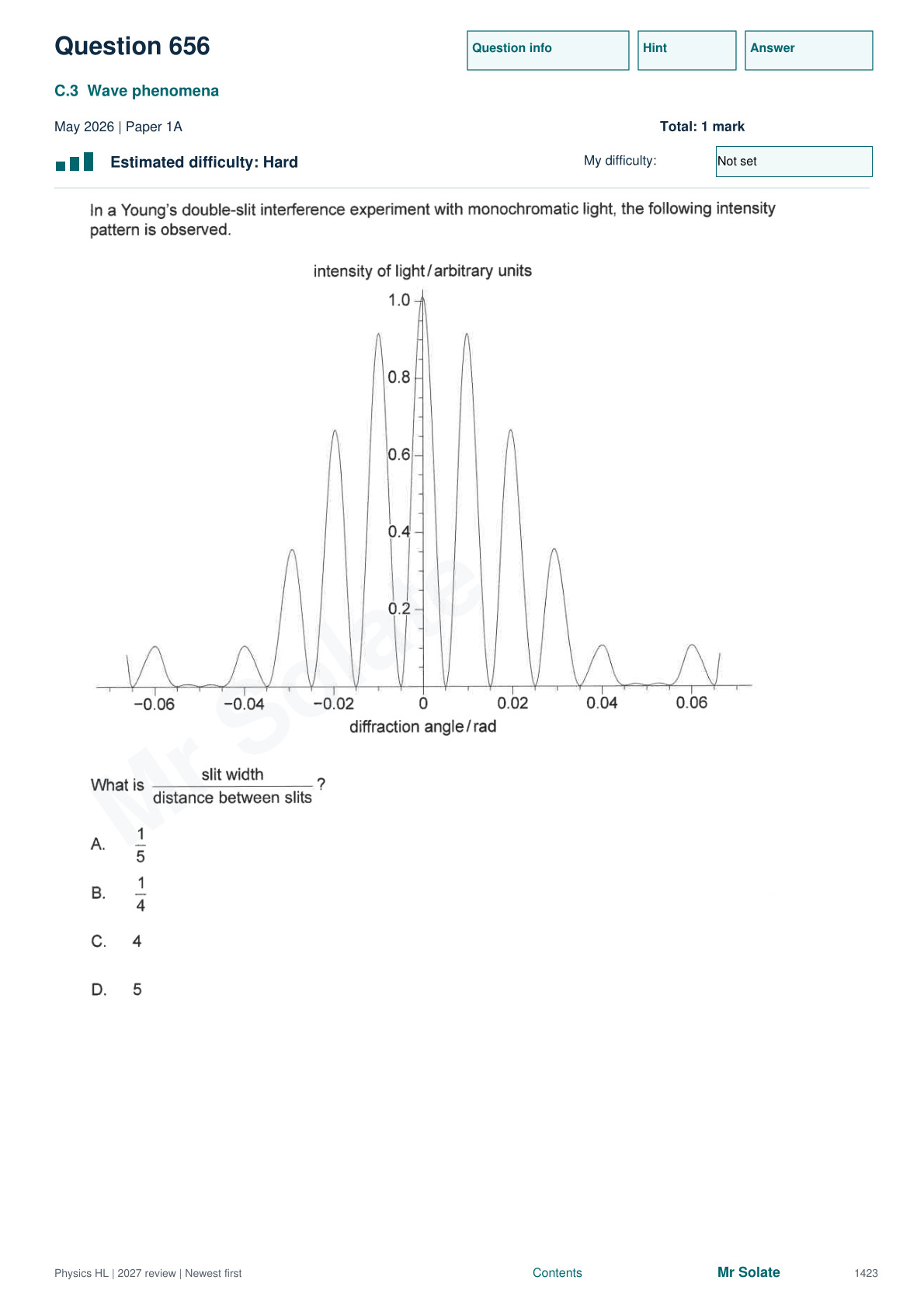
Slit width sets envelope width, while slit separation sets interference spacing.
Write it before you reveal it
A worked exam-style example
Original teaching example, created for this lesson.
Light of wavelength 600 nm falls normally on a grating with 400 lines per millimetre. Find the first-order angle and the maximum number of principal maxima.
Reveal the worked solution
- Convert density to 4.00 × 10⁵ lines m⁻¹; spacing d = 2.50 × 10⁻⁶ m.
- For m = 1, sinθ = 600 × 10⁻⁹/(2.50 × 10⁻⁶) = 0.240, so θ = 13.9°.
- The largest integer satisfying m ≤ d/λ = 4.17 is 4. There are four orders on each side plus the central order.
Answer: First-order angle 13.9°; nine principal maxima in the ideal grating model.
Check: The fourth order has sinθ = 0.96 and is allowed; the fifth gives 1.20 and is impossible.
From your own collection
Apply it to past-paper questions
These questions anchor the patterns above. Attempt one without the answer, then compare your setup and conclusion with the reasoning. The linked reader contains the source answer and the question-specific syllabus review.
Question 655
Converts interface angles before using Snell's law.
Compatibility: Current syllabus: Converts interface angles before using Snell's law.
View the original question
Original page images preserve the equations and diagrams. Write your response before revealing the reasoning.
Reveal the revision reasoning
The incidence angle is 30° and refraction angle 40°. Snell's law gives n₂=1.5 sin30°/sin40°.
Editorial revision reasoning. Check the original answer for its marking detail.
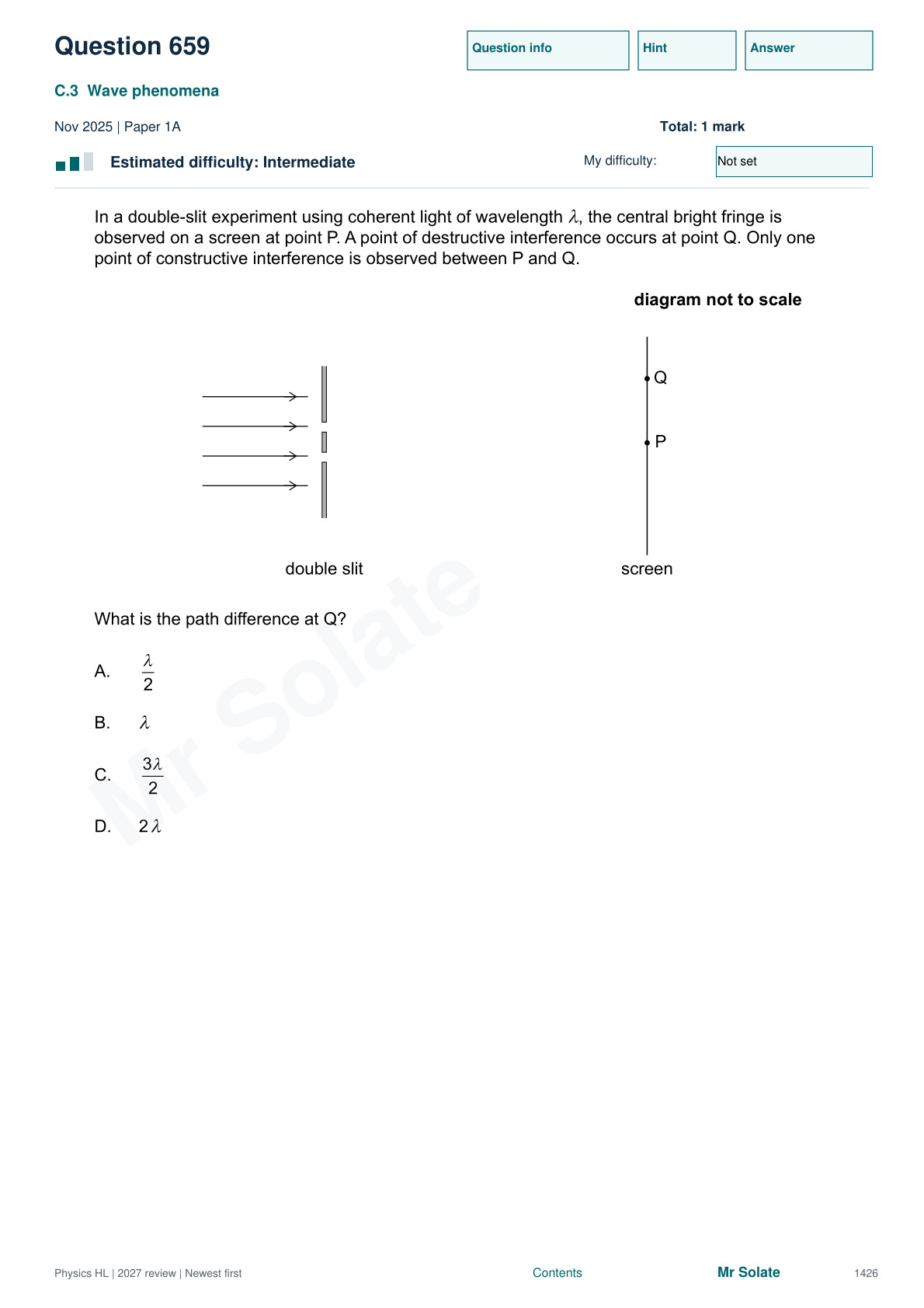
Question 659
Counts fringe orders to identify destructive interference.
Compatibility: Current syllabus: Counts fringe orders to identify destructive interference.
View the original question
Original page images preserve the equations and diagrams. Write your response before revealing the reasoning.
Reveal the revision reasoning
With one bright fringe between the central bright point and Q, Q is the second dark fringe. Its path difference is 3λ/2.
Editorial revision reasoning. Check the original answer for its marking detail.
Question 656
Combines diffraction-envelope minima with fringe spacing.
Compatibility: Current syllabus: Combines diffraction-envelope minima with fringe spacing.
View the original question
Original page images preserve the equations and diagrams. Write your response before revealing the reasoning.
Reveal the revision reasoning
The first envelope minimum is about 0.04 rad and fringe spacing about 0.01 rad. Since these are λ/a and λ/d, a/d≈0.01/0.04=1/4.
Editorial revision reasoning. Check the original answer for its marking detail.
All 97 questions in this topic
Close your notes first
Can you retrieve the method?
1. What stays constant during refraction at a stationary boundary?
Check answer 1
Frequency.
2. What path difference gives the first minimum for in-phase coherent sources?
Check answer 2
λ/2.
3. Why is full central diffraction width twice the first-minimum distance?
Check answer 3
The central maximum extends to the first minimum on both sides of the axis.
Before you move on
- Draw the normal and label the angle actually used by the equation.
- After calculating an order limit, count left, centre and right explicitly.
Your revision note
Record one missed cue, one corrected step and one question to retry. Saved only in this browser.